
Can a scar be fixed, or do you learn to live with it? That question usually hides two different concerns. You may want the mark to blend more naturally with the surrounding skin, or you may be dealing with itching, tightness, pain, tethering, or limited movement.
Scar revision addresses either goal, and often both. It isn't a method for deleting the skin's memory of an injury or operation. Instead, it uses carefully selected surgery, laser treatment, injections, topical care, and time to make a scar less noticeable, more comfortable, or less restrictive. The right plan depends on what the scar is doing, not just how it looks.
Table of Contents
- A Quick Conversation About Scars and Why Revision Matters
- What Scar Revision Really Is and What It Can Do
- Surgical Techniques Used in Scar Revision
- Nonsurgical and Adjunct Treatments That Support Scar Revision
- Who Is a Good Candidate and When the Timing Is Right
- What Happens Before During and After a Scar Revision
- Costs Insurance and Choosing the Right Practice for Scar Revision
- Frequent Questions and Next Steps for Scar Revision
A Quick Conversation About Scars and Why Revision Matters
Before asking whether a scar can be removed, ask a more useful question: what needs to improve? A narrow line that draws attention in a photograph calls for a different approach than a burn scar that prevents a joint from moving freely. A raised scar that itches also has a different treatment logic from an indented acne scar.
Scar revision is best understood as repaving a damaged road, not wiping the road off a map. The surgeon may change the direction, width, height, texture, or tension of the scar. Additional treatments can then influence redness, thickness, surface irregularity, and ongoing collagen remodeling. The result may be a quieter, softer, more functional scar, but the incision or treated area still has to heal.
Medical scar care has developed in stages. Before anesthesia, people largely accepted wounds or concealed them. After anesthesia emerged in the late nineteenth century, surgeons could develop more formal revision techniques. Following World War I, Sir Harold Gillies' reconstructive work helped advance modern excision and resurfacing methods. By the twenty-first century, rehabilitation and regeneration had become central parts of scar management, as described in this historical overview of surgical scar revision.
A useful expectation: revision changes how a scar behaves and how easily the eye notices it. It doesn't promise untouched skin.
The need is widespread. An international survey of 11,100 people across Brazil, China, France, Russia, and the United States found that 48.5% reported at least one scar, while 22% said their most recent scar was less than one year old. Among scars present for more than a year, the average time since appearance was 12.4 years. A separate medical review estimated that about 100 million people in the developed world develop scars from surgery, burns, or injury, including approximately 11 million from elective operations and 25 million from trauma-related operations. These figures appear in this review of scar burden and treatment.
What Scar Revision Really Is and What It Can Do
What is scar revision? It's a group of procedures and therapies designed to improve an established scar's appearance, texture, color, position, or mechanical behavior. The treatment may involve removing and re-closing part of the scar, rearranging nearby tissue, resurfacing the skin, flattening raised tissue, filling an indentation, or combining several methods over time.
The biological limit matters. A scar forms because the body repairs damaged tissue with collagen rather than recreating the original arrangement of skin, hair follicles, glands, nerves, and supporting structures. Even when a surgeon creates a finer line, the new wound must form its own scar. Major clinical guidance therefore describes revision as making a scar less noticeable, not completely erasing it, as outlined in this clinical explanation of scar revision.
Two goals that should be separated
The first goal is cosmetic blending. A surgeon may improve a scar's alignment with relaxed skin tension lines, reduce a widened or uneven contour, soften a color difference, or make a raised or indented area less conspicuous. The eye often notices a straight, isolated line more readily than a scar that follows a natural crease or has a broken, less predictable outline.
The second goal is functional and symptom relief. Scar tissue can contract like a tightening drawstring. When it crosses a joint, eyelid, lip, or another mobile area, it may restrict movement or distort nearby anatomy. Revision may release that tethering. It may also reduce irritation or itching when the scar's thickness, tension, or surface is contributing to symptoms, although relief isn't guaranteed.
Those goals can overlap, but they aren't interchangeable. A person may accept a visible line if it no longer pulls during movement. Another may have full motion but still want a flatter, less visible scar. Your consultation should identify the priority before anyone recommends a technique.
Why the scar's direction matters
Surgeons examine how a scar sits relative to the skin's natural tension patterns. A scar under constant pull tends to widen or become more conspicuous. A revision that lowers tension and places the final line along a resting skin crease can improve the visual result, while a release procedure can reduce contractile forces that interfere with movement.
The central principle is simple: revision improves the conditions under which the scar heals again. It doesn't control every part of wound healing, so the plan must include aftercare and, when appropriate, additional treatments.
Surgical Techniques Used in Scar Revision
Surgery is most useful when the scar's geometry, orientation, depth, or contracture can't be adequately addressed with surface treatments alone. The operation isn't selected by scar name alone. A surgeon considers location, length, width, skin tension, nearby structures, tissue quality, and whether the scar restricts movement.
Elliptical excision and direct closure
For a relatively narrow scar that already follows a favorable skin tension direction, the surgeon may remove it in an ellipse and close the wound carefully. This can replace a wide or irregular line with a narrower, better-aligned one. The closure must be tension-free, and the ends need thoughtful design to avoid puckering.
The surgical literature describes a 3:1 length-to-width ratio and end angles of no greater than 30 degrees for elliptical excisions to reduce the risk of standing cone deformities, sometimes called dog-ears, as explained in this technical review of scar revision planning. These measurements aren't a promise of a particular result. They're planning principles that help the surgeon manage how skin gathers at the ends.
Z-plasty for tight or poorly oriented scars
A Z-plasty uses angled limbs and triangular skin flaps to change the direction of a scar. The design can lengthen a contracted segment and redirect the final line toward a more favorable crease. That makes it particularly useful when a straight scar acts like a tight cord across a moving area.
Think of a drawstring pulled across a sleeve. Cutting and closing the drawstring in the same direction may leave the restriction intact. Rearranging its path distributes the pull differently, allowing the surrounding tissue to move more freely.
W-plasty and geometric broken-line closure
W-plasty and related geometric broken-line techniques divide a long, straight scar into small irregular segments. They don't remove the need for a scar, but they interrupt the visual continuity that makes a straight line easy to follow.
These methods are often considered in visible areas where a regular line contrasts sharply with surrounding skin. The surgeon must still match the design to local anatomy, skin thickness, facial expression, or body movement. A broken line placed under excessive tension can still heal conspicuously.
Flaps and grafts for larger defects
A local flap moves nearby skin with its own blood supply into a scarred or released area. Because the tissue may better match the surrounding color, thickness, and texture, a flap can be useful when simple closure would create too much pull or distortion.
A skin graft covers a prepared wound with skin taken from another site. Grafts can be valuable for broad defects, although their color, texture, and contour may differ from adjacent skin. In extensive burn or trauma scars, reconstruction may require release of the contracture, coverage of the defect, and a period of splinting or therapy to preserve the functional gain.
The common thread across these procedures is biomechanical control. Surgeons aren't merely cutting out an objectionable mark. They're changing tension vectors, redistributing contractile forces, and positioning the new closure where it has a better chance to mature discreetly.
Nonsurgical and Adjunct Treatments That Support Scar Revision
Nonsurgical treatments work best when matched to the scar's structure. A raised scar, a red scar, a depressed acne scar, and a tight burn scar don't respond to the same intervention. The strongest evidence is for selected hypertrophic scars and keloids, while evidence is less consistent for some other scar categories, including stretch marks.
Silicone sheets and gels are commonly used after a wound has closed, particularly for hypertrophic scars and keloids. Silicone, tension reduction, and wound-edge eversion received high-efficacy ratings for preventing hypertrophic scarring in a high-level review. Pressure garments, scar massage, and onion extract received low-efficacy ratings for prevention in that same review.
For an existing raised scar, treatment may include silicone, pulsed-dye laser, carbon dioxide laser, corticosteroid injections, 5-fluorouracil, bleomycin, or massage. Keloids may require an adjunctive plan around excision, with options such as corticosteroids, mitomycin C, bleomycin, or radiation therapy. This review of scar prevention and treatment evidence explains why the choice must be scar-specific.
| Treatment | Best For | Evidence Strength |
|---|---|---|
| Silicone sheets or gel | Hypertrophic scars and keloids, especially during maturation | Stronger support for selected raised scars |
| Corticosteroid injections | Raised hypertrophic scars and keloids | Stronger support as part of a planned protocol |
| 5-fluorouracil or other injected therapies | Selected raised scars | Supported for specific cases, not every scar |
| Pulsed-dye laser | Redness and vascular prominence | Supported for selected hypertrophic scars |
| Fractional laser resurfacing | Texture and surface irregularity | Useful in selected scars and combination plans |
| Microneedling or radiofrequency microneedling | Some depressed or uneven acne scars | Variable, scar-dependent support |
| Pressure therapy | Selected raised scars, often as an adjunct | Lower prevention efficacy in the cited review |
| Regenerative injectables | Selected cases under specialist guidance | Evidence and indications remain variable |
Lasers and energy devices also require thoughtful skin-type assessment. The settings, wavelength, depth, and aftercare must be adjusted to reduce the risk of prolonged discoloration or other complications, particularly in patients prone to pigment changes. Chemical approaches and needling similarly require individualized judgment.
Surgery and nonsurgical care often work in sequence. Surgery can correct an unfavorable line or release tethered tissue, while silicone, pressure, injections, laser treatment, or carefully selected resurfacing can influence the remodeling phase. The field is also moving toward earlier and multimodal care rather than treating revision as one isolated operation, as summarized in this NIH reference on scar treatment timing and modalities.
For patients exploring acne-scar resurfacing as one part of a broader plan, acne scar laser treatment may be discussed alongside other options.
Who Is a Good Candidate and When the Timing Is Right
Good candidacy starts with a clear diagnosis. A surgeon needs to determine whether the scar is flat, raised, widened, indented, tethered, discolored, painful, itchy, or contractile. The cause matters too. A surgical line, acne scar, burn scar, traumatic wound, and keloid each impose different constraints.
For purely cosmetic revision, surgeons commonly prefer a scar to mature before operating. The usual planning window is at least 6 to 12 months after the original injury or surgery, because immature scars are still actively changing and may improve without an operation, as noted in the evidence review on scar management linked above. This waiting period isn't a rigid rule for every patient.
When function changes the timetable
A scar that restricts movement, pulls on an eyelid or lip, causes significant tightness, or contributes to recurrent breakdown deserves earlier assessment. Functional candidacy can be present even when the patient isn't primarily concerned about appearance. In these cases, waiting for complete cosmetic maturity may allow a contracture to interfere with movement or tissue development for too long.
The consultation should separate two questions:
- Does the scar look different from the surrounding skin?
- Does it interfere with comfort, mobility, or normal anatomy?
Your answers help determine whether observation, conservative care, surgery, or a combined pathway makes sense.
Health and commitment matter
Patients generally need good control of medical conditions that affect healing. Smoking can impair wound healing, so cessation is an important part of preparation. Expectations also need to be realistic. Someone hoping for invisible skin may be disappointed even after technically successful revision, while a patient seeking less tightness or easier movement may value a functional improvement more than a perfectly camouflaged line.
Aftercare is part of candidacy, not an optional extra. A plan may involve silicone, sun protection, dressings, pressure, injections, laser sessions, massage, or therapy. The practice's guidance on how to minimize scarring can help patients understand the daily habits that support maturation, but your own surgeon's instructions should govern after a procedure.
What Happens Before During and After a Scar Revision
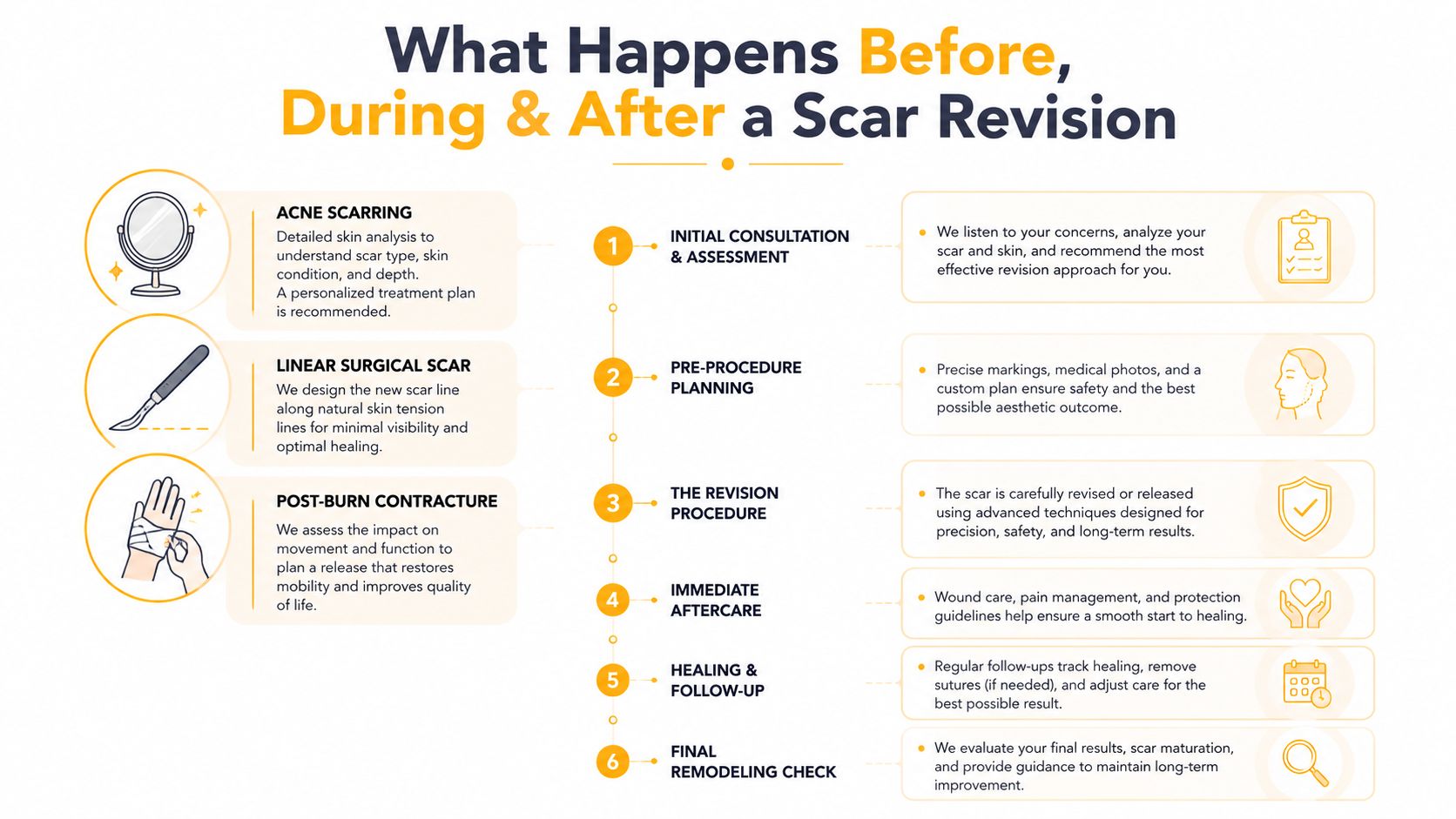
The process begins with an assessment, not an operation. During consultation, the surgeon photographs the scar, maps its direction and boundaries, checks skin quality, tests movement when relevant, and discusses whether the primary goal is blending, symptom relief, or release of restriction.
Consider three different patients. Someone with shallow acne depressions may need a surface-focused plan involving resurfacing, microneedling, or another staged treatment. Someone with a widened linear surgical scar may be considered for excision and re-closure. Someone with a post-burn contracture near a joint may need release, tissue rearrangement or grafting, followed by splinting and therapy.
Planning and procedure day
A small, straightforward revision may take place in an office or procedure room with local anesthesia. A larger revision, flap, graft, or contracture release may require a surgical facility and a different anesthesia plan. Before treatment, the surgeon marks the scar and the intended incision or treatment zones, reviews medications and health conditions, and confirms the aftercare instructions.
Immediately afterward, the area may have a dressing, ointment, tape, or protective covering. The exact instructions depend on the technique and location. Patients shouldn't judge the result while swelling, bruising, redness, or early wound changes are present.
The remodeling period
Early recovery focuses on protecting the closure and watching for problems. Sutures are removed according to the site and closure, and activity restrictions are individualized. A patient with a contracture may begin guided movement or splinting at a different point from someone with a small facial excision.
Over subsequent weeks, the scar can look pink, firm, raised, or uneven before it settles. Collagen gradually reorganizes during the 6 to 12 month remodeling period, so interim improvement isn't the same as the final appearance. The cited scar revision literature emphasizes that mature scars are often safer to evaluate for operative revision because active remodeling can change the appearance without surgery.
Follow-up visits help the surgeon decide whether the plan is progressing or needs another layer, such as silicone, an injection, laser treatment, or therapy. Increasing pain, spreading redness, drainage, wound separation, fever, or a sudden change in movement warrants prompt contact with the surgical team.
For patients considering treatment after an operation, the practice's information on cosmetic surgery scars provides another starting point for discussing prevention and revision options.
Costs Insurance and Choosing the Right Practice for Scar Revision
A scar revision estimate depends on the plan, not the scar's length. A simple excision and closure may involve fewer resources than a Z-plasty, flap, graft, or contracture release. Facility and anesthesia costs can change the estimate, as can the number of laser, microneedling, injection, or follow-up sessions.
Geography also affects pricing, but a precise amount can't be responsibly quoted without examining the scar. Ask for a written estimate that distinguishes the procedure fee from anesthesia, facility charges, pathology when applicable, postoperative supplies, and future adjunct sessions.
| Cost Driver | Typical Impact on Price | Insurance Likelihood |
|---|---|---|
| Simple excision and closure | Lower complexity than tissue rearrangement | Often self-pay when cosmetic |
| Z-plasty or geometric rearrangement | More planning and operative work | Depends on documented function |
| Flap or skin graft | Greater reconstruction and aftercare needs | More plausible when medically necessary |
| Laser or microneedling series | Repeated treatment visits | Usually cosmetic coverage is limited |
| Contracture release | Driven by anatomy, reconstruction, and therapy | More likely when movement is restricted |
| Raised symptomatic scar treatment | May require staged injections or procedures | Depends on symptoms and policy |
Insurance decisions often follow the cosmetic-versus-functional distinction. A revision intended only to improve appearance is commonly treated as elective. A procedure that releases a contracture, restores range of motion near a joint, corrects structural distortion, or addresses a symptomatic scar may have a stronger medical-necessity argument, but coverage varies by policy and documentation.
Bring specific questions to the consultation:
- Bundling: Which visits, dressings, injections, or revisions are included?
- Staging: Could the plan require surgery plus laser, silicone, injections, or therapy?
- Facility: Where will the procedure occur, and what separate fees apply?
- Follow-up: How are postoperative concerns handled?
- Financing: Are third-party medical lenders or staged payment arrangements available?
A thorough evaluation should include scar mapping, photography, functional testing when needed, skin-type assessment, and a plan for the entire remodeling arc. Chernoff Cosmetic Surgery offers surgical scar care alongside laser and medical spa services, allowing the team to discuss procedural and nonsurgical options within one practice.
Frequent Questions and Next Steps for Scar Revision
Can revision erase a scar? No. It can make the scar less visible, smoother, better aligned, or more functional, but it can't restore completely uninjured skin.
How soon can surgery be considered? For cosmetic revision, surgeons commonly wait 6 to 12 months after the original injury or operation while the scar matures. Earlier evaluation is appropriate when tightness, restricted movement, distortion, significant symptoms, or recurrent breakdown is present.
Can a keloid be cured? Keloids can be difficult to control and may recur. Excision may need support from injections, silicone, pressure, or other therapies rather than standing alone.
Will combined treatment shorten healing? Combination care can address different scar features, but it doesn't eliminate the body's remodeling process. Think of revision as a pathway with checkpoints, not a single appointment.
Photograph the scar in consistent lighting, note itching, pain, tightness, and movement changes, and seek a consultation that evaluates both surgical and nonsurgical options. Choose a practice that can match treatment to the scar's structure and continue care while the result matures.
Chernoff Cosmetic Surgery evaluates scars with attention to appearance, function, symptoms, and long-term remodeling, offering surgical revision and complementary laser, microneedling, injection, and medical spa options when appropriate. Visit Chernoff Cosmetic Surgery to request a consultation and discuss a personalized scar improvement plan.