

You catch it in a video call first. Your face looks fine, but the skin under your chin looks soft, the angle from jaw to neck has blurred, and two vertical cords show up when you talk. You search for how to tighten neck skin expecting one answer, and you get twenty products, devices, and procedures that all claim to do the same thing.
They don't. Neck aging is not one problem, and tightening is not one decision. In a consult, the useful first question isn't which treatment you want. It's which problem is making your neck look older, because each one routes to a different fix, with a different magnitude of change, recovery, and risk.
Table of Contents
- What an Aging Neck Actually Is
- Prevention and At-Home Support
- Non-Surgical Tightening Options
- Surgical Options for Significant Laxity
- Candidacy and Choosing the Right Treatment
- Cost, Recovery, and Choosing a Provider
- Realistic Expectations and Final Takeaways
What an Aging Neck Actually Is
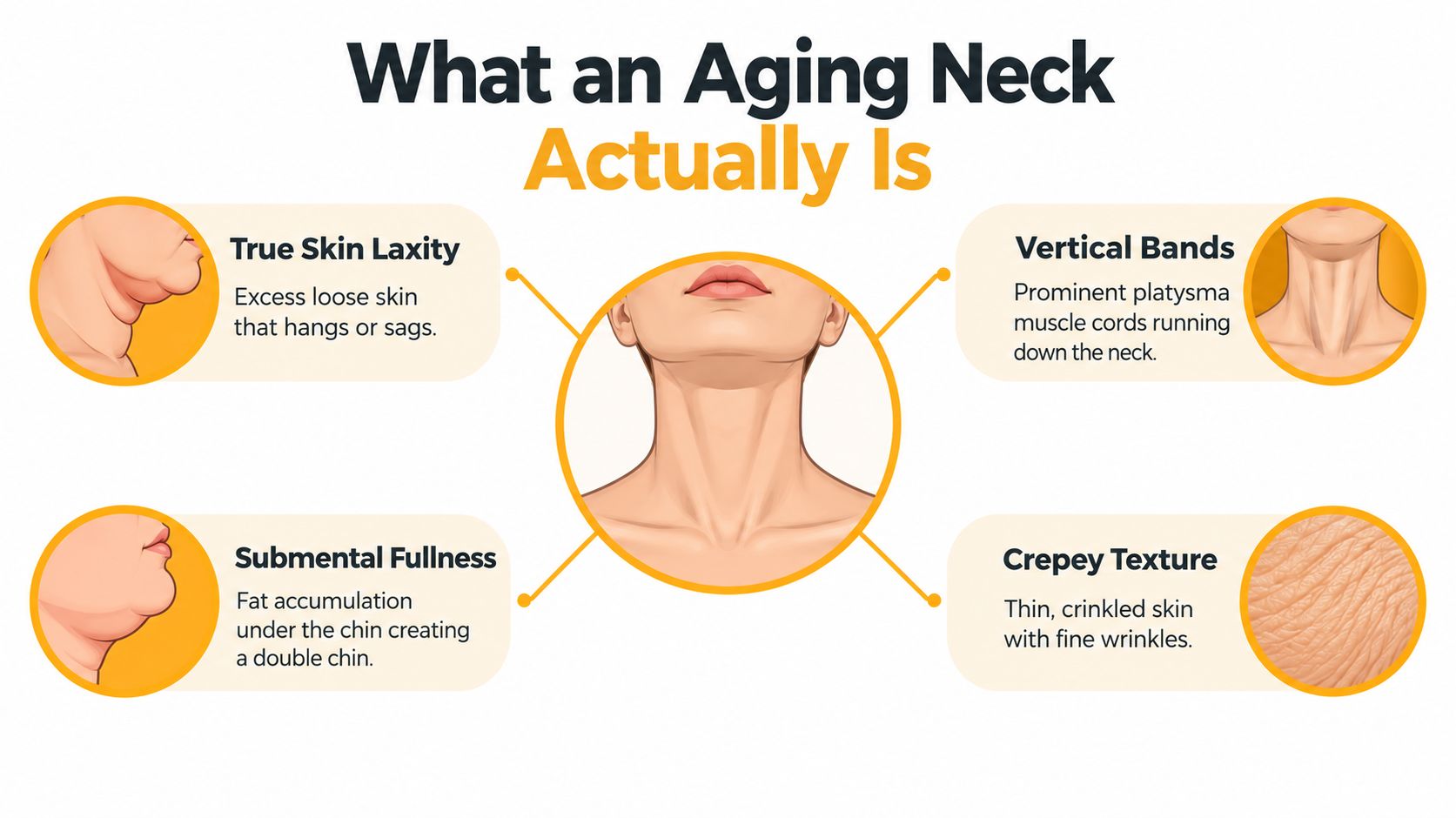
Many individuals use one phrase, loose neck skin, to describe four separate changes. Lumping them together leads to the most common mistake I see, asking for tightening when the dominant issue is fat, muscle banding, or surface texture. A treatment that remodels skin will not remove a fat pocket, and a treatment that removes fat will not repair crepey skin.
Clinical guidance reinforces that separation. Clinical guidance on separating the contributors to an aging neck distinguishes excess skin, submental fat, platysmal bands, structural volume loss, and lower-face descent, and recommends evaluating all of them before selecting a procedure. That evaluation is the difference between a targeted plan and a guess.
Four Problems to Identify in the Mirror
Stand in neutral light, look straight ahead, then turn to profile. Don't pull the skin back with your hands, because that tells you what removal might do, not what a cream or device will do. Use plain descriptions instead of trying to diagnose yourself.
- Loose skin that hangs: Skin gathers or folds under the chin and along the jaw, and it moves when you pinch it gently. This is true skin excess, the only problem on this list that physically removing skin addresses directly.
- Vertical bands: Two cords run down the front of the neck, most visible when you clench your teeth or grimace. That's the platysma muscle separating and becoming prominent, not a skin problem at its root.
- Fullness under the chin: The profile looks rounded even though the skin itself feels fairly firm. Submental fullness can come from fat, but chin projection and jaw structure also shape this angle, which is why fat removal alone sometimes disappoints.
- Crepey texture: The surface looks thin, crinkled, and finely lined, like tissue paper, without much hanging skin. This is a skin quality issue driven by sun damage and collagen loss, and it responds to a different set of tools.
Naming what you see, loose skin, vertical bands, fullness, or crepey texture, gives your surgeon a far better starting point than asking for tightening in general.
Most patients have a combination, usually with one problem dominating. Home inspection can't replace an examination, because palpation, skin thickness, and how the lower face is contributing all change the recommendation. But arriving able to say which of the four bothers you most focuses the entire conversation.
Prevention and At-Home Support
No cream lifts significant laxity, and any product claiming otherwise is overselling. What at-home care does well is protect skin quality, which determines how good any in-office result looks and how long it holds up. Treat this as the floor of every plan, not an alternative track you choose instead of treatment.
Build the Daily Routine
Start with sun protection, because ultraviolet exposure breaks down collagen and elastin and the neck gets neglected. Apply sunscreen to the front and sides of the neck and the upper chest every morning, not just the face. Many people stop at the jawline, which is why neck and chest pigment and texture often look older than the face above them.
Retinoids support collagen production and cell turnover, but neck skin is thinner and more reactive than facial skin. Introduce one slowly, a few nights a week, and back off if you develop persistent redness, peeling, or burning. Those are signs the product is too aggressive for this area, not signs it's working harder.
Hydration matters for how crepey skin looks day to day. Dehydrated skin shows fine lines more prominently, so a consistent moisturizer with humectants improves appearance even though it doesn't change structure. Peptide products sit in this supportive category too. If antioxidant ingredients interest you, the Q10 anti-aging cream evidence is worth reviewing before you spend money, so you can separate plausible support from marketing language.
Habits That Protect Your Investment
- Avoid tobacco: Smoking and vaping impair skin elasticity and wound healing, which affects both device response and surgical recovery.
- Keep weight stable: Repeated fluctuations stretch thinner neck skin and reduce its ability to recoil.
- Watch posture: Hours spent looking down at a phone crease the front of the neck repeatedly and deepen horizontal lines over time.
- Support collagen generally: Adequate protein, sleep, and limiting alcohol won't tighten skin on their own, but they support the tissue every treatment depends on.
Non-Surgical Tightening Options
This category gets oversold more than any other, so calibrate expectations first. A 2025 systematic review of HIFU covering 45 clinical trials from 2010 to 2024 reported skin-laxity improvements of approximately 18% to 30%, with the lower face and neck among the areas showing meaningful response. That's real, measurable improvement. It is not the equivalent of removing loose skin, and anyone framing it that way isn't being straight with you.
Ultrasound Based Tightening
High-intensity focused ultrasound and microfocused ultrasound deliver heat to deeper tissue layers without incisions, stimulating collagen remodeling over the following months. Results build gradually rather than appearing the next day, and the effect suits mild-to-moderate laxity best. Short-term redness and swelling are the usual trade-off, with little interruption to work.
If you're comparing energy platforms, a skin tightening laser treatment overview can help you understand how light and heat based options differ in target depth and downtime before you sit down for an assessment.
RF Microneedling, Threads, and Biostimulators
Radiofrequency microneedling pairs controlled micro-injury with heat delivered through the needles. Its strength is texture plus modest firming, so it fits crepey skin with early laxity better than it fits hanging skin. Expect a series rather than a single visit, and expect some social downtime while the surface settles.
PDO threads work differently. They provide a short-term mechanical lift by repositioning tissue along the thread's path, with some collagen stimulation as they dissolve. The honest limitation is longevity and patient selection, because threads don't remove skin and can't hold significant excess.
Biostimulators take the slowest route. Injected in diluted form, they encourage your tissue to build collagen gradually, improving firmness and surface quality over time. They add structure, they don't lift, and they suit patients whose complaint is thin, crepey skin more than sagging.
Practical rule: Energy devices improve early laxity. They don't correct substantial hanging skin, prominent muscle banding, or significant fullness, no matter how many passes are delivered.
One more caution. More energy isn't automatically better. Skin type affects both tightening response and the risk of pigment changes after heat or resurfacing based treatments, so your skin tone and pigment history belong in the discussion before anyone selects settings.
Non-Surgical Neck Tightening at a Glance
| Modality | Best For | Sessions | Downtime |
|---|---|---|---|
| Focused ultrasound | Mild-to-moderate laxity, lower face and neck | Often a single treatment, then reassessment | Minimal, short-term redness and swelling |
| RF microneedling | Crepey texture with early laxity | Typically a series | A few days of surface recovery |
| PDO threads | Early descent in carefully selected patients | Single procedure, repeat as effect fades | Swelling and bruising for several days |
| Biostimulators | Thin, crepey skin needing gradual support | Series spaced over time | Minimal, possible bruising |
Surgical Options for Significant Laxity
When there's substantial skin to remove, visible banding, and a jaw-to-neck angle that's disappeared, surgery is the only approach that physically removes excess skin and repositions the tissue underneath. That magnitude of correction is exactly what devices can't replicate. It's also why the recovery and risk discussion has to be equally direct.
The Three Components of a Neck Lift
A neck lift isn't one maneuver. Cervicoplasty removes redundant skin and redrapes what remains. Platysmaplasty repairs the neck muscle, addressing the vertical bands at their source rather than camouflaging them. Submental liposuction refines fat under the chin and along the jaw when fullness is part of the picture.
A good surgeon sequences these based on your anatomy, not as items you pick from a menu. The assessment covers skin redundancy, fat, muscle separation, and the glands under the jaw, and the plan has to preserve blood supply to the skin flap while protecting the marginal mandibular nerve, which controls part of lower lip movement. Incisions typically hide under the chin and around the ears, but they are incisions, and scars take months to mature.
Recovery and Risk Stated Plainly
Expect compression, head elevation, and activity restriction in the early period. Swelling doesn't resolve on a two week schedule for everyone, it can persist for weeks to months, and scar maturation can take up to six months. Plan your calendar around that reality rather than around best case photos.
The numbers deserve the same candor. A pooled review of 2,106 neck-lift procedures involving platysma treatment reported recurrent platysma bands in 1.4%, nerve damage in 0.9%, hematoma in 1.8%, and sialoma in 0.3%, while a separate 336-patient series reported an overall complication rate of 20.2%. That second figure includes issues like residual laxity, scarring concerns, temporary lower-lip dysfunction, and contour irregularity, so ask your surgeon how complications are defined and handled in their practice.
Common pitfalls aren't exotic. Over-tightening looks operated, under-correction leaves residual laxity, and underestimating hematoma or healing risk creates problems that technique alone can't fix. The trade is clear, the largest and most durable correction available, in exchange for anesthesia, recovery time, and surgical risk.
Candidacy and Choosing the Right Treatment
Candidacy starts with the mirror check from earlier, then gets filtered through factors you can't assess at home. The goal is matching the treatment tier to the dominant problem, not starting with a device or procedure and working backward.
Match the Pattern to the Tier
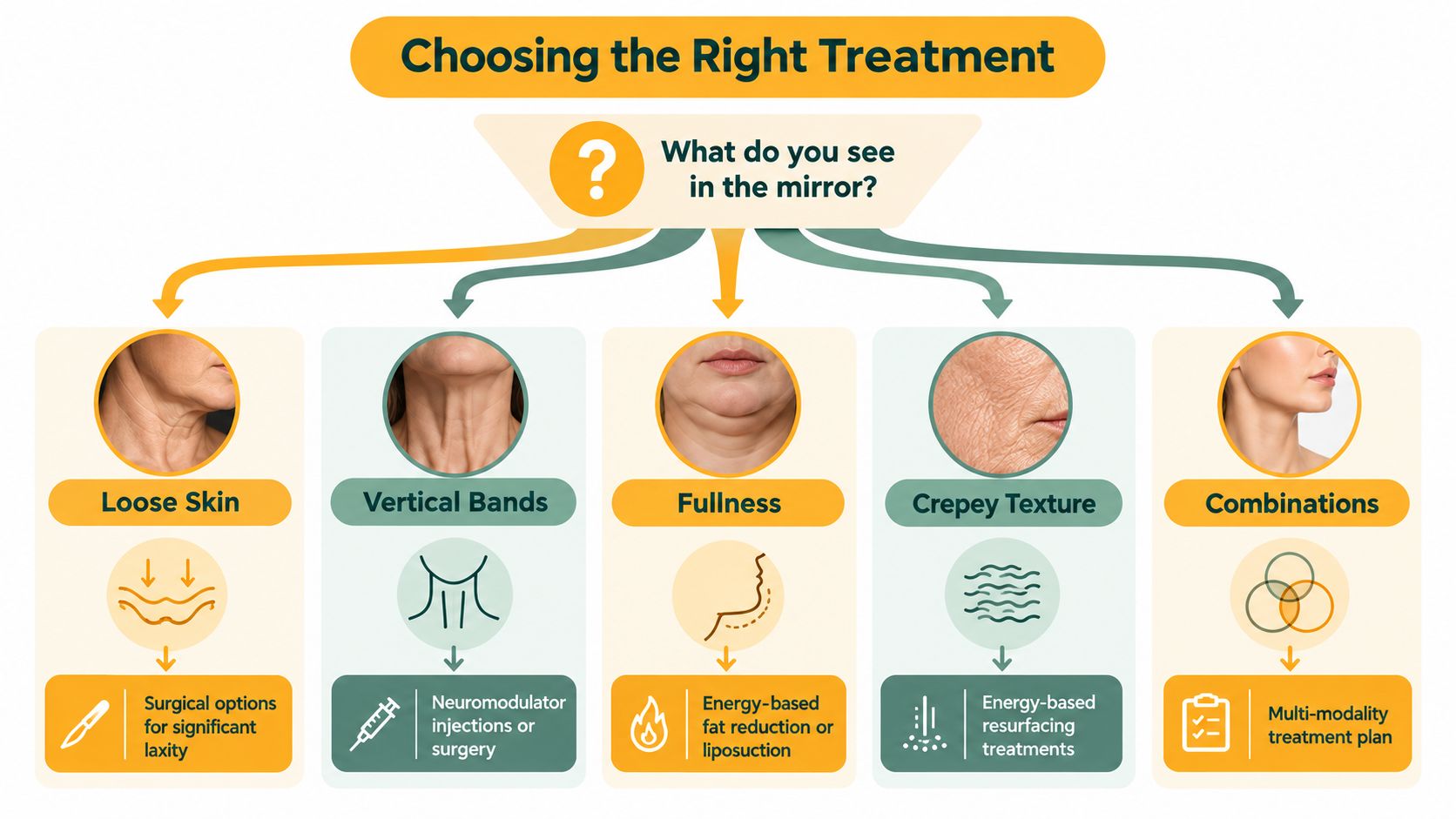
- Early texture change only: Prevention, retinoids used carefully, and resurfacing or RF microneedling for surface quality. Surgery has nothing to offer skin that isn't redundant.
- Mild-to-moderate laxity with decent skin quality: Focused ultrasound or radiofrequency based treatment, with biostimulators as support if the skin is thin.
- Fullness with firm skin: Fat focused treatment, whether energy based reduction or liposuction, after confirming fat is the cause.
- Banding, significant redundancy, or a lost cervicomental angle: Surgical correction, because muscle repair and skin removal are what's required.
- Several problems at once: A staged or combined plan, sequenced so each step targets a named problem.
The evidence on ultrasound selection shows how much candidacy drives results. Patient selection data for microfocused ultrasound shows treatment typically excludes excessive laxity or BMI above 30, where response tends to decline, and the same review found 92% of 337 evaluable patients showed investigator-rated improvement at day 90. Read those two facts together. High response rates come from selecting the right patients, not from treating everyone.
Factors That Change the Answer
Skin type and pigment history influence which energy settings are safe. Smoking history affects healing and can disqualify or delay surgery. Prior neck surgery or scarring changes tissue planes and blood supply. Age matters less than tissue quality, but baseline laxity, tissue thickness, and whether the lower face is descending into the neck all shift the recommendation. Bring that history to the consult instead of a screenshot of a treatment you saw advertised.
Cost, Recovery, and Choosing a Provider
Quotes vary too much by geography, anesthesia type, facility, and what's included for a single number to mean anything. What you can compare intelligently is structure. Energy based treatments are usually priced per session and often sold in packages, threads are a one-time procedure you'll repeat as the effect fades, and surgery is a single larger investment that shifts depending on whether muscle repair or liposuction is added. A detailed neck lift cost breakdown helps you see which components drive a quote so you're comparing like with like.
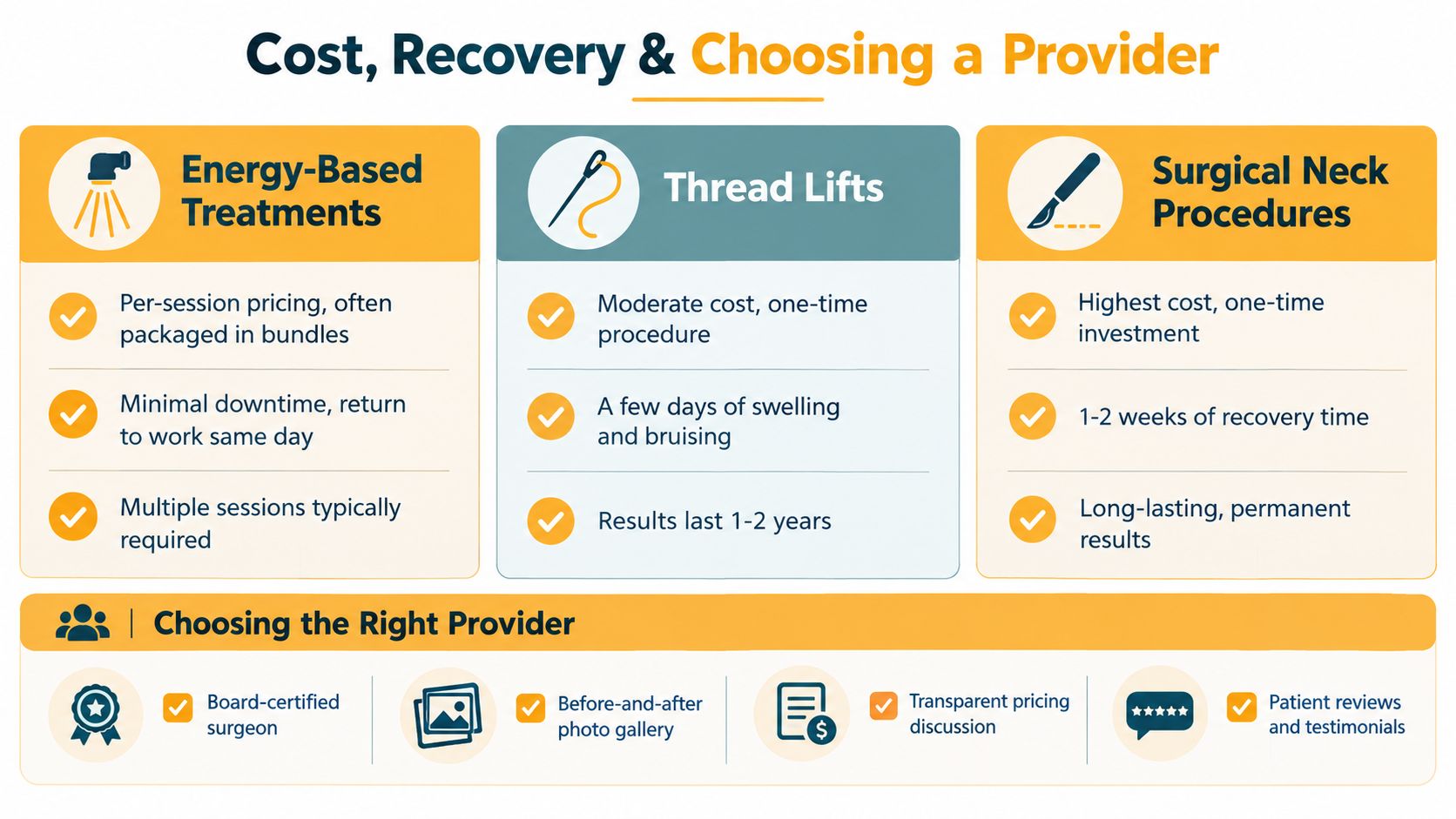
Durability belongs in the cost conversation, because a cheaper treatment that fades quickly isn't cheaper over time. A 2023 meta-analysis of microfocused ultrasound covering 13 studies and 477 participants reported a pooled response rate of 77% at 90 days and 69% at 180 days. Benefits persist for months, then response rates decline, which means maintenance and reassessment are part of the true price of nonsurgical tightening. Note that analysis covered facial treatment broadly, so treat it as a guide to trajectory, not a guaranteed neck-specific outcome.
Choosing Who Treats You
Credentials and case volume matter more than the device in the room. Ask whether the person recommending surgery is board certified in a relevant specialty, how many neck procedures they perform, and who delivers nonsurgical treatments in the practice. Facility accreditation and a clear complication policy aren't fine print, they're core safety information.
Consultation Checklist Questions to Ask
| Topic | What to Ask |
|---|---|
| Diagnosis | Which of my concerns is skin, fat, muscle, or structure, and which one dominates? |
| Candidacy | Why am I a good or poor candidate for this specific treatment? |
| Magnitude | How much improvement should I realistically expect, in plain terms? |
| Evidence | Can I see before-and-after photos of patients with anatomy like mine? |
| Longevity | How long does this last, and what does maintenance look like? |
| Risk | What are the most likely complications for me, and how are they managed? |
| Cost | What exactly is included, and what would change the quote? |
Realistic Expectations and Final Takeaways
How to tighten neck skin isn't a single decision. It's four decisions wearing one label, and the right answer depends entirely on whether your dominant problem is excess skin, crepey texture, platysmal bands, or submental fullness. Match the treatment to the tissue causing the problem and outcomes improve at every tier.
Meaningful improvement is possible with skincare, devices, and surgery, but the magnitude, longevity, and risk are not equal, and no tier substitutes for another.
Start by identifying what you see in the mirror, using the plain descriptions from the opening section. Build or upgrade the prevention routine in parallel, because it supports whatever you choose next. Then book a consultation with specific questions about which tissue the recommended treatment targets, rather than a general request for tightening.
If surgery ends up being the right tier for you, review what neck lift surgery recovery involves before you commit, so your timeline, support at home, and expectations are set before the procedure date. A well matched plan, chosen candidly, is what produces a neck that looks like yours, just better defined.
If you're ready to find out which of these four problems is driving your neck concerns, Chernoff Cosmetic Surgery offers individualized consultations covering both nonsurgical tightening and surgical neck lift options, so your plan targets skin, fat, muscle, or texture as your anatomy requires. Visit Chernoff Cosmetic Surgery to request a consultation and get a candid assessment of what each option can realistically achieve for you.