
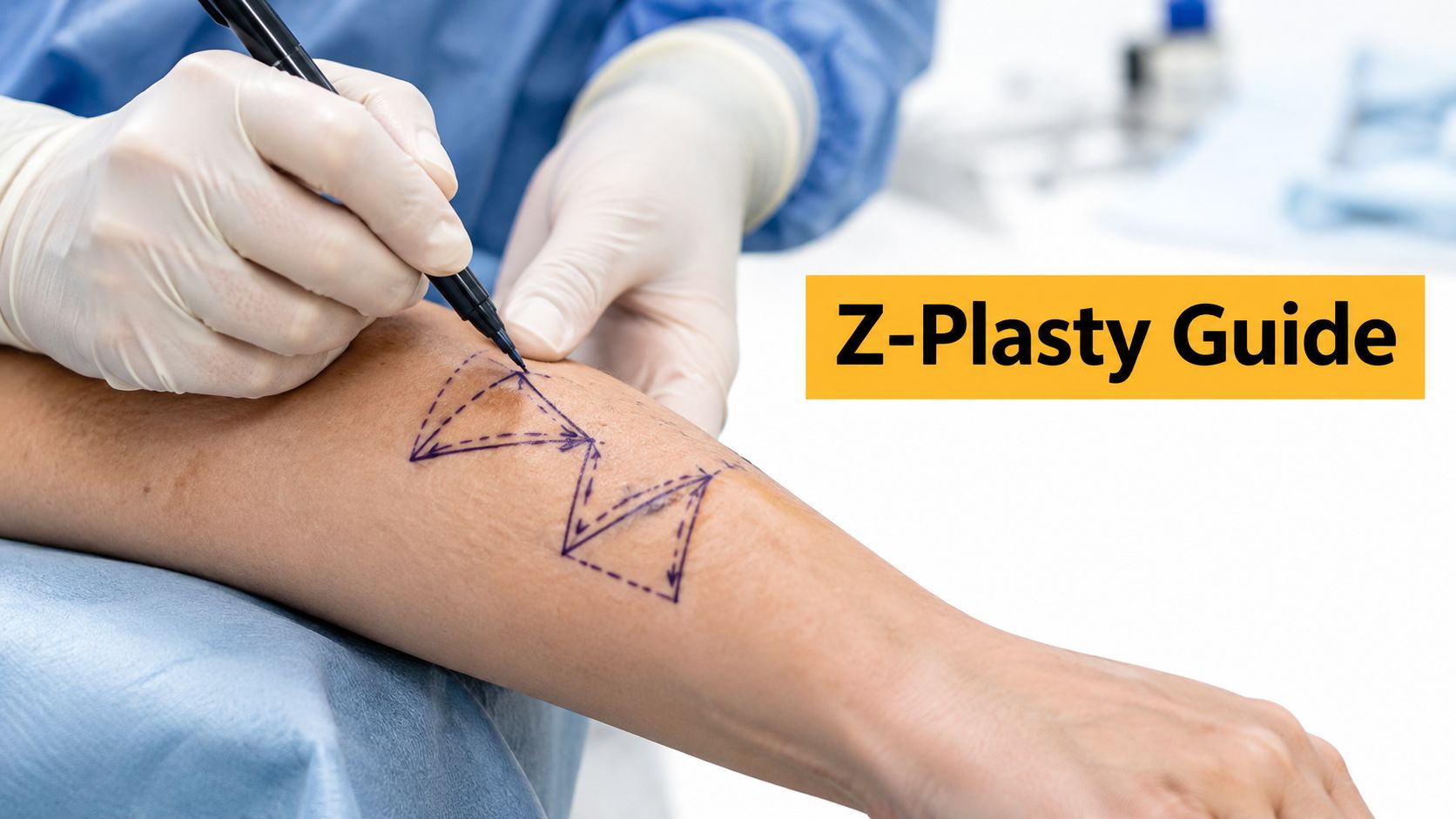
You've watched a scar close, waited for the swelling to settle, and expected the final line to become less noticeable. Instead, it may still pull when you move, cross the face or neck in an awkward direction, or feel tight and tethered beneath the skin. That can be frustrating, especially when the scar is fully healed but still behaves like a shortened strap.
Scar revision Z-plasty addresses that mechanical problem by changing the scar's direction and redistributing tension. It doesn't erase the mark, and it isn't the right answer for every scar. The value lies in matching the technique to what the scar is doing, then deciding whether surgery, laser treatment, or a combination will address the problem most effectively.
Table of Contents
- What Brings Patients to Z-Plasty in the First Place
- How Z-Plasty Actually Works
- Angle, Length, and Direction in Numbers
- Matching the Scar Problem to the Right Treatment
- Candidacy and the Chernoff Consultation
- Recovery Timeline and What to Expect
- Risks, Limitations, and Common Misconceptions
- Planning Your Next Step Toward a Better Scar
What Brings Patients to Z-Plasty in the First Place
A patient may come in after surgery or an injury with a scar that looks acceptable at rest but pulls when the nearby skin moves. A line across the neck may tighten when the head turns. A scar near the eyelid or mouth may tug on a facial feature. A burn scar over a joint may restrict movement because the tissue has contracted as it healed.
Other patients aren't dealing with a major functional limitation. Their concern is direction. A straight line crossing a facial contour or natural crease can catch the eye, even when it's narrow and flat. The scar may be healthy, but its orientation keeps it visually prominent.
A third group notices color, firmness, or surface texture more than tightness. Their scar might be pink, darker than the surrounding skin, raised, depressed, or uneven. Those concerns may respond better to non-surgical treatments than to a flap rearrangement.
The problem comes before the procedure
Z-plasty is most useful when tension, contracture, or direction is the central problem. The technique converts a straight or contracted scar into transposed triangular flaps, creating a longer, angled line that can sit closer to natural creases or relaxed skin-tension lines. This is why the procedure has a role in both functional contracture release and aesthetic camouflage, as described in the NCBI Bookshelf review of Z-plasty.
Practical rule: If a scar is tight or pulling, ask what force needs to be released before asking how the scar can be made less visible.
That distinction prevents a common misunderstanding. Z-plasty isn't a sanding treatment, a color treatment, or a universal scar eraser. It creates a different scar, usually a longer zigzag, in exchange for a line that may pull less and blend more naturally with the surrounding anatomy.
At Chernoff Cosmetic Surgery in Santa Rosa, Dr. Chernoff's patient-centered evaluation would begin with the scar's behavior, not just its appearance. The important questions are whether the scar restricts motion, tethers nearby tissue, crosses a natural crease, or mainly needs surface refinement.
How Z-Plasty Actually Works
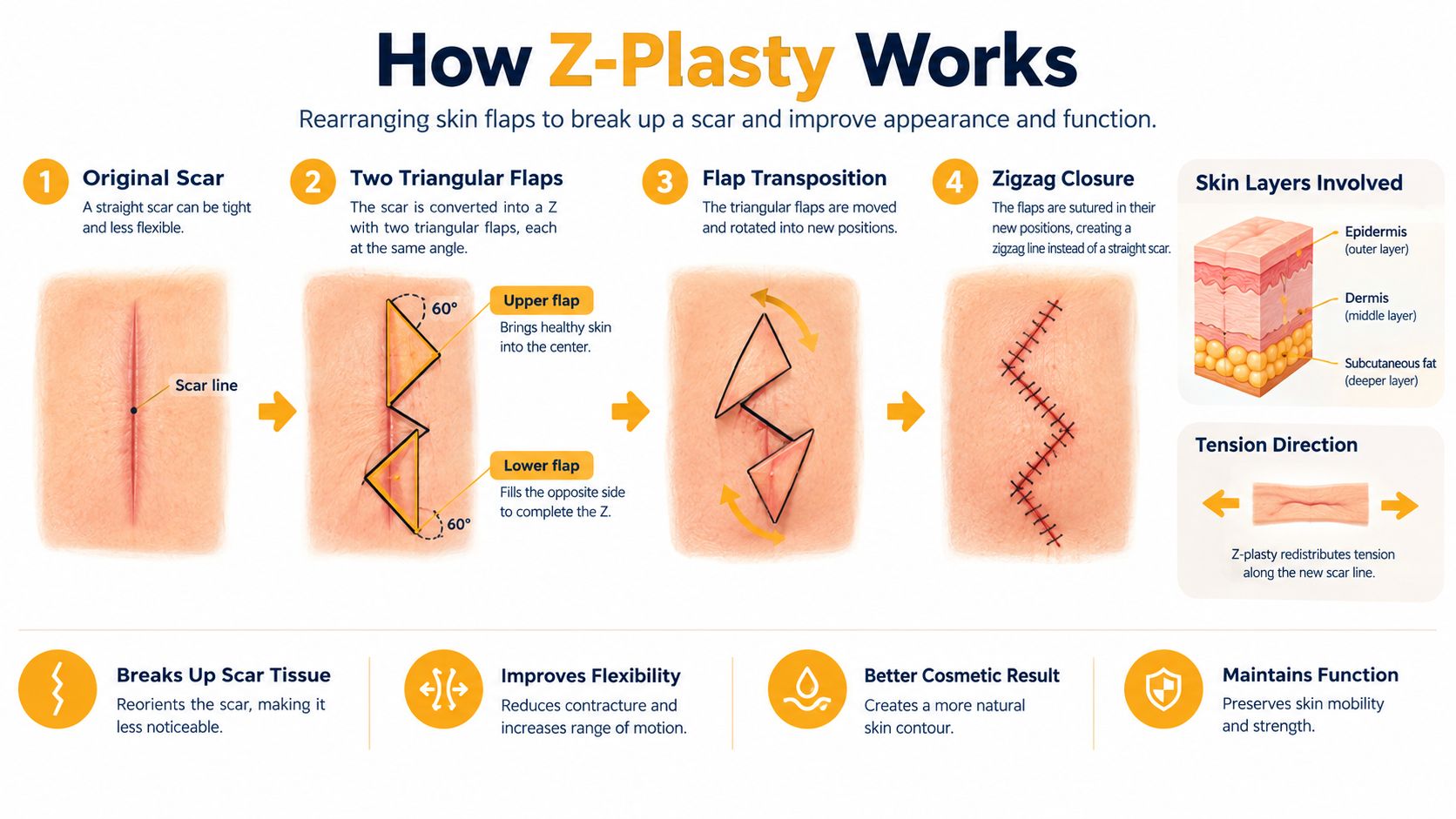
Start with the scar as a straight center line. This is called the central limb. The surgeon then marks two additional lines of equal length, one extending from each end of the central line at matching angles. Together, the three lines form a Z.
Those two side lines define triangular skin flaps. The flaps remain attached to the surrounding tissue, so they retain a blood supply. After the surgeon releases the scar and lifts the triangles, the flaps are transposed, meaning they swap positions. One moves into the space previously occupied by the other.
Why the straight line becomes a zigzag
Before transposition, the scar concentrates pull along one direction. Afterward, the closure follows several shorter segments that point in different directions. The eye is less likely to track that line as a single uninterrupted mark, and the skin can gain length along the original tight axis.
The effect resembles rearranging two triangular puzzle pieces. You haven't removed the board. You've changed how the pieces meet so the original narrow path becomes a broader, angled pathway. The surrounding healthy skin supplies the movement needed for the release, while dense scar tissue generally doesn't provide the same flexibility.
Equal limb lengths and matching angles matter because they make the transposition more predictable. If one side is substantially different from the other, the flaps may not fit comfortably after they move, and the resulting tension can become uneven.
The mechanical reason it can help
A contracted scar behaves like a shortened strap. Transposing the flaps interrupts that longitudinal contractile vector and redirects the repair. Healthy, extensible skin in the triangles can then share the tension rather than forcing the entire pull through the original scar line.
The result isn't a longer scar. It's a longer, redirected, segmented scar that may be better aligned with a relaxed skin-tension line. The amount of release depends on the design, the limb length, the location, the tissue's elasticity, and the quality of the surrounding skin.
This is also why a surgeon doesn't choose the largest possible design automatically. A larger geometric gain can require more force to move the flaps and may create excessive closure tension. The procedure works when geometry and biology cooperate.
Angle, Length, and Direction in Numbers
The angle tells the surgeon how the two peripheral limbs leave the central scar. As the angle increases, the theoretical lengthening also increases. The figures below describe geometric estimates, not guaranteed clinical results, because real skin stretches, resists movement, and varies from one body area to another.
| Angle | Approx. Length Gain | Directional Change | When Surgeons Use It |
|---|---|---|---|
| 30 degrees | Approximately 25% | Directional change varies with design | When a smaller transposition is needed and tissue mobility is limited |
| 45 degrees | Approximately 50% | Directional change varies with design | When moderate lengthening is appropriate |
| 60 degrees | Approximately 75% | Approximately 90 degrees | The common compromise for substantial release and reorientation |
| 75 degrees | Approximately 100% | Directional change varies with design | Selected cases with sufficient tissue and a need for greater theoretical lengthening |
| 90 degrees | Approximately 125% | Directional change varies with design | Rarely selected designs where the tissue can safely accommodate the geometry |
These geometric estimates are summarized in the World Journal of Experimental Medicine discussion of Z-plasty geometry. A 30-degree design offers approximately 25% theoretical length gain, while a 45-degree design offers approximately 50%. Those changes can be useful when the surgeon needs a smaller release or when the surrounding skin has limited mobility.
Why 60 degrees is often the workhorse
A 60-degree Z-plasty theoretically lengthens the scar by approximately 75% and changes its direction by approximately 90 degrees, according to the clinical review of Z-plasty principles. That combination is valuable because it addresses both parts of the mechanical problem, shortening along the scar and an unfavorable line of pull.
The number is a planning guide, not a promise. Skin elasticity, scar stiffness, flap thickness, local laxity, vascularity, and closure tension all affect the actual result. Clinical length gain is often lower than the geometric estimate.
Why bigger isn't automatically better
Increasing the angle can produce greater theoretical lengthening, but it also increases the transverse shortening and the force needed to transpose the flaps. That can make the closure more difficult and increase tension. At the other end, angles below 30 degrees can increase the risk of poor blood flow at the flap tips.
Surgeons therefore choose an angle that balances release, tissue safety, and the visual boundaries of the nearby area. The best design isn't the one with the largest number. It's the one that achieves useful release without asking the skin to do more than it can safely tolerate.
Matching the Scar Problem to the Right Treatment
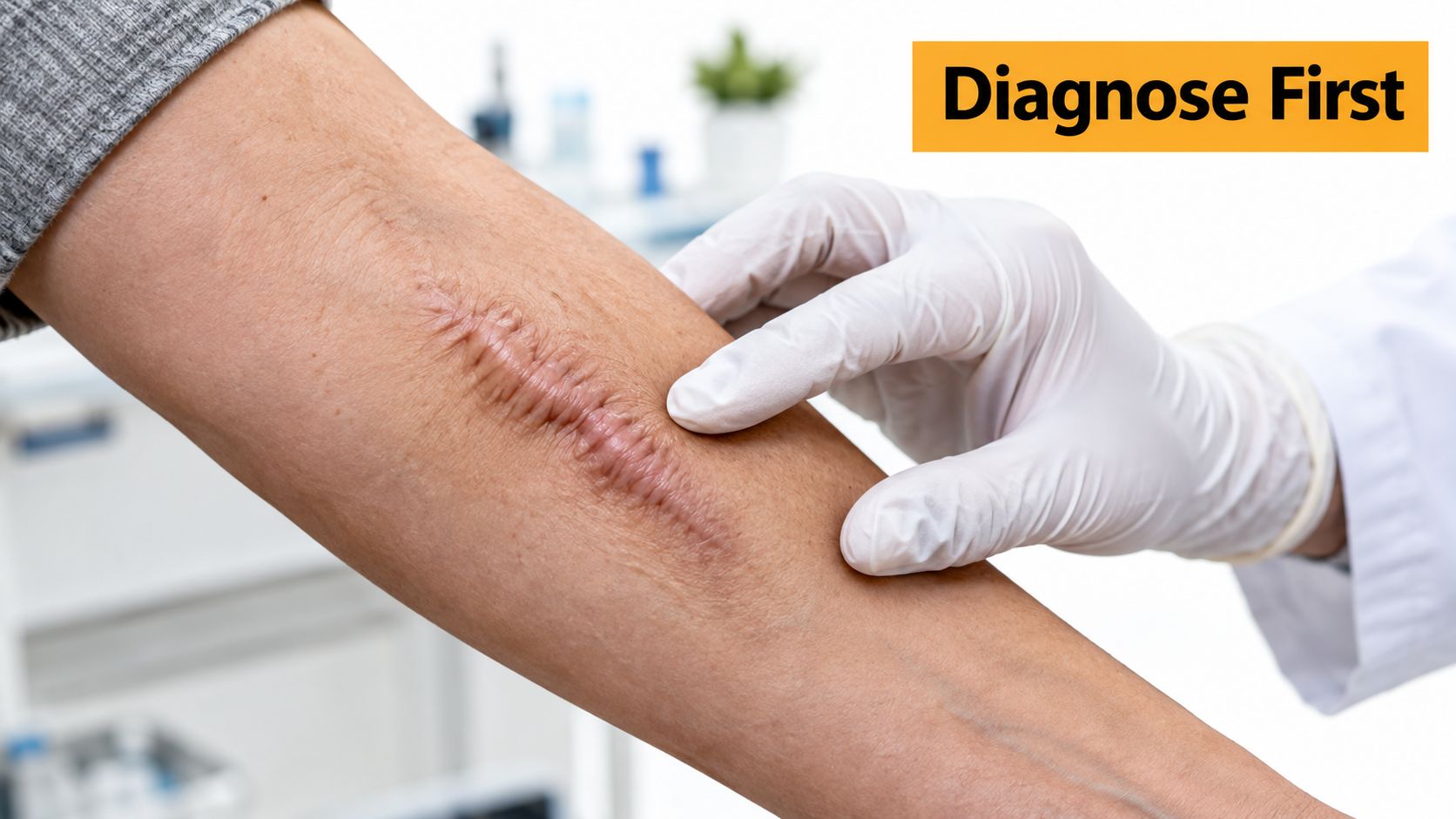
A useful consultation starts with diagnosis in plain language. Is the scar tight, tethered, misdirected, raised, depressed, painful, or mainly different in color and texture? Those features point toward different tools.
Z-plasty is especially relevant when the scar restricts movement, creates a contracture, pulls on a nearby structure, or lies across a direction of tension. Laser resurfacing is more suited to selected surface concerns, such as residual texture or color, when the underlying scar isn't significantly shortened.
A practical comparison
| Scar problem | Z-plasty | Laser or resurfacing | Combination planning |
|---|---|---|---|
| Tight or contractile scar | Often directly addresses length and tension | Usually doesn't release a shortened band by itself | Surgery can release tension, then resurfacing can refine texture or color |
| Poorly oriented linear scar | Reorients the line | May improve surface visibility without changing direction | Useful when direction and surface quality both matter |
| Color or texture concern without tightness | May create an unnecessary longer scar | Often the more direct approach | Considered when a surgical change is also needed |
| Raised or biologically active scar | Requires careful individualized assessment | May be part of a broader plan | Treatment depends on scar behavior and recurrence risk |
For a wider explanation of surgical approaches, scar revision treatment at Chernoff Cosmetic Surgery can help patients understand how removal and careful re-closure fit into a broader plan.
The decision isn't surgery versus laser in every case. A 2025 comparative study found that surgical scar reorientation combined with fractional laser resurfacing produced better appearance and psychological-satisfaction outcomes than laser treatment alone for linear facial scars, as summarized in the NCBI Bookshelf resource on scar revision. That finding supports a problem-first approach. Surgery can address the mechanical direction, while resurfacing can address the remaining surface characteristics.
Questions that clarify the choice
Ask yourself:
- Does the scar restrict movement? Pulling across a joint, neck, eyelid, or mouth suggests a mechanical issue.
- Does it feel tethered underneath? A depressed or anchored line may need release rather than surface treatment alone.
- Is the complaint mainly color or texture? If the scar is soft and well oriented, resurfacing may be more appropriate.
- Would a longer zigzag be an acceptable trade? Z-plasty improves the relationship between scar and tension, but it doesn't make the scar disappear.
Candidacy and the Chernoff Consultation
A strong candidate usually has a stable scar whose main problem is tension, contracture, or direction. The scar should be fully closed, free of active infection, and mature enough for the surgeon to understand its behavior. Timing is individualized, particularly when function is affected, and a surgeon may recommend observation when the scar is still changing.
Your general health matters because flap healing depends on reliable blood flow and good tissue repair. A history of thick scars, hypertrophic scars, or keloids doesn't automatically rule out treatment, but it changes the discussion. Patients with active skin inflammation or a strong tendency toward problematic scarring may be guided toward alternatives or additional precautions.
What happens during the evaluation
A consultation should feel like a planning session, not a quick look at the scar. Dr. Gregory Chernoff may assess:
- Direction and tension: How the scar behaves when you move, stretch, smile, bend, or turn.
- Tissue quality: Whether healthy skin is available to form reliable triangular flaps.
- Functional effect: Whether the scar limits motion or pulls on a nearby structure.
- Design options: The likely angle, limb length, number of Z-plasties, and the position of the final line.
- Adjunctive care: Whether laser, skin treatment, silicone therapy, or another measure may be useful before or after surgery.
Photographs and scar mapping help document the starting point and make the proposed design easier to understand. Bring a list of previous procedures, treatments, medications, allergies, medical conditions, and any history of delayed healing or raised scars.
Set expectations before choosing a design
The consultation should also address what will change and what won't. Z-plasty may release a tight line and make its direction less obvious, but the final result still depends on healing biology, location, movement, skin characteristics, and aftercare.
Chernoff Cosmetic Surgery provides English and Spanish support, financing options, and resources for patients traveling from outside the area. Those practical details matter because scar revision often requires planned follow-up, especially if the treatment includes staged refinement.
Recovery Timeline and What to Expect
Recovery is easier to understand when you treat it as a sequence rather than a single event. The first week focuses on protecting the repair. The following weeks involve gradual return to activity. Scar maturation continues long after the skin appears closed.
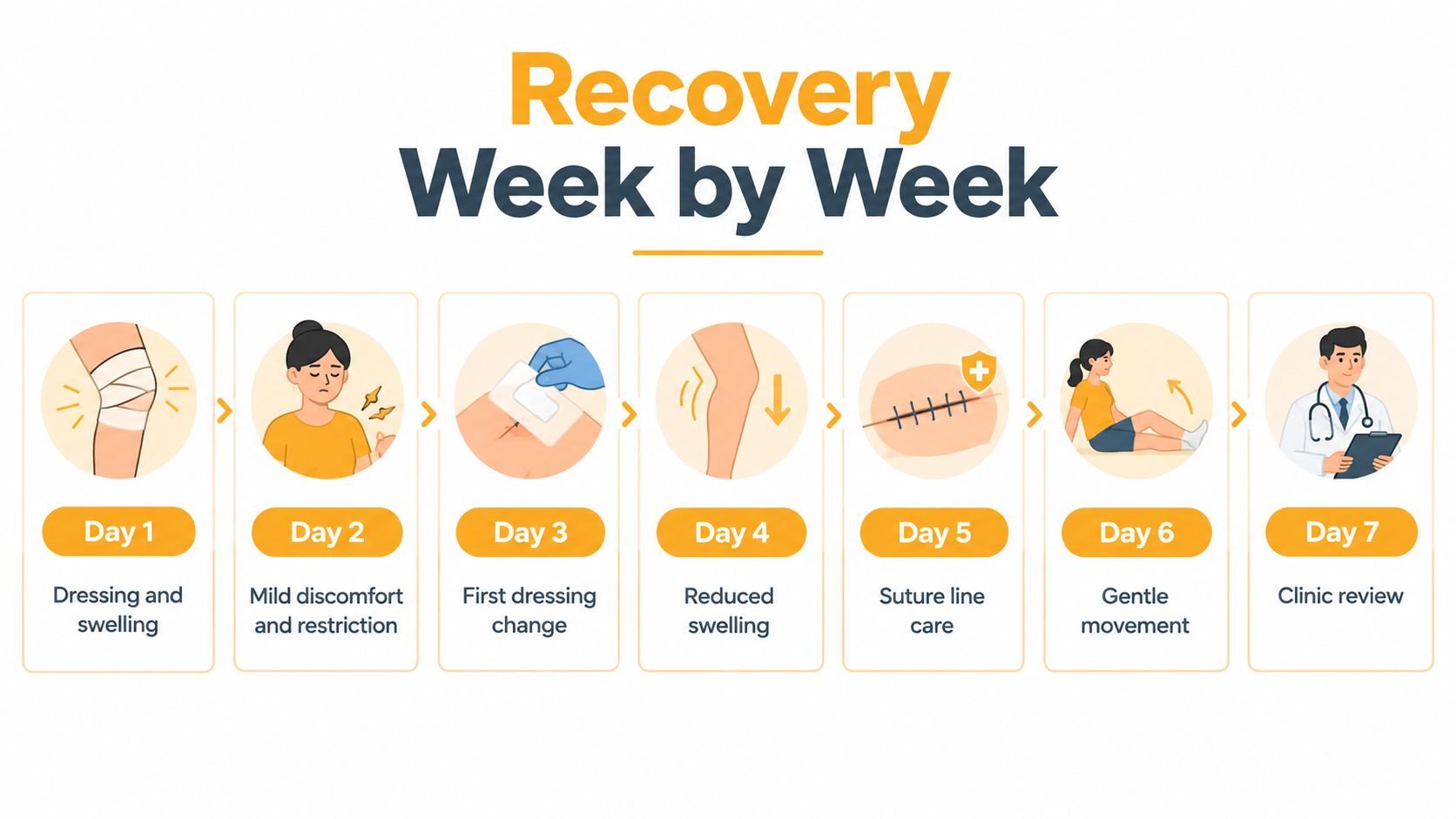
The first week
During the first few days, dressings protect the incision while swelling, bruising, tightness, and mild discomfort settle. Your instructions may include keeping the area clean and dry, limiting movement that stretches the repair, and watching for changes that need medical attention.
By the middle of the week, swelling often begins to reduce, but the zigzag line may look more noticeable than expected. Surface sutures or dressings are managed according to the surgical site and the surgeon's plan. A review near the end of the first week may assess the flaps, wound edges, and early healing.
Weeks two through four
Once the surface has sealed, your surgeon may discuss silicone therapy, scar tape, or gentle care. Makeup may be possible at an appropriate stage, but it shouldn't cover an open or irritated incision. Light activity can resume according to the location and the repair, while stretching, heavy lifting, and contact activity may remain restricted.
The early scar can look pink, firm, raised, or irregular. That appearance doesn't predict the final result. A zigzag design can also look more conspicuous at first because it's new and inflamed, while the old scar may have become pale over time.
For practical aftercare principles, review how to minimize scarring after treatment, then follow the instructions given for your specific repair.
Months of maturation
During the following months, the new scar generally softens and settles. Sun protection helps reduce unwanted darkening, and silicone-based care may support a smoother maturation process when recommended by the clinical team. If the remaining concern involves texture or color, laser refinement may be considered after the tissue has healed sufficiently.
The result should be judged gradually, not at suture removal. Scar remodeling can continue for many months, and some patients need follow-up treatment or a later refinement. The honest exchange is simple: Z-plasty creates a different scar in an effort to make it less tight, better oriented, and less visually continuous.
Risks, Limitations, and Common Misconceptions
The first misconception is that Z-plasty erases a scar. It doesn't. Any incision through the deeper skin layers heals with a scar, and the procedure exchanges an unfavorable line for a redesigned one.
The second misconception is that a larger angle guarantees a better release. Larger angles can create more theoretical lengthening, but they also increase the force required to move the flaps and may increase closure tension. Very small angles can compromise the flap tips, so the surgeon must balance geometry with blood supply and tissue behavior.
What can go wrong
Potential problems include:
- Flap-tip ischemia: The tip may receive inadequate blood flow and heal slowly.
- Partial flap loss: A portion of the transposed tissue may not survive.
- Widening or thickening: The revised scar may remain prominent or heal with excess firmness.
- Incomplete release: The scar may improve without fully restoring movement.
- Asymmetry: The surrounding tissue may settle unevenly.
- Further treatment: Laser refinement, injections, therapy, or another revision may be considered.
These complications aren't inevitable, but they aren't zero-risk possibilities either. The risks depend on the scar's location, tissue quality, medical history, smoking status, previous treatment, and the complexity of the design.
A third misconception is that surgery and laser are competing philosophies. They address different layers of the problem. Surgery changes length, direction, and tension. Laser or other resurfacing approaches may address surface texture and color. A patient with both types of concern may benefit from staged combination planning.
Keloid-prone patients need particularly careful counseling because another incision can stimulate further overgrowth. Keloid scar treatment information can provide context, but an in-person assessment is essential before choosing surgery.
Planning Your Next Step Toward a Better Scar
Start with the scar's behavior. If it pulls, restricts motion, or crosses a high-tension direction, Z-plasty may address the mechanical cause. If the scar is soft and well oriented but differs in color or texture, a non-surgical approach may make more sense. When both problems exist, surgical reorientation and later resurfacing can be planned as complementary treatments.
Patients who want broader background on resurfacing can see Omega Lasers' resurfacing guide before discussing options with a qualified clinician. The important next step isn't choosing a procedure from a photograph. It's having the scar examined while you move so the treatment matches the problem.

If you're in Santa Rosa or traveling from out of town, schedule a consultation with Dr. Chernoff to discuss whether scar revision Z-plasty, laser refinement, or a staged combination plan fits your scar's tension, direction, and healing history.
Chernoff Cosmetic Surgery evaluates complex scars and offers individualized surgical and non-surgical treatment planning, including scar revision and laser-based refinement when appropriate. Visit Chernoff Cosmetic Surgery to request a consultation and discuss a realistic path toward a more comfortable, better-oriented scar.