
A PDO thread lift's practical expected effect is about 6 to 12 months, although published estimates range from about 1 month to 2.5 years depending on the thread, technique, treatment area, and patient. The threads themselves can take roughly 4 to 9 months to be absorbed, but that doesn't mean the visible lift lasts only as long as the material remains.
The difference matters in a consultation. “How long does a PDO thread lift last?” can refer to two separate things: how long the polydioxanone (PDO) material remains in the body and how long you see a lifting or skin-quality benefit. Those timelines overlap, but they aren't interchangeable.
Claims such as “12 to 18 months” can describe an outcome some patients experience, not a reliable promise for everyone. Your result depends on the amount of laxity, skin quality, placement plan, thread design, and how your tissues respond. The sensible starting expectation is temporary improvement, followed by reassessment based on what your face does.
Table of Contents
- How Long a PDO Thread Lift Realistically Lasts
- How PDO Threads Actually Work Beneath the Skin
- Thread Design and Technique That Change the Timeline
- Patient Factors That Shorten or Extend Your Result
- What You Will Actually See Month by Month
- How PDO Threads Compare to Other Lifting Options
- Maintenance, Retreatments, and When to Escalate
- Setting Realistic Expectations and Asking the Right Questions
How Long a PDO Thread Lift Realistically Lasts
PDO thread lift results follow two overlapping timelines: how long the suture material takes to break down and how long the visible improvement lasts. In practice, the visible effect often lasts about 6 to 12 months, while published clinical estimates range from about 1 month to 2.5 years. That wide range reflects differences in technique, treatment area, thread type, patient anatomy, and how studies assess improvement (clinical review of PDO thread lift outcomes).
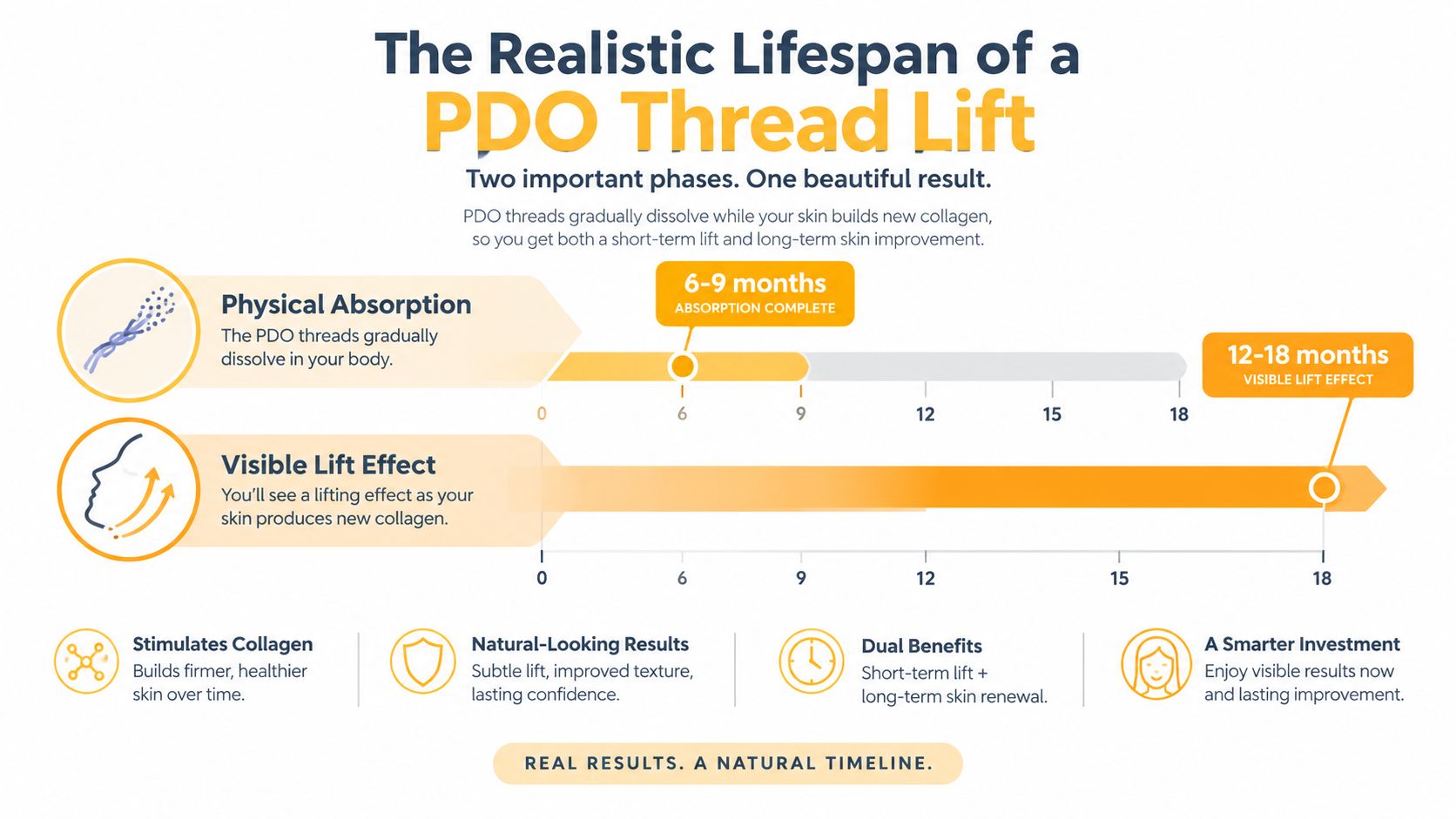
Absorption does not mark a fixed expiration date for the result. FDA records describe PDO suture mass loss over time: roughly 5% within 2 months, 50% within 4 months, and most of the remaining mass within 6 months. Some scaffold designs may take up to 9 months to be fully absorbed, so material and tissue conditions affect the timeline (FDA documentation on polydioxanone material behavior).
Visible improvement can outlast the thread itself as the surrounding tissue responds, but that does not make the lift permanent or predictable. Treat the often-promoted “12 to 18 months” as a possible outcome, not a promise.
For planning, use 6 to 12 months as a practical expectation, then weigh your own anatomy and treatment plan. Mild laxity and a well-matched thread configuration may support a longer-lasting result. More advanced laxity, weaker skin quality, or a result that relies heavily on mechanical repositioning may fade sooner. The patient's starting laxity and the placement plan matter more than a single marketing number.
How PDO Threads Actually Work Beneath the Skin
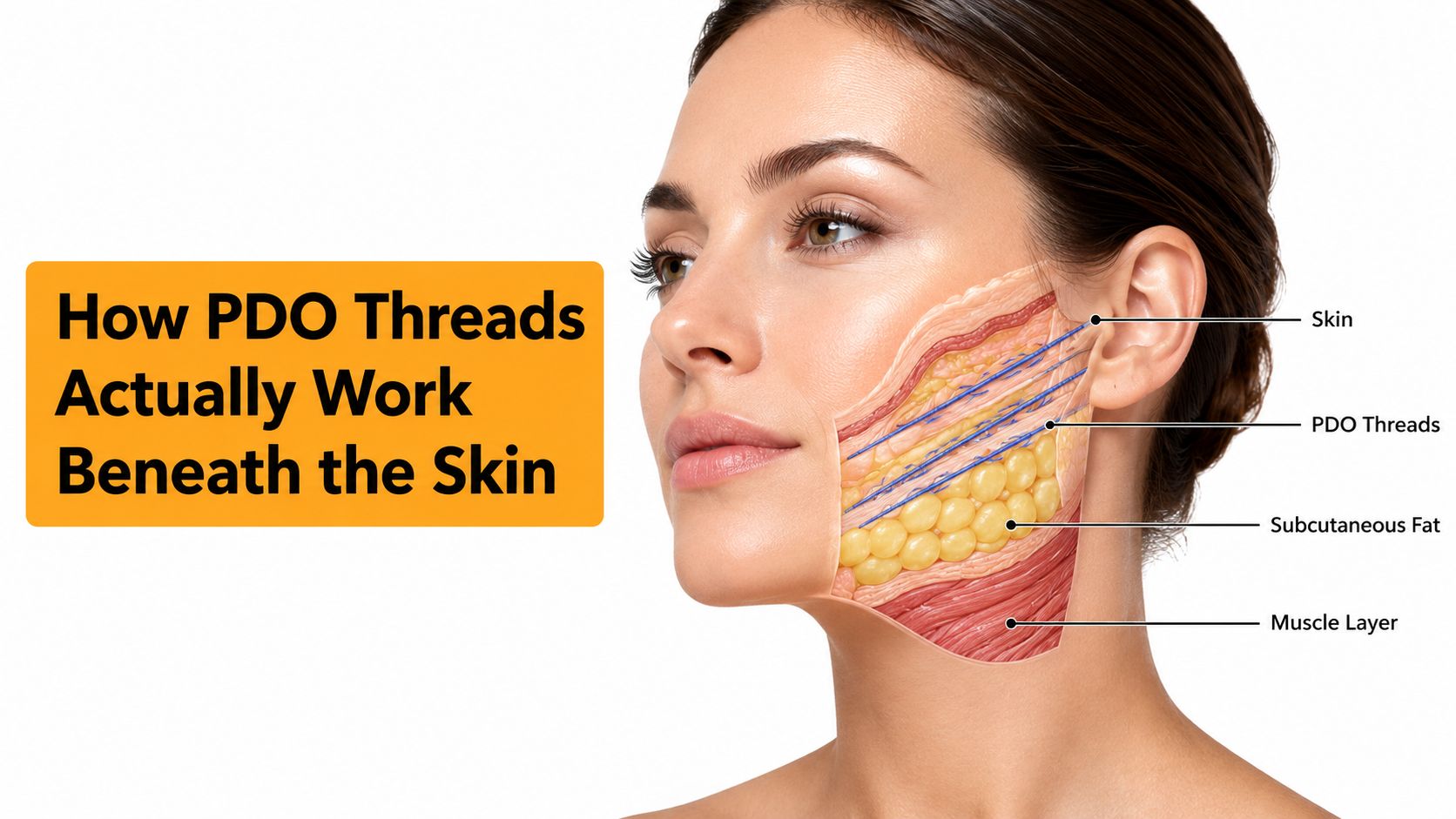
PDO threads are absorbable surgical sutures made from polydioxanone. A qualified provider places them beneath the skin along chosen vectors, with the design and depth depending on the area and the intended effect. Once in place, they can change tissue position mechanically and prompt a healing response around the thread.
The immediate lift and the slower response
The first effect is mechanical: threads designed to engage tissue can reposition it as they're placed. That's the change you may notice soon after treatment, though early swelling and firmness can make the initial appearance different from the settled result.
The second effect is biological. The thread acts a little like temporary scaffolding while the surrounding tissue responds to its presence. Cells involved in wound healing and collagen production gather around the treated area; the scaffold itself can then lose strength and dissolve while the tissue response develops on a separate schedule.
Smooth PDO threads generally retain their original form for about 12 weeks, fragment by roughly 24 weeks, and may be fully absorbed by 48 weeks. In the same tissue-response model, myofibroblast activity appears during the first 0–12 weeks, fibroblast activity continues to about 24 weeks, and collagen production may extend beyond 48 weeks (review of PDO thread changes and tissue response).
Practical rule: The thread's presence and the face's appearance are related, but they aren't the same clock.
That distinction helps make sense of both outcomes: a thread can be mostly absorbed while some improvement remains, and an early lift can soften even while the material is still present. Your provider should discuss each timeline separately rather than promise that the lift lasts as long as the thread.
Thread Design and Technique That Change the Timeline
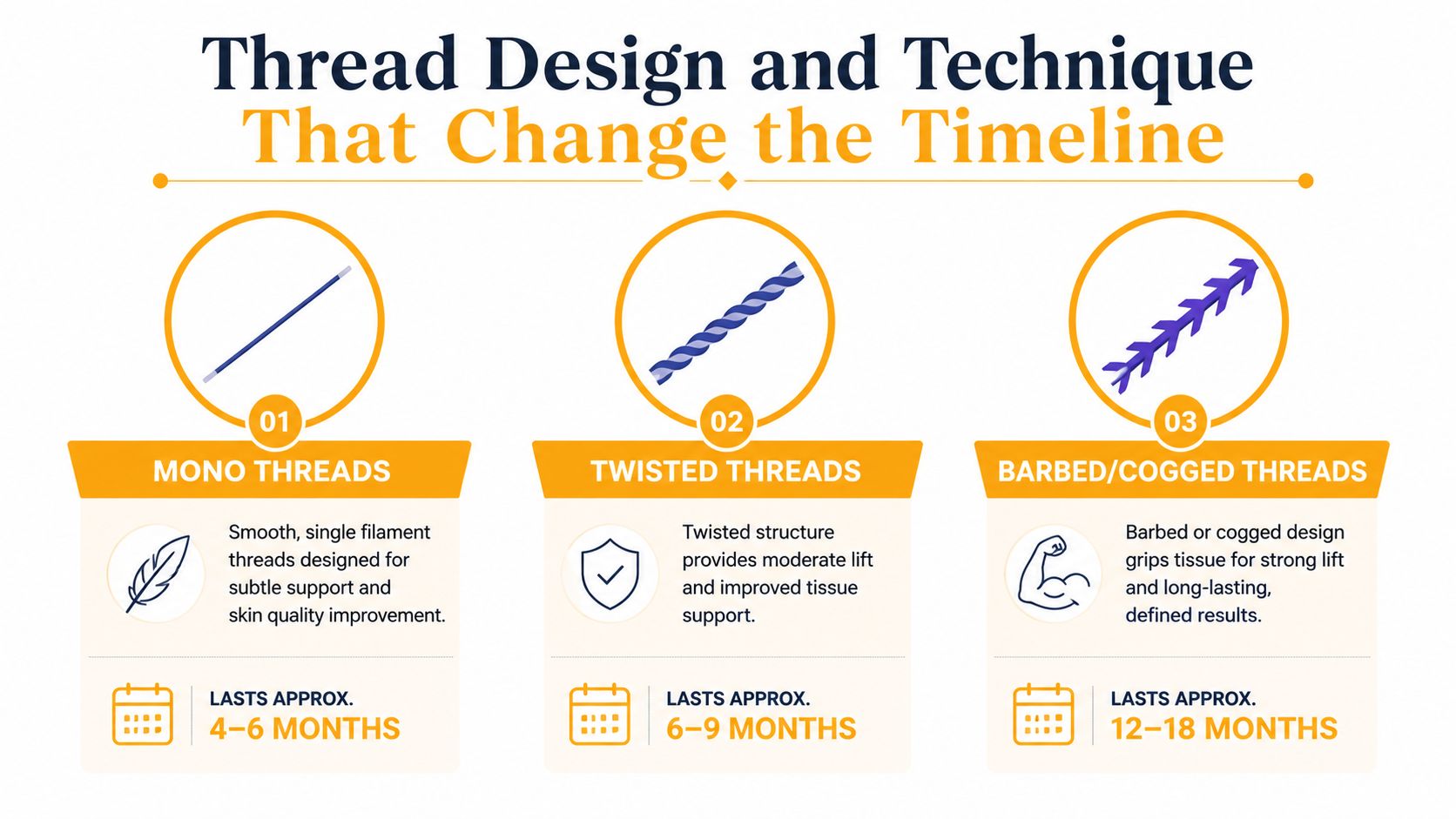
Thread configuration affects the kind of lift you see and how long it remains visible. Smooth mono threads are simple strands used for subtle support and tissue stimulation. Twisted threads add material in a spiral form, while barbed or cogged threads grip tissue to create a more direct lifting effect. Their absorption follows its own timeline, separate from how long the visible lift lasts.
Why placement can matter as much as thread count
The provider selects each thread's path, direction, and depth to suit the tissue and treatment area. Those choices influence how the tissue is repositioned immediately. A thread designed for subtle support will not create the same effect as one designed to anchor and lift tissue.
More threads do not necessarily produce a longer-lasting result. In the randomized trial cited earlier, increasing the number of PDO threads did not significantly improve sustained lifting or patient satisfaction. Early changes in facial volume and tissue displacement had diminished by day 60. The finding is a reminder that thread count alone cannot make up for a mismatch between thread design, placement, facial anatomy, and the result you want.
The practical trade-off is between the intended degree of support and what your tissue can hold. Ask which configuration is planned, where the threads will sit, and what change they are intended to produce. A useful explanation should cover both the direction of support and the limits of the expected lift. The right choice is based on your anatomy and goals, not just on using the greatest number of threads.
Patient Factors That Shorten or Extend Your Result
Your skin and tissue set the conditions for both parts of the result: mechanical support and healing-related remodeling. More substantial laxity can make a subtle, minimally invasive lift less noticeable or less durable. Skin thickness and quality, treatment area, and your individual healing response also influence what you see.
Age is relevant, but it isn't a stand-alone verdict on candidacy. A 2024 review and meta-analysis of 26 studies reported higher risks of dimpling and infection among patients over 50. Its pooled complication incidences included 35% for swelling, 10% for dimpling, 6% for paresthesia, 4% for visible or palpable threads, 2% for infection, and 2% for extrusion (review and meta-analysis of thread-lift complications). These figures describe reported pooled incidences, not a prediction that any individual patient will experience a complication.
| Factor | Direction of effect | Practical note |
|---|---|---|
| Degree of laxity | More laxity can limit the apparent lift | Threads offer modest support, not the same correction as removing excess skin. |
| Skin quality and thickness | Influences tissue response and thread visibility | Your provider should assess the tissue directly, not judge candidacy from age alone. |
| Age and healing profile | May affect risk and the biological response | Discuss risks in light of your health and anatomy, including the age-related complication findings above. |
| Weight and hormone changes | Can change facial volume and tissue appearance | A change in the face after treatment may reflect more than thread absorption. |
| Smoking and sun exposure | May work against skin health and recovery | Share relevant habits and history so your clinician can plan appropriately. |
Hydration, medication, and overall health may also affect the treatment plan and recovery. None of these factors can be used to calculate a precise expiration date for your lift. A careful consultation should identify which ones are most relevant to you and whether PDO threads are likely to meet your expectations at all.
What You Will Actually See Month by Month
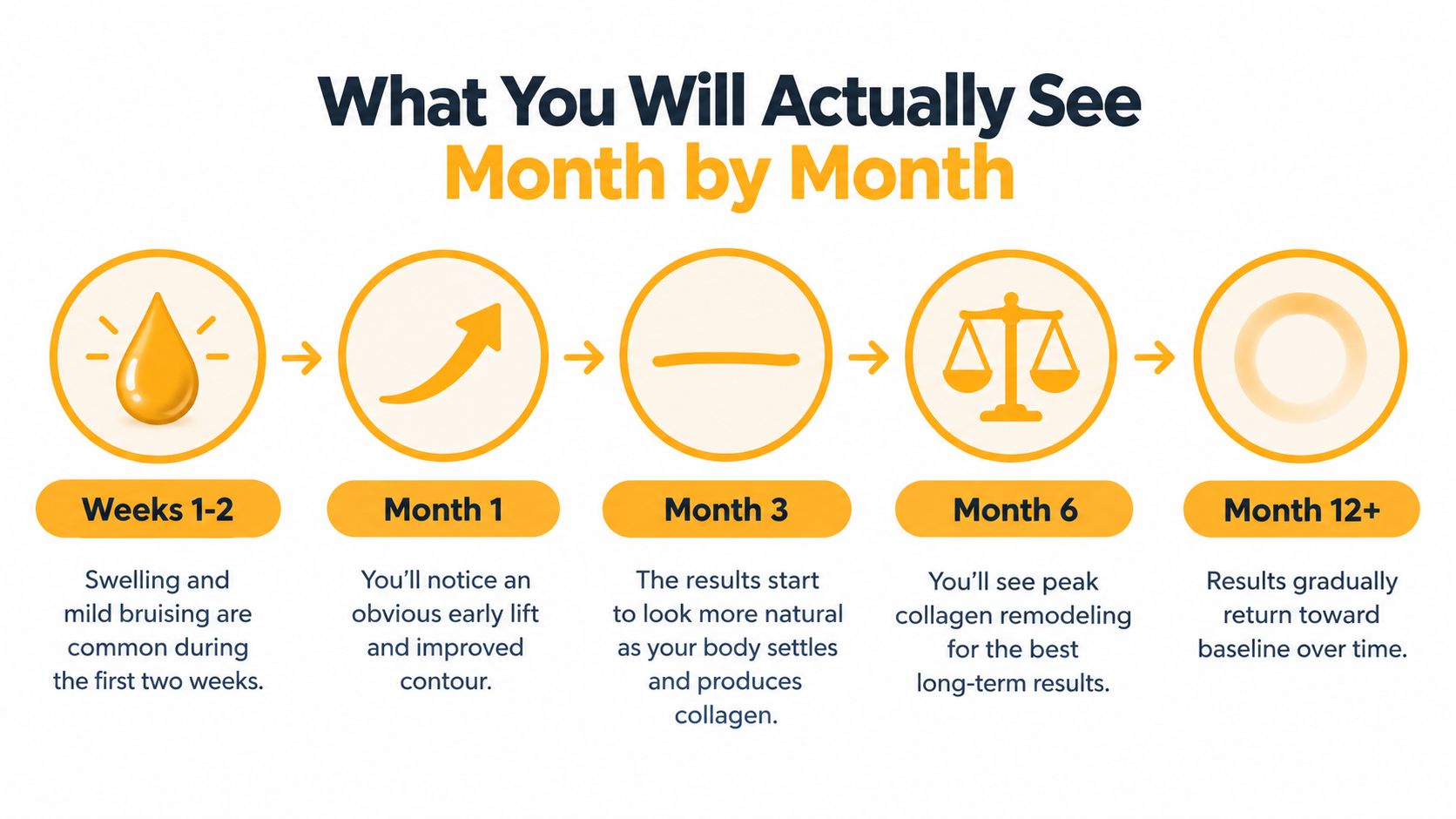
The thread's absorption timeline and the visible lift follow overlapping but different paths. A thread can continue breaking down after the initial lift has softened, and the material's timeline does not predict the exact month your appearance will change.
From the early lift to gradual settling
In the first 1 to 2 weeks, swelling, mild bruising, tightness, or a pulling sensation may affect how your face looks and feels. Temporary unevenness or dimpling can also occur. Follow the aftercare guidance from your treating clinician, and contact them if symptoms worsen or concern you.
During the first several weeks, the lift may look stronger or less even than the settled result because of swelling and tissue tension. Between roughly months 2 and 4, the mechanical effect may soften as the tissue response becomes more relevant. Your result depends in part on your starting laxity and the thread configuration, so a general timeline cannot promise the same course for every patient.
As covered earlier, the material's gradual breakdown follows an FDA-documented absorption curve, but those figures do not show exactly when a lift will fade. At around 6 months, some patients may notice less visible support than in the early weeks, while others still see a meaningful improvement. By 12 months, the lift may be more subtle or no longer meet the patient's original expectations. These are practical checkpoints, not fixed deadlines.
When to check in
Take photos in similar lighting and from the same angle at intervals, especially as the early swelling settles and in the later months. Consistent images give you and your provider a clearer comparison than memory or a single selfie.
Contact your treating provider if you notice persistent asymmetry, worsening dimpling, a thread becoming visible or palpable, or signs that may indicate infection. A gradual softening can fit the expected course; a sudden change, worsening symptom, or uncomfortable change deserves clinical assessment. Your clinician can determine whether the appearance reflects normal settling or needs attention.
How PDO Threads Compare to Other Lifting Options
PDO threads sit between topical or injectable treatments and surgery. They can provide temporary support without the incisions and tissue removal of a facelift, but they don't deliver the same kind of correction. Clinical reviews describe a typical PDO effect of 6 to 12 months, with limited long-term evidence, while surgical lifting generally provides multi-year correction for people with more substantial laxity (clinical review of PDO threads and facial rejuvenation options).
Fillers and threads address different concerns. Hyaluronic acid fillers add volume in selected areas, while PDO threads are intended to reposition tissue and prompt a local healing response. If you're weighing filler choices for a smile-related concern, this guide to which filler suits your smile offers a focused overview. A consultation should still determine whether filler, threads, or another approach fits your own anatomy.
Energy-based treatments, including radiofrequency microneedling and ultrasound, aim to improve skin firmness through controlled heating rather than physically suspending tissue. They may suit someone whose main concern is skin quality or mild looseness, but they aren't a substitute for repositioning descended tissue. The right choice depends on what you want changed and how much downtime you can accept.
| Option | Main role | Fit for laxity |
|---|---|---|
| PDO threads | Temporary tissue support and lifting | Often considered for mild to moderate laxity |
| Fillers | Restore or adjust volume | Better suited to volume-related concerns than tissue descent |
| Energy-based tightening | Improve skin firmness | Considered for selected patients seeking non-surgical skin improvement |
| Surgical lift | Reposition tissue and address excess skin | More appropriate when laxity is substantial |
A surgical consultation is worth considering if you need a larger, more durable change than a minimally invasive treatment can reliably deliver. No option is universally best. The goal is to match the treatment to the problem, rather than asking a temporary procedure to perform a surgical lift.
Maintenance, Retreatments, and When to Escalate
Maintenance should follow your actual result, not an automatic schedule. A provider may reassess you around the time the visible support begins to decline, but repeating treatment before reviewing tissue position, skin quality, and prior response can add procedures without solving the underlying concern. Ask for an objective comparison using consistent photos and an examination.
Combining threads with fillers, collagen-stimulating treatments, or energy-based procedures may be considered when each addresses a different issue. Evidence for combination approaches shouldn't be treated as proof that adding more treatments guarantees longer-lasting lifting. A small prospective study of a combined approach cannot isolate the contribution of PDO threads, so your plan should rest on your specific anatomy and goals rather than a promise of extra durability.
If you're considering surgery because laxity has progressed beyond what threads can reliably support, review what facelift results can involve and discuss candidacy with a qualified surgeon. A surgical option may be more appropriate when excess skin or tissue descent is the main issue, rather than a lack of collagen stimulation.
Complications also belong in the maintenance conversation. The pooled rates for swelling, dimpling, altered sensation, visible or palpable threads, infection, and extrusion are detailed in the earlier patient-factor discussion. Contact your provider if you develop worsening pain, increasing redness or swelling, drainage, a thread that becomes exposed, or a new and persistent change in sensation; follow any urgent-care instructions your clinician has given you.
Don't repeat a treatment just because a calendar says it's time. First ask whether the original concern has returned, whether the prior result was worth repeating, and whether another option would address it more directly.
Setting Realistic Expectations and Asking the Right Questions
The most useful answer to “pdo thread lift how long does it last” isn't a single number. Expect a temporary effect, commonly around 6 to 12 months, while remembering that published outcomes range from about 1 month to 2.5 years. The physical thread's absorption and the visible result follow different, overlapping timelines; your skin, the amount of laxity, and the treatment plan help determine where you fall.
Before agreeing to treatment, ask your provider:
- Which thread type are you recommending, and why is it suited to my concern?
- Where will the threads be placed, and what direction of lift do you expect?
- What should I realistically expect to see at 6 and 12 months?
- If my result fades sooner than expected, how will you reassess the plan?
Consider a different approach if you have advanced laxity, need substantial excess skin removed, or expect a permanent result from a temporary procedure. A non-surgical facelift overview can help you understand the range of less-invasive approaches, but an in-person assessment is what determines whether threads fit your anatomy.
Before deciding, check that:
- Your main concern is one a thread lift can address.
- You understand the difference between material absorption and visible benefit.
- Your provider has explained the thread design, placement, risks, and follow-up plan.
- You're comfortable with a temporary, individualized result rather than a guaranteed duration.
Chernoff Cosmetic Surgery offers PDO thread lifts alongside surgical and non-surgical facial rejuvenation, with treatment planning based on your skin, tissue response, and goals. To discuss whether threads or another approach makes sense for your concerns, visit Chernoff Cosmetic Surgery and request a consultation.