
Three days after a facelift, most patients do the same thing. They stand at the bathroom mirror, tilt their chin left and right, and try to answer one anxious question: “Is this what I'm going to look like?”
At that moment, your face is giving you an incomplete report. You may see puffiness along the jaw, bruising that wasn't there yesterday, tape or sutures that draw your eye more than your actual contours, and a neck that feels tight when you swallow or turn your head. You may also notice something encouraging underneath all of that. Even early on, many patients can already sense a cleaner outline and a more rested look.
That tension between early signs and final results is where most confusion lives. A facelift doesn't reveal itself all at once. It arrives in layers. Swelling leaves. Tissue relaxes. Scars fade. Expression returns to normal. Then the face settles into something that shouldn't look “done.” It should look like you, with gravity rewound.
Table of Contents
- What Face Lift Results Look Like From Day One to a Decade Later
- How Facelift Techniques Shape Your Results
- The Facelift Recovery Timeline and What You See in the Mirror
- Factors That Influence How Good Your Results Look and Last
- Deep Plane vs SMAS Facelift Results Compared
- Risks, Revisions, and the Realistic Complication Picture
- Maintaining Facelift Results With Nonsurgical Treatments
- Patient Questions About Face Lift Results Answered
What Face Lift Results Look Like From Day One to a Decade Later
On day three, many patients search the mirror for an answer that is not visible yet. Swelling rounds out the cheeks, bruising can travel downward into the neck, and the jawline may look less sharp than expected before it starts to look better.
Early facelift results are a progress report, not a verdict. The contours are there, but they are partly hidden. A cleaner lower face and neck often peek through before the face has settled enough to read clearly.
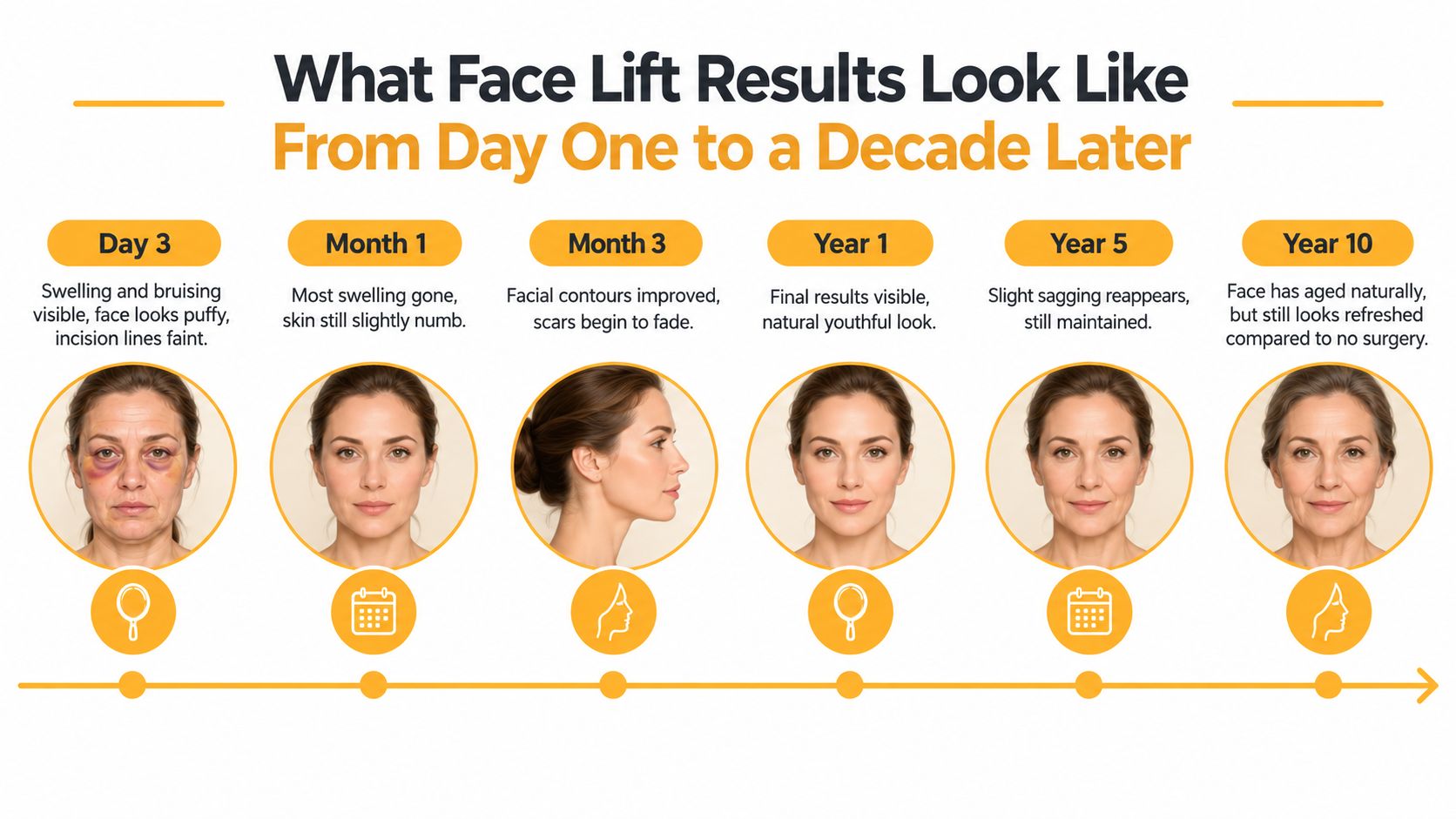
By the first month, the result is usually easier to judge. Much of the obvious swelling has eased, the cheeks sit in a more supported position, and the neck angle often looks more defined. This is also the stage when friends may notice you look rested without being able to say exactly why. If you want a realistic visual reference for that progression, a facelift before-and-after gallery is often more useful than trying to interpret your own face too early.
The one-year mirror
At one year, the question changes from "Am I still swollen?" to "How did my facial structure settle?" That is the point when scars have matured further, tissue relaxation has largely occurred, and the result usually looks integrated rather than surgical.
A long-term satisfaction study followed facelift patients over time and found that 87 patients rated their one-year result as "very good or beyond expectations," which was 97.8% of that group, according to this PubMed study on long-term facelift satisfaction.
The same paper adds a useful layer of honesty. 31% were disappointed with some aspect of the facelift. That sounds contradictory until you remember how patients judge surgery. A person may feel pleased overall while still noticing a scar, a small asymmetry, or a neck contour that fell short of what she had hoped to see. Satisfaction is not all-or-none.
A practical takeaway follows from that timeline. Judge recovery week by week, but judge the operation itself at about the one-year mark.
Five years and beyond
A facelift resets the clock, then aging resumes at its usual pace. That idea matters because it protects patients from two common mistakes. The first is expecting a permanent freeze-frame. The second is assuming any change years later means the surgery failed.
Long-term follow-up studies show that many patients continue to report durable improvement years after surgery, although the percentage declines over time and the exact pattern depends on technique, tissue quality, and how the face aged to begin with. One published long-term series with follow-up extending beyond five years found sustained aesthetic benefit for many patients over time, while also confirming that some recurrence of laxity is expected with normal aging, as described in this PubMed long-term facelift follow-up report.
What does that mean in the mirror?
- At five years: many patients still look clearly rejuvenated, especially in the jawline and neck, even though the face is no longer as crisp as it was at one year.
- At ten years: the result usually reads as natural aging from a younger baseline, not preservation of the exact post-op look.
- Beyond a decade: durability spreads into a wider range. Some faces hold definition very well. Others show more softening because of skin quality, weight change, sun exposure, or the original technique used.
That realistic distribution matters more than a single best-case photo. The right question is not whether facelift results can look excellent. They can. The better question is how long a given technique tends to hold its shape, and how often patients remain happy with it years later.
How Facelift Techniques Shape Your Results
A facelift shapes results by deciding which layer gets moved, how far it moves, and where the tension sits once healing is over. That is why two patients with the same amount of looseness can end up with very different mirrors at six months and five years.
Modern face lift results usually come from repositioning the deeper support layer, then laying the skin back without much pull. Skin can smooth the surface, but the deeper layers set the contour. If too much tension stays in the skin, the result may look tight at first and soften earlier than expected.
Skin-only, SMAS, and deep plane in plain language
The face ages in layers. Skin stretches, fat shifts, retaining ligaments loosen, and the support system under the skin descends. Pulling only the outer layer is a bit like straightening a bedsheet while the mattress underneath is still sagging. The surface looks neater, but the shape under it has not changed enough.
Here is the broad difference:
- Skin-only lifts focus on the surface. They can create some smoothing, but they usually do less for jowls, cheek descent, and deeper structural change.
- SMAS lifts work on the fibromuscular support layer under the skin. That gives the surgeon more control over the jawline and lower face, often with better durability than skin-only surgery.
- Deep plane lifts release and lift deeper tissues together as one unit. That tends to matter most in the cheek and fold area, where a surface pull alone often looks incomplete.
This is also where satisfaction and longevity start to separate by technique. Published follow-up studies generally show that patients can remain happy for years after facelift surgery, but the spread of outcomes is wider with less structural approaches and narrower with techniques that address deeper descent more directly. In plain terms, stronger structural correction often holds shape better, though it is still filtered through anatomy, healing, and the surgeon's execution.
Why the same patient can look different with different techniques
Technique changes the result because it changes what can be moved naturally.
A patient with early jowling, good skin elasticity, and only mild cheek descent may look excellent after a SMAS-based lift. Another patient may have heavier tissue, deeper folds, or more drop through the midface. In that setting, deeper release can produce a softer transition from cheek to jaw because the lift is happening closer to the structures that fell.
The goal is not a more aggressive operation. The goal is a better match between the problem and the layer being treated.
A useful way to frame it is this: SMAS techniques often do very well when the main target is the lower face and jawline. Deep plane techniques can add more effect in the midface when that area needs repositioning. Neither name guarantees a superior result. A well-chosen, well-executed operation usually beats a trendy label.
The best technique matches the anatomy on the operating table, not the label used in consultation.
What technique changes in the mirror
Patients usually notice the difference in three places.
- Cheeks: Deeper methods often restore more support here, so the midface looks less hollowed or dropped.
- Jawline: SMAS and deep plane techniques usually define this area more effectively than skin-only lifting.
- Neck: Neck improvement depends on the facelift technique and on whether the neck itself needs separate contouring under the chin or along the muscle edges.
Expression matters too. Natural movement usually comes from good deep support and low skin tension. A face should still look like itself when speaking, smiling, and turning in profile.
This is why evidence-based timelines matter. Some techniques produce a quick early change on the surface. Others create a result that may look less dramatic in the first weeks but reads more balanced after swelling settles and often ages more gracefully over time. The right question is not which facelift has the strongest name. It is which operation is most likely to improve your cheek, jawline, and neck in a way that still looks believable years later.
The Facelift Recovery Timeline and What You See in the Mirror
The first week feels longer than it is. Your face changes daily, sometimes hourly. What matters is recognizing normal progression so you don't mistake temporary healing for a poor result.
Days one through three
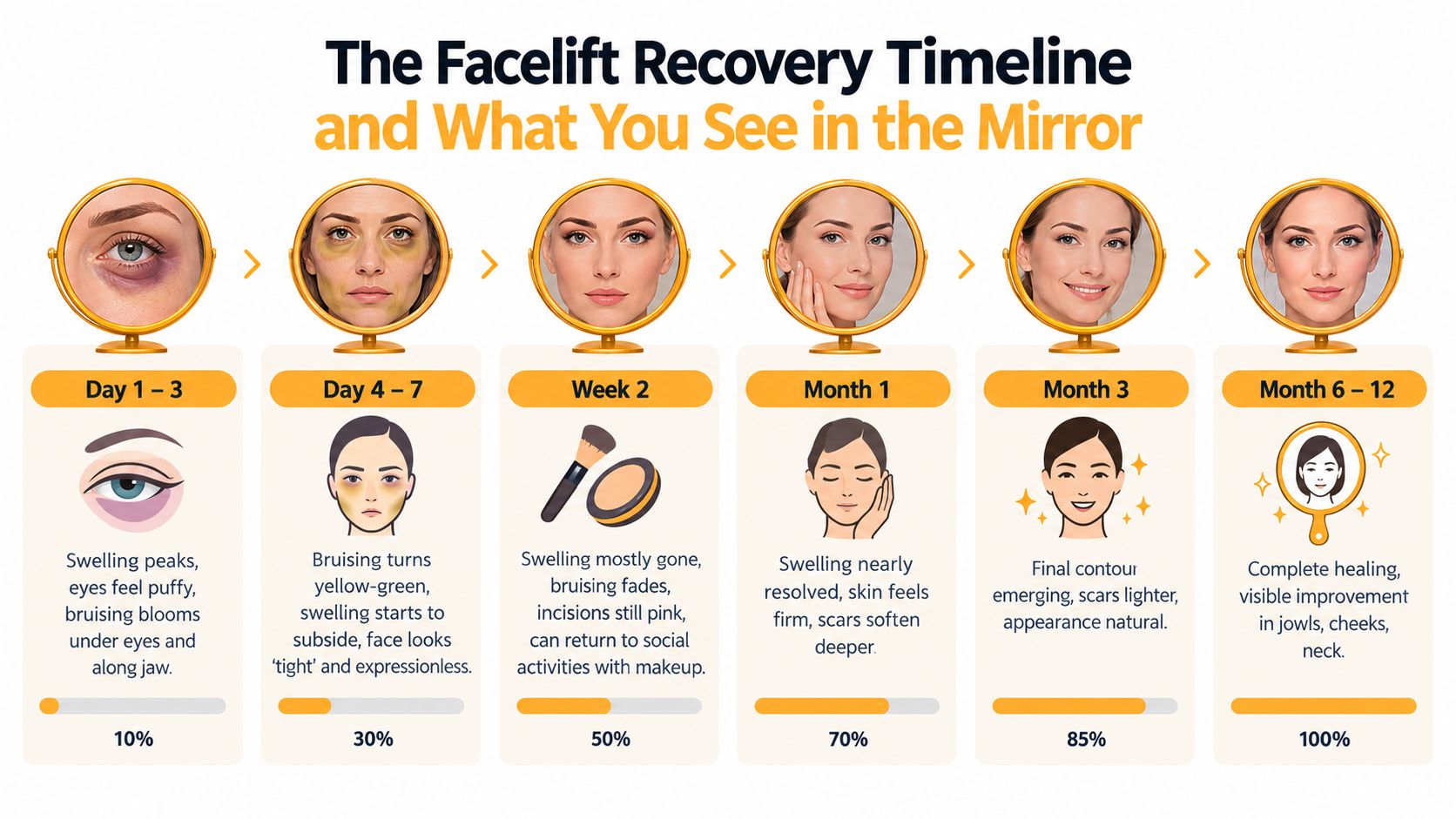
This is usually the peak swelling window. The lower face may look broad. The area in front of the ears can feel firm. Bruising often begins to declare itself more clearly rather than less. Some patients also feel puffy around the eyes even though surgery was lower on the face, because fluid shifts don't always stay where you expect them.
Compression garments, drains in some cases, and head elevation all become part of the routine. The mirror can feel discouraging here, but this phase is more about healing than appearance.
Days four through seven
Now the face begins to change from “swollen” to “settling.” Bruising can move downward into the neck. The jawline often starts to reappear before the cheeks look fully natural. Sutures or staples may come out during this stretch, which helps many patients feel less like they are in active recovery.
If you want a more detailed walkthrough of this stage-by-stage process, a day-by-day facelift recovery guide can help translate the medical timeline into what patients notice at home.
Weeks two through six
This is the social recovery phase. By the second or third week, close friends may notice that you look better, but not necessarily “surgical.” Makeup, hair styling, and a scarf can hide most remaining signs when bruising lingers.
Typical milestones often look like this:
- Desk work: Many patients feel comfortable returning around day ten to fourteen.
- Light exercise: This often resumes around the third week if healing is uneventful.
- Strenuous activity: Usually waits until about six weeks, when tissues are more stable.
The face also starts to feel more normal. Tightness while opening the mouth eases. The skin feels less stiff. Incision lines along the hairline and behind the ears begin flattening, though they are still immature.
Healing isn't linear. One side may soften faster. The neck may improve before the cheeks. That asymmetry in timing is common.
Months three through twelve
Refinement happens. Deeper swelling resolves, scar color fades, and the face starts moving like your face again instead of like a healing face. The result becomes less about “lifted” and more about “restored.”
Patients often understand this better when they compare it to other forms of tissue repair. If you're curious about how healing unfolds in stages more broadly, the framework in four stages of burn recovery is useful because it reminds you that visible healing and deeper tissue remodeling are not the same event.
Call your surgeon promptly if you see expanding bruising, sudden one-sided swelling, worsening pain, drainage that changes abruptly, a new facial movement difference, or sudden calf pain. Those aren't details to watch for later. They deserve immediate contact.
Factors That Influence How Good Your Results Look and Last
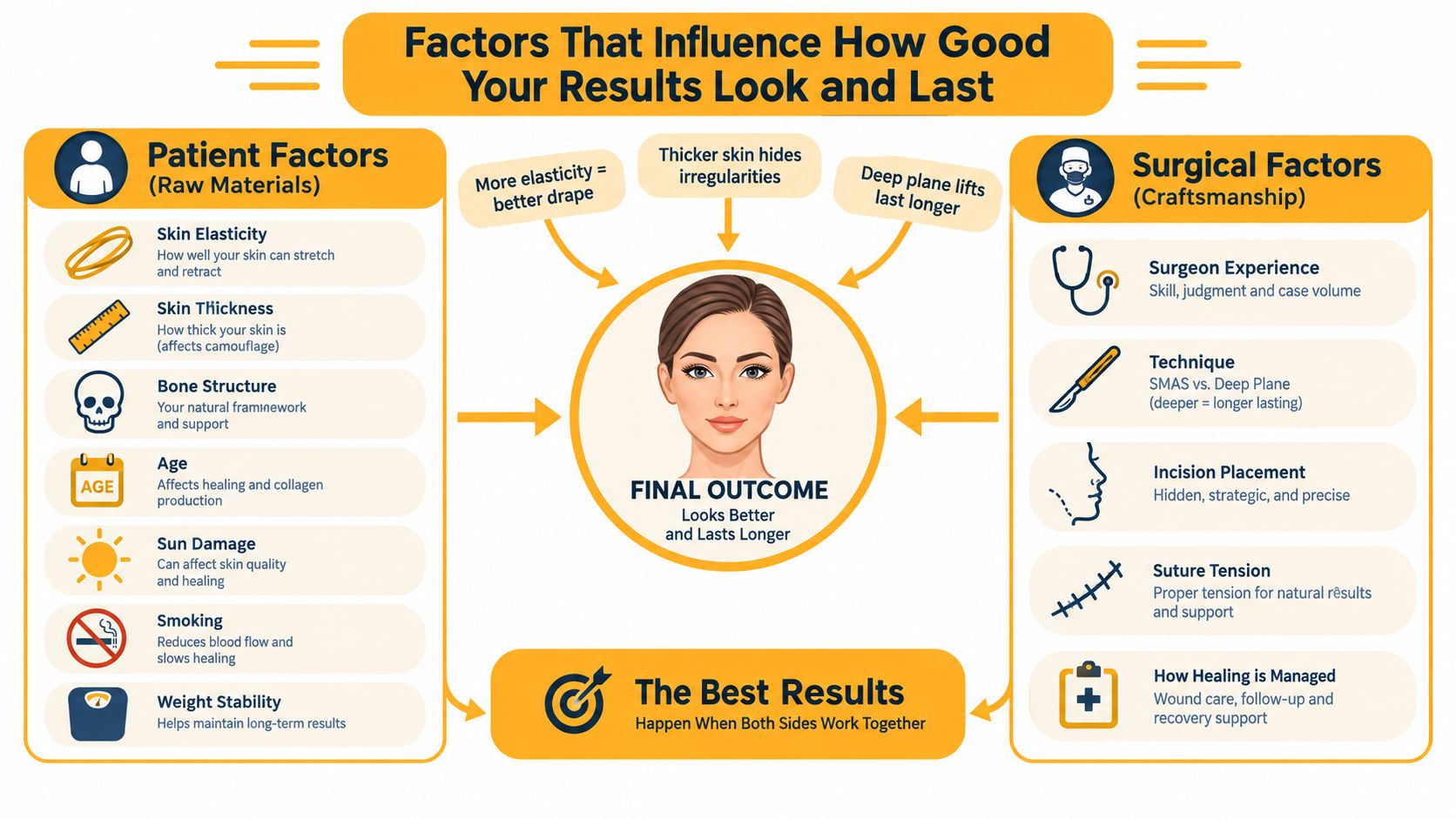
At the one-year mark, two patients may both say they had “a facelift,” yet one looks refreshed while the other still feels that something looks a little off in the jawline or neck. Usually, the difference comes from three things working together. Your starting anatomy, the surgical plan, and how healing is supported afterward.
Your tissues set the stage
Your skin behaves a bit like fabric being laid back over a chair after the frame has been tightened. If the fabric is thick, it can hide minor transitions well, but it also carries more weight. If it is thin, it may settle beautifully, yet small contour changes can show more easily.
Elasticity matters for the same reason. Skin with some spring tends to redrape and soften more gracefully over time. Skin that has had heavy sun exposure or years of nicotine exposure often has less recoil, which can limit how crisp or how durable the result appears.
The facial skeleton also matters. A stronger chin, better jaw definition, or more cheek support gives lifted tissue a firmer base. With a smaller or less projected framework, the outcome can still be attractive, but it often reads as softer rather than sharply sculpted.
Age matters less than tissue quality.
Surgical choices shape how the result settles
A facelift is not a single standardized operation. It is a set of decisions about what layer is lifted, how far tissues are released, where the pull is directed, how the neck is treated, and where tension is placed before the skin is closed.
Those choices affect both appearance and durability. A lift that restores support deeper in the face usually holds up differently from one that relies more on skin redraping alone. The goal is not to pull upward. The goal is to restore structure so the face looks like you on a well-rested year, not like your features were stretched.
Published evidence reflects that variation. A 2023 systematic review of 27 studies covering 6,086 SMAS facelift patients found that more than 85% were satisfied with their results, with complication rates differing across SMAS techniques, according to this systematic review of SMAS facelift outcomes. That is useful in a consultation because it shifts the conversation away from “Does a facelift work?” and toward “Which method fits this face, and what result range is realistic with it?”
The factors you can influence are not small details
Some variables are fixed before surgery. Many are not.
- Weight stability: Repeated gain and loss can blur jawline definition and change how the neck redrapes.
- Nicotine exposure: Smoking and nicotine constrict blood vessels, which can interfere with skin healing and increase the chance of wound problems.
- Sun habits: Ongoing UV exposure speeds collagen breakdown, so a technically good result can age faster in damaged skin.
- Wound care and follow-up: Scar quality often improves when patients follow incision care and activity guidance closely.
- Expectations: Patients seeking restoration usually judge their outcome more favorably than patients expecting symmetry, perfection, or a permanent stop to aging.
One more factor belongs on this list. Surgeon judgment. The right operation for a heavier neck with cheek descent is not always the right operation for mild jowling in a patient with thin skin. Good planning means matching the technique to the anatomy rather than trying to force every face into the same template.
That is also how longevity is best understood. A facelift does not freeze time. It resets the clock to a younger-looking point, and then aging resumes from there. How long that younger look remains convincing depends on the quality of the reset and on what happens to the tissues in the years that follow.
Deep Plane vs SMAS Facelift Results Compared
A common consultation moment goes like this. A patient points to her cheeks and jawline and asks, “Which lift gives the better result?”
The honest answer is that the better result depends on what is falling, where it is falling from, and how much release the tissues need. Deep plane and SMAS lifts can both produce attractive, natural outcomes. They do not usually solve the same pattern of aging in the same way.
A 2026 systematic review comparing deep plane and SMAS facelifts reported patient satisfaction of 94.4% for deep plane versus 87.8% for SMAS, with overall complication rates of 17.2% and 10.3% in the included studies. The authors also found that deep plane techniques may produce stronger midface improvement, but the studies were heterogeneous. That matters. Heterogeneous evidence means the published results come from different surgeons, patient groups, and operative details, so the averages are useful for orientation, not for promising a personal outcome.
Deep Plane vs SMAS Facelift Outcomes Side by Side
| Metric | Deep Plane Facelift | SMAS Facelift |
|---|---|---|
| Patient satisfaction | 94.4% in the 2026 systematic review | 87.8% in the 2026 systematic review |
| Overall complication rate | 17.2% in the 2026 systematic review | 10.3% in the 2026 systematic review |
| Midface effect | May produce stronger cheek and midface elevation | Often focuses more on lower-face support |
| What it is trying to move | Skin and deeper facial layers released and repositioned together | SMAS layer tightened or repositioned, with less deep release in many versions |
| Best fit in plain language | More visible cheek descent, deeper nasolabial fold contribution, heavier jowls | Earlier laxity, especially when the jawline and lower face are the main concern |
| Universal winner | No | No |
Here is the practical difference a patient usually sees in the mirror. Deep plane surgery often changes the transition from the lower eyelid to the cheek and can soften the sense that the middle of the face has slid downward. SMAS surgery can do very good work along the jawline and neck, especially when the central complaint is early jowling rather than a deflated or descended midface.
A simple way to picture it is this. If the face has drifted downward from the cheek, the operation often needs to address the cheek. If the problem is more limited to looseness along the lower face, a SMAS approach may be enough.
That does not mean deep plane is automatically “better.” The review's satisfaction figures are helpful, but they describe group averages. In real practice, a well-executed SMAS lift on the right face can look better than a deep plane lift chosen for the wrong anatomy. Technique names matter less than the match between the operation and the facial pattern being treated.
The most useful takeaway is a distribution, not a winner. Deep plane may offer a higher ceiling for midface change, while SMAS may offer a lower overall complication rate in the published review. Patients usually do best when they use those numbers the way a surgeon does: as part of a decision, not as the whole decision.
Risks, Revisions, and the Realistic Complication Picture
A patient usually does not ask about complications first. She asks what she will look like. Then, once the excitement settles, a harder question comes up. What can go wrong, and what does "revision" mean if the mirror does not match the plan?
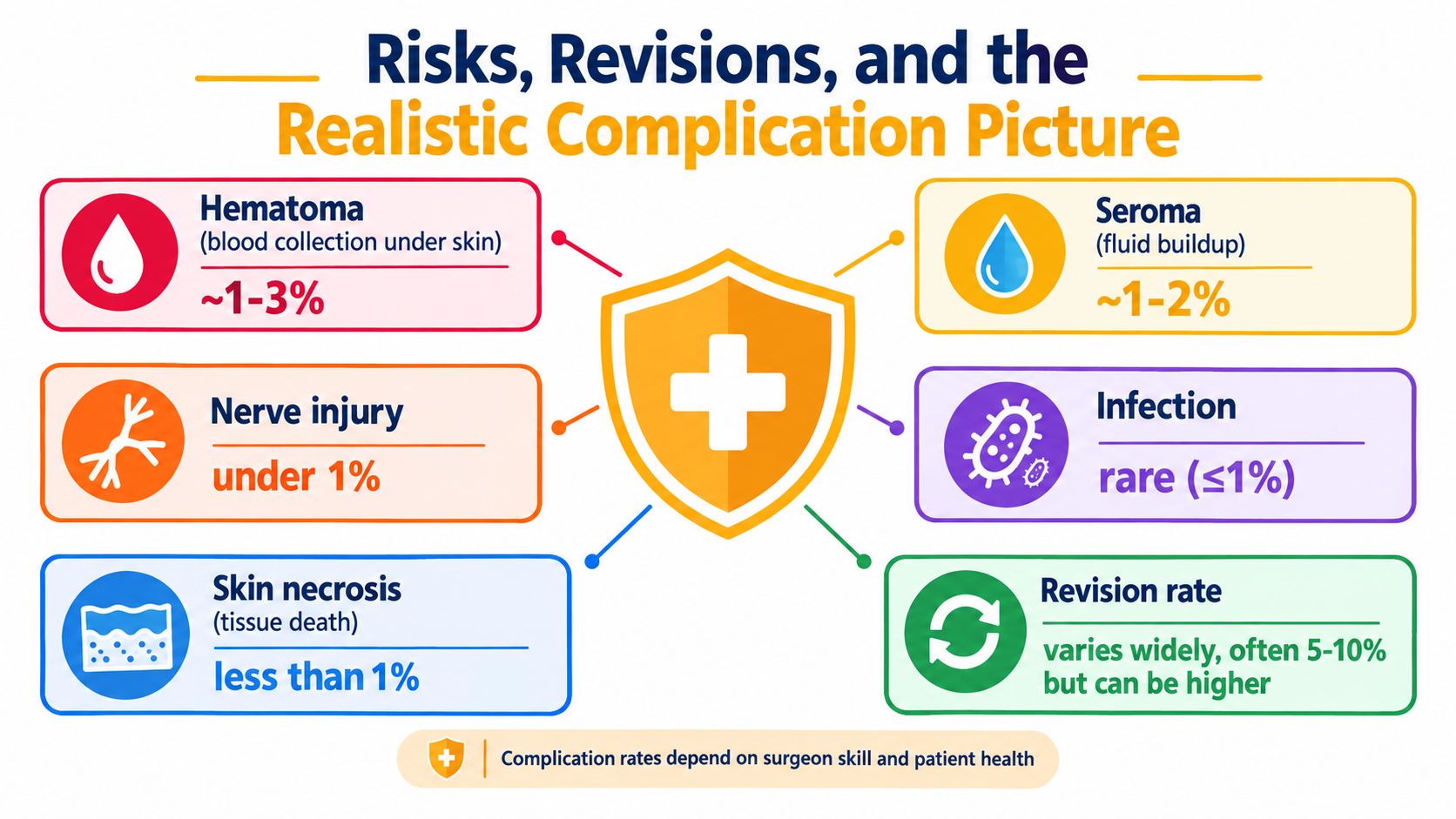
A useful consultation covers both the best-case result and the full spread of outcomes. That includes the smooth recoveries patients hope for, the temporary problems that usually settle, and the smaller group of issues that may need treatment or a second procedure. In facelift surgery, "complication" is a broad bucket. It can refer to a blood collection under the skin, delayed wound healing, temporary weakness in movement, an incision that heals thickly, or a contour that looks slightly off once swelling is gone.
Earlier sections covered how technique can change the look of the result. Risk also follows technique, but not in a simple winner-and-loser way. Published series show a distribution. Some methods may offer more change in a given area of the face, while some may carry lower rates of certain problems. Patients do better when they hear those numbers as probabilities, not promises.
What complication data usually means in practice
The SMAS review discussed earlier reported that temporary facial nerve weakness and skin healing problems were among the more common adverse events in that dataset, and that rates varied by operative method. The practical point is straightforward. A complication rate is not a forecast of your personal outcome. It is a group average drawn from many surgeons, many patient types, and many versions of a technique.
That distinction matters.
For example, temporary facial nerve weakness usually means a branch of the nerve was stretched, irritated, or affected by swelling. In the mirror, that may look like an uneven smile or reduced movement in one area early on. It is different from the permanent, frozen-face image many patients fear.
Skin necrosis sounds alarming because it is. In practice, it often refers to a limited area where blood supply was not strong enough for normal healing, most often near the incision or in skin under tension. Smokers, patients with vascular disease, and patients with thin or stressed skin usually deserve a more cautious discussion here.
What revision usually means
Revision surgery covers several very different situations, and patients are happier when those are separated clearly.
Sometimes revision is small. A scar is widened. An earlobe is pulled and needs correction. One side settles a little differently than the other and needs a contour adjustment. Those cases are closer to fine-tuning than starting over.
Sometimes revision reflects biology rather than error. Scar tissue can mature unpredictably. Swelling can unmask asymmetry that was already present before surgery but was harder to notice. Aging also continues. A face that looked excellent at one year may look ready for another procedure many years later, which is maintenance over time, not failure of the first operation.
A smaller group of revisions follow a true complication, such as a hematoma, skin loss, or an area of persistent distortion. Those are the cases that deserve the most direct discussion before surgery, because they shape the long tail of dissatisfaction far more than minor bruising or temporary tightness.
Warning signs that should prompt a call
Patients should know which problems are expected and which ones need fast attention.
- Rapidly expanding swelling or bruising: This can signal bleeding under the skin.
- A new change in smile or facial movement: Early review helps distinguish swelling from nerve-related weakness.
- Pain that is worsening instead of easing: Sudden, one-sided pain deserves prompt assessment.
- Shortness of breath or calf pain: These symptoms need immediate medical evaluation.
The mirror helps here too. Normal recovery usually changes gradually. Trouble often looks abrupt. One side enlarges over hours. The neck feels tighter instead of looser. A patch of skin turns darker rather than pinker.
The honest complication picture is reassuring and sobering at the same time. Facelift surgery has a high rate of patient satisfaction in properly selected patients, yet high satisfaction does not mean zero risk. A careful patient should leave the consultation knowing both truths at once.
Maintaining Facelift Results With Nonsurgical Treatments
A facelift repositions tissue. It doesn't stop sun damage, erase pigment, shrink pores, or prevent future volume loss. Long-lasting face lift results usually come from pairing the surgery with a maintenance plan that treats the parts surgery cannot reach.
Start with skin quality
The first layer is skincare. Once your surgeon says the incisions are ready, patients often begin a structured routine focused on barrier support, pigment control, and collagen maintenance. That may include prescription-strength or medical-grade products chosen for the individual skin type.
For patients who want a broad overview of ingredients and options that support skin renewal for adults, general educational resources can help them understand categories like antioxidants, moisturizers, and renewal-focused topicals before discussing specifics with their own clinician.
Add movement control and volume only when timing is right
Neuromodulators help with expression lines and platysmal band activity. Fillers or fat-based volume strategies help where deflation remains after the lift. These aren't substitutes for surgery. They are finishing tools.
Here's the practical way to think about them. A facelift improves contour. Injectables refine motion and restore selective fullness. Skin treatments improve surface quality.
Nonsurgical Maintenance Toolkit After a Facelift
| Treatment | When to Start | What It Targets | Result-Extending Effect |
|---|---|---|---|
| Medical-grade skincare | After your surgeon clears the skin for active products | Texture support, tone, daily maintenance | Helps preserve skin quality so the surgical contour looks fresher longer |
| Neuromodulators | After early healing when facial movement treatment is appropriate | Frown lines, neck band activity, dynamic wrinkling | Reduces repetitive creasing that surgery doesn't address |
| Hyaluronic acid filler | After swelling has settled enough to judge true volume needs | Hollow areas, contour refinement, focal volume loss | Restores balance when repositioning alone doesn't replace lost volume |
| Energy-based resurfacing | After incisions are fully mature and your surgeon approves | Texture, fine lines, pigment, pores | Improves surface quality that a facelift cannot change |
| Biostimulatory treatments | When the tissues are fully ready for longer-term collagen-focused care | Gradual collagen remodeling and skin support | May help the face maintain a healthier skin envelope over time |
One option patients often explore in this category is a non-surgical face lift approach, which can include injectables or device-based treatments for maintenance or for people who aren't ready for surgery.
Surgery resets position. Maintenance preserves polish.
Not every treatment belongs in the first postoperative year. The right sequence matters more than doing everything early. The face needs time to declare what surgery has already accomplished before you start correcting details that may disappear on their own as swelling resolves.
Patient Questions About Face Lift Results Answered
Some questions show up in almost every consultation, and they usually have better answers than “it depends.” It does depend, of course, but not in a vague way. It depends on timing, anatomy, and the technique used.
When do I look normal, and when do I look final
Most patients become socially presentable well before they are finished healing. Looking acceptable in photos and looking fully settled are different milestones. Early photos can look good while the deeper tissues are still organizing themselves. Final judgment belongs later, after the face has softened and scars have matured.
A useful way to frame it is this: you'll likely recognize improvement early, but you shouldn't ask the early mirror to deliver the final verdict.
Will I still look like myself
That's the right question. A good facelift changes contour more than identity. You should still look like yourself when you smile, talk, and turn your head. If a patient is hoping for a different face, surgery is the wrong tool. If she wants her face back before descent and heaviness took over, surgery can be a strong one.
How satisfied are patients overall
One study of 53 facelift patients using the FACE-Q found very high satisfaction scores, including 80.7 out of 100 for facial appearance, 90.4 for social confidence, 92.8 for psychological well-being, and 90.5 for satisfaction with the decision to have surgery. Patients in that study also felt they looked an average of 6.9 years younger after the procedure. Satisfaction was strongest for the nasolabial folds, cheeks, and lower face or jawline, while the neck and under-chin area scored lower, according to this FACE-Q facelift outcomes study.
That last point matters. Patients often expect the neck to match the best parts of the facial result exactly. In real life, some areas delight more than others.
What's the fairest way to judge before-and-after photos
Use these filters:
- Look for consistency: Don't focus on one dramatic patient.
- Check movement clues: A natural result should not look rigid or over-tight.
- Compare the neck and jaw together: Harmony matters more than one isolated angle.
- Ask whether the patient still looks recognizable: That's often the best sign of good work.
A facelift can produce beautiful change, but it works best when you want a more rested version of your own face, not an edited one.
If you're weighing surgery against recovery, longevity, and maintenance, Chernoff Cosmetic Surgery offers both surgical facelift care and nonsurgical facial rejuvenation in one practice, which helps patients plan results over years instead of only around the operation itself. To learn more about treatment options, expected recovery, and how your anatomy shapes the result, visit Chernoff Cosmetic Surgery.