
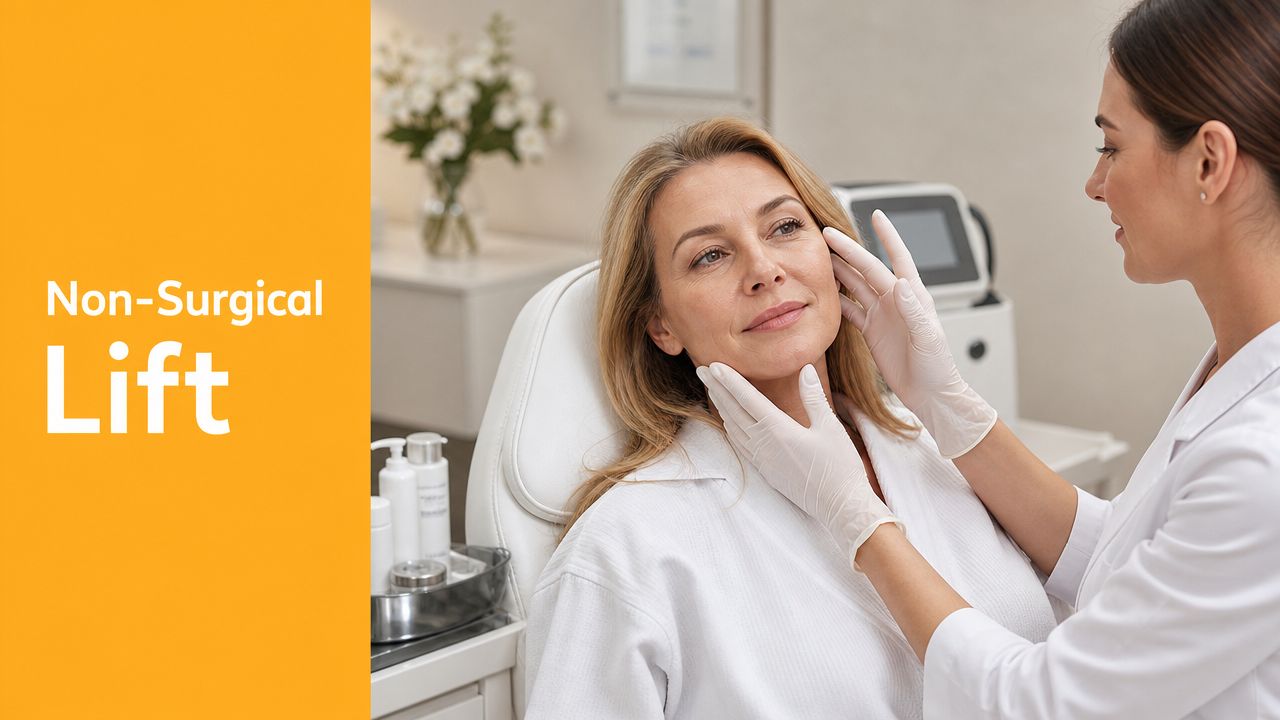
You catch yourself doing it in bright bathroom light or on a work call. You look rested enough, but the face in the mirror seems less supported than it used to. The cheeks look flatter. The jawline isn't as crisp. Makeup settles differently. You may not want surgery, anesthesia, or weeks of recovery, but you also don't want a vague promise of “refreshing” that doesn't address what's changing.
That's where a non-surgical face lift can make sense, if you think of it correctly.
It isn't one treatment. It isn't a shortcut to a surgical facelift either. It's a customized plan that uses different tools to address different layers of facial aging. That distinction matters. When people are disappointed with non-surgical treatment, it's often because they were given a menu instead of a strategy.
This approach has moved well beyond trend status. A report discussed by the American Society of Plastic Surgeons noted about 19.1 million non-surgical cosmetic treatments worldwide in 2023, compared with about 15.8 million surgical procedures, showing how strongly patients have shifted toward minimally invasive options for aesthetic improvement (American Society of Plastic Surgeons overview of non-surgical facelift trends).
Table of Contents
- Introduction The Modern Approach to Facial Rejuvenation
- Understanding the Non-Surgical Face Lift Concept
- The Three Pillars of Non-Surgical Facial Rejuvenation
- Surgical vs Non-Surgical A Candid Comparison
- Your Rejuvenation Journey What to Expect
- Prioritizing Safety and Selecting an Expert Provider
- Frequently Asked Questions and Your Next Steps
Introduction The Modern Approach to Facial Rejuvenation
Many patients start in the same place. They're not looking for a dramatically different face. They want to look less tired, less heavy through the lower face, and more like themselves from a few years ago. They're also wary of overfilled cheeks, frozen expressions, and treatments that chase every line while ignoring the overall structure of the face.
That's why the modern non-surgical face lift works best as a planning exercise, not a product purchase. A thoughtful approach evaluates where support has diminished, where muscle pull is creating etched lines, and where skin quality has changed enough to blunt definition. The answer is rarely a single syringe or a single device.
In practice, the right plan often combines modest steps. One treatment may restore shape. Another may soften expression lines that make the face look tense or tired. A third may improve skin tightness or texture so the surface matches the underlying contour. If you want a practical overview of the range of options available, Chernoff Cosmetic Surgery offers a broad non-surgical treatment overview.
Practical rule: A good non-surgical plan should make your face look more balanced and supported, not simply fuller.
Facial aging is layered. Skin changes are only part of it. Fat pads shift, volume diminishes, muscles keep pulling, and the transition from cheek to jaw becomes less clean. Treating only one of those elements usually produces partial improvement. Treating the right combination is where the art lies.
Understanding the Non-Surgical Face Lift Concept
A non-surgical face lift is often misunderstood because the name suggests one procedure. In reality, it's a combination approach designed to temporarily refresh, firm, or plump the face. Cleveland Clinic notes that this strategy is best suited to patients with mild-to-moderate laxity, because it works by restoring volume and support rather than removing excess skin or repositioning deeper tissues (Cleveland Clinic explanation of non-surgical facelift treatment).
Why one treatment rarely solves the whole problem
Think of the face like a well-designed building.
If the foundation settles, the windows don't line up as cleanly. If internal supports weaken, the exterior can look worn even if the paint is fresh. If the facade loses texture and brightness, the whole structure appears older even when the frame is sound. The face ages in a similar way. Bone support changes, fat compartments lose volume or descend, muscle activity creates repeated creasing, and skin gradually reflects those deeper changes.
That's why a true non-surgical face lift isn't “skin tightening only.” It may include filler for support, toxin for muscular balance, threads for selective lift, and resurfacing or regenerative skin treatments for the surface.
In some patients, skin quality is a significant part of the picture. That's where topical recovery and barrier support can complement in-office care. If you're comparing post-procedure skin support options, this overview of PDRN serum benefits is a useful consumer-friendly reference.
The core goals behind combination planning
A careful plan usually aims to do three things:
- Restore support: Replace strategic volume loss in areas such as the cheeks, temples, or jawline.
- Reduce overactive pull: Relax muscles that deepen frown lines, crow's feet, forehead lines, or downward pull at the lower face.
- Improve envelope quality: Tighten or refine the skin so the facial surface looks smoother and sits better over the underlying structure.
Not every patient needs all three. Some need mostly contour support. Others need skin tightening plus very selective injectable treatment. For patients considering a lifting option with collagen stimulation, PDO thread treatments are one example of how mechanical support can be incorporated into a broader facial plan.
The most natural result usually comes from correcting the dominant cause of aging first, then adding smaller adjustments around it.
That's the difference between a menu-based approach and an anatomical one. A menu says, “What treatment do you want?” A surgeon's assessment asks, “What is your face missing?”
The Three Pillars of Non-Surgical Facial Rejuvenation
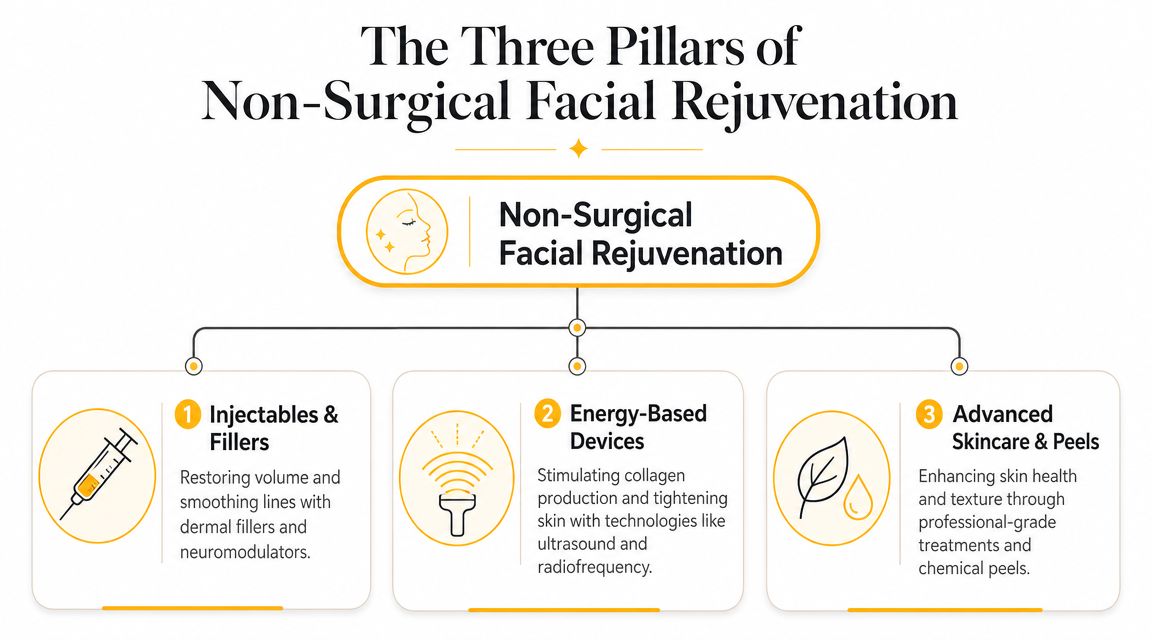
A reliable non-surgical face lift rests on three treatment categories. They don't compete with each other. They solve different problems. The art is knowing when to use one, when to combine two, and when to stop before the face starts looking treated.
Global treatment patterns reflect this reality. Injectables dominate the category. In 2023, there were an estimated 8.8 million botulinum toxin treatments and 5.5 million hyaluronic acid filler treatments worldwide, underscoring how central they are to non-surgical rejuvenation (global non-surgical cosmetic procedure statistics).
Pillar One Volume restoration and contour
Fillers are often the structural component of a non-surgical face lift. Used well, they don't just fill lines. They rebuild support.
When the midface loses volume, the lower face often looks heavier. Patients may point to nasolabial folds or early jowling, but the root issue can sit higher. Strategic filler in the cheek, temple, chin, or jawline can restore proportions and create a lift effect without making the face puffy.
The key is restraint and placement. Overfilling the front of the face is one of the most common mistakes in aesthetic medicine. Better results usually come from supporting the lateral cheek, rebuilding transitions, and respecting natural contours.
Common uses include:
- Cheeks and midface: Recreating support and softening a flattened profile.
- Temples: Restoring harmony to the upper face.
- Jawline and chin: Improving definition and balancing the lower third.
- Perioral area: Softening lines around the mouth when appropriate, but only after overall support is assessed.
Not every line should be filled directly. In many faces, lifting adjacent structure works better than chasing folds themselves.
Pillar Two Muscle relaxation and wrinkle control
Neurotoxins such as BOTOX, Dysport, DAXXIFY, Jeuveau, or XEOMIN serve a different purpose. They don't replace volume. They reduce repeated muscular contraction that etches expression lines and can pull facial features downward over time.
This is why toxin belongs in a non-surgical face lift conversation. It helps rebalance the face. Softening the glabella can make the upper face look less severe. Refining forehead movement can reduce a strained appearance. Selective treatment around the brow, platysma, or lower face can sometimes improve harmony when done with precision.
What it doesn't do is lift loose skin in any meaningful structural way. Patients are often told they need “a little Botox” for sagging. That's incomplete advice. Toxin can refine the result, but it doesn't replace support or skin tightening when those are the actual problem.
A syringe isn't a strategy. If the problem is descent, treating only muscle activity won't rebuild shape.
The same caution applies in reverse. If a patient has strong dynamic lines but good volume, filler won't solve the issue cleanly. The treatment has to match the mechanism.
Pillar Three Tightening texture and structural support
This third pillar includes energy-based devices, resurfacing approaches, and threads. These options are often grouped together in marketing, but they're not interchangeable.
Some devices target skin quality. Some aim for collagen remodeling and modest tightening. Some improve texture more than lift. Some provide a temporary mechanical repositioning effect. A discerning patient should expect that difference to be explained clearly.
For tissue quality and tightening, radiofrequency microneedling is a useful example. Treatments such as Morpheus8 skin remodeling are often used when the goal is to improve skin firmness, texture, and contour support rather than add volume. They're especially helpful in patients whose complaint is less about hollowing and more about crepey skin, early jawline softening, or uneven texture.
Thread lifting occupies a narrower but important role. In thread-based lifting, absorbable sutures are placed through the soft tissue to grasp and suspend selected areas of the face, while the thread material can also stimulate collagen formation. One expert educational source describes thread lifts as a way to restore a more V-shaped facial contour, and reports that Silhouette InstaLift is typically done under local anesthesia in about an hour, with results commonly lasting 12 to 18 months (clinical overview of non-surgical facelift techniques and thread lifts).
That sounds appealing, but the trade-off is important. Threads can create visible improvement in selected patients, particularly those with early laxity who want more lift than filler alone can provide. They do not replace a surgical facelift in patients with heavier tissue descent or significant excess skin.
If you're comparing broader categories of tightening treatments, this consumer guide to Skinsation Aesthetics skin tightening gives a useful overview of how these technologies are commonly discussed outside the surgical consultation room.
What works best in combination
The strongest non-surgical plans usually look something like this:
- Support first: Restore cheek or temple volume if facial architecture has flattened.
- Refine movement second: Add neurotoxin where muscle activity is exaggerating age-related lines or downward pull.
- Tighten or resurface third: Use an energy-based treatment or threads when skin quality or laxity is limiting the final result.
A different patient may need the reverse order. Someone with good volume but poor skin texture may start with resurfacing or RF-based treatment. Another may look refreshed with toxin alone because the dominant issue is muscular overactivity, not structural descent.
That's why the phrase “non-surgical face lift” can be misleading if it sounds like a package. It's closer to a design problem. The face has multiple layers, and the plan only works when the practitioner knows which layer to treat, and which layer to leave alone.
Surgical vs Non-Surgical A Candid Comparison
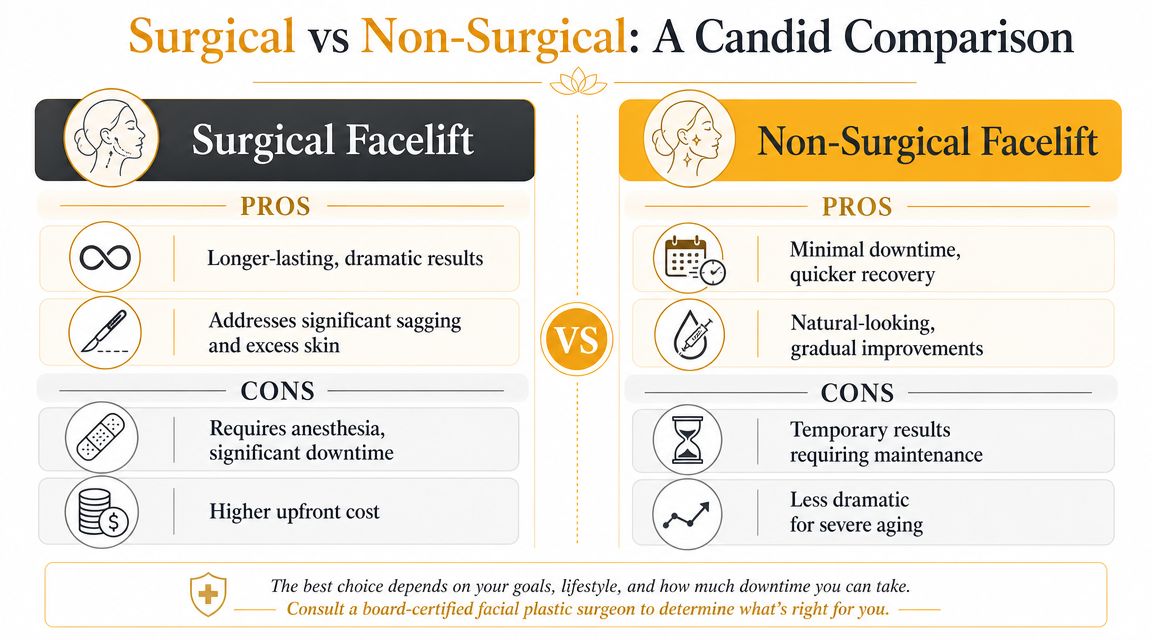
A surgical facelift and a non-surgical face lift are not rival products. They are different tools for different degrees of aging. Problems arise when patients use one while expecting the outcome of the other.
If the concern is early heaviness, mild jowling, volume loss, fine lines, or skin quality, non-surgical treatment can be very effective. If there is substantial tissue descent, redundant skin, or a strong desire for a larger reset, surgery usually provides a cleaner and more durable correction.
Surgical vs. Non-Surgical Facelift at a Glance
| Factor | Non-Surgical Facelift | Surgical Facelift |
|---|---|---|
| Degree of change | Subtle to moderate improvement | Moderate to significant improvement |
| Main mechanism | Volume restoration, wrinkle reduction, skin tightening, selective lift | Repositioning deeper tissues and removing excess skin |
| Downtime | Usually limited, depending on treatment mix | More recovery and aftercare |
| Longevity | Temporary and maintenance-based | Longer-lasting |
| Best fit | Mild-to-moderate laxity and early aging changes | More advanced sagging and structural aging |
| Flexibility | Can be adjusted gradually over time | More definitive reset |
| Cost pattern | Lower entry point but ongoing upkeep | Higher upfront commitment |
What patients often get wrong
Some patients assume surgery will make them look unnatural. That's not inherent to surgery. It depends on planning and technique.
Others assume non-surgical treatment is always the safer or smarter choice. It can be appropriate, but repeated temporary treatments can become inefficient if the problem is really excess skin and deeper descent. There is a point where camouflage stops being elegant.
A candid consultation should address these trade-offs directly:
- If you want minimal downtime: Non-surgical treatment is often the more practical path.
- If you want one major correction: Surgery may align better with your goals.
- If you're unsure: Start by identifying the dominant issue, not the treatment category.
The right choice isn't the least invasive option. It's the option that actually matches the anatomy.
A useful decision lens
Ask three questions.
First, are you trying to refresh or reposition? Refreshing favors non-surgical care. Repositioning points more toward surgery.
Second, is the issue mostly volume loss, dynamic lines, or loose tissue? The answer usually reveals which path is realistic.
Third, how do you feel about maintenance? Non-surgical results can be elegant, but they're temporary by design. If you'd rather not return regularly, a surgical approach may fit your preferences better.
Your Rejuvenation Journey What to Expect
The process feels much less intimidating when you know what the visit looks like. Most non-surgical face lift plans are straightforward. The complexity is in the thinking, not in the patient experience.
Who usually does well
The best candidates usually have mild-to-moderate laxity, some preserved skin elasticity, and realistic expectations. They want improvement, not a completely different face. They're open to maintenance and understand that subtle, layered correction often looks better than aggressive single-session change.
Patients who struggle most are usually seeking a surgical level of lift from non-surgical tools. That expectation gap matters more than age alone.
What happens at the appointment
The first step is a full facial assessment. A good consultation looks at facial balance in motion and at rest, not just isolated wrinkles. Your provider should assess volume loss, asymmetry, skin texture, muscle activity, and how each area contributes to the overall impression of fatigue or heaviness.
On treatment day, the visit depends on the plan. Injectables are generally performed in the office with topical numbing, ice, vibration distraction, or local anesthetic when needed. Energy-based treatments may involve numbing cream or other comfort measures. Thread lifting typically requires local anesthesia.
For a visual walk-through of what a non-surgical rejuvenation discussion can involve, this video is a useful starting point.
Recovery maintenance and follow-up
Recovery varies with the combination used. Some patients return to regular activity quickly. Others have temporary swelling, bruising, tenderness, or mild asymmetry while tissue settles. Thread procedures and energy-based treatments may involve a bit more visible recovery than toxin alone.
Typical aftercare includes a few simple rules:
- Protect the area: Avoid pressure, excessive manipulation, and strenuous activity when instructed.
- Expect some fluctuation: Early swelling can temporarily exaggerate or mask the result.
- Attend follow-up: Small refinements are sometimes part of careful treatment, not a sign something went wrong.
Good outcomes often come from sequencing. One visit may lay the foundation, and a later visit may refine the result after the tissue settles.
Maintenance is part of the bargain. Some elements wear off faster than others, and not every modality needs to be repeated on the same schedule. The plan should be individualized rather than turned into automatic routine treatment.
Prioritizing Safety and Selecting an Expert Provider
A non-surgical face lift may be less invasive than surgery, but it still requires medical judgment. These treatments aren't interchangeable, and they aren't risk-free because they're done in an office.
Common issues include bruising, swelling, tenderness, temporary irregularity, and asymmetry. More serious problems are uncommon, but the reason to choose an experienced injector or surgeon isn't just technical execution. It's diagnostic judgment, patient selection, and the ability to say no when a requested treatment is the wrong choice.
Why expertise matters more with combination plans
Recent reviews of facial aging treatment emphasize that modern rejuvenation is moving toward customized, multi-modality protocols, while the evidence remains uneven across many options. That's one reason patient-facing content can be misleading when it presents fillers, ultrasound, threads, and RF treatments as if they all do the same thing. They don't. The provider has to understand which combinations fit specific aging patterns and which are mostly marketing language (review of combination treatment planning in facial aging).
Experience is evident here.
A knowledgeable provider should be able to explain:
- Why a specific treatment fits your anatomy
- What it won't fix
- What trade-offs come with choosing it
- Whether staging treatment is wiser than doing everything at once
What to look for in a provider
The checklist is practical.
- Board certification: Look for formal surgical training and recognized certification relevant to cosmetic facial treatment.
- Range of tools: A provider with only one device often tries to make every face fit that device.
- Natural aesthetic judgment: You want someone who understands restraint, proportion, and when support is better than volume.
- Follow-up structure: Safe care includes aftercare, reassessment, and a plan for managing expected side effects.
Dr. Greg Chernoff is a triple board-certified surgeon, and that kind of background matters because facial rejuvenation decisions often sit at the intersection of anatomy, aesthetics, and procedural judgment. Even when the treatment is non-surgical, the face deserves a surgical level of respect.
If a consultation feels like product selection instead of diagnosis, keep looking.
The safest and most attractive results usually come from practitioners who are comfortable recommending surgery when surgery is the better answer, and comfortable recommending less when less will do.
Frequently Asked Questions and Your Next Steps
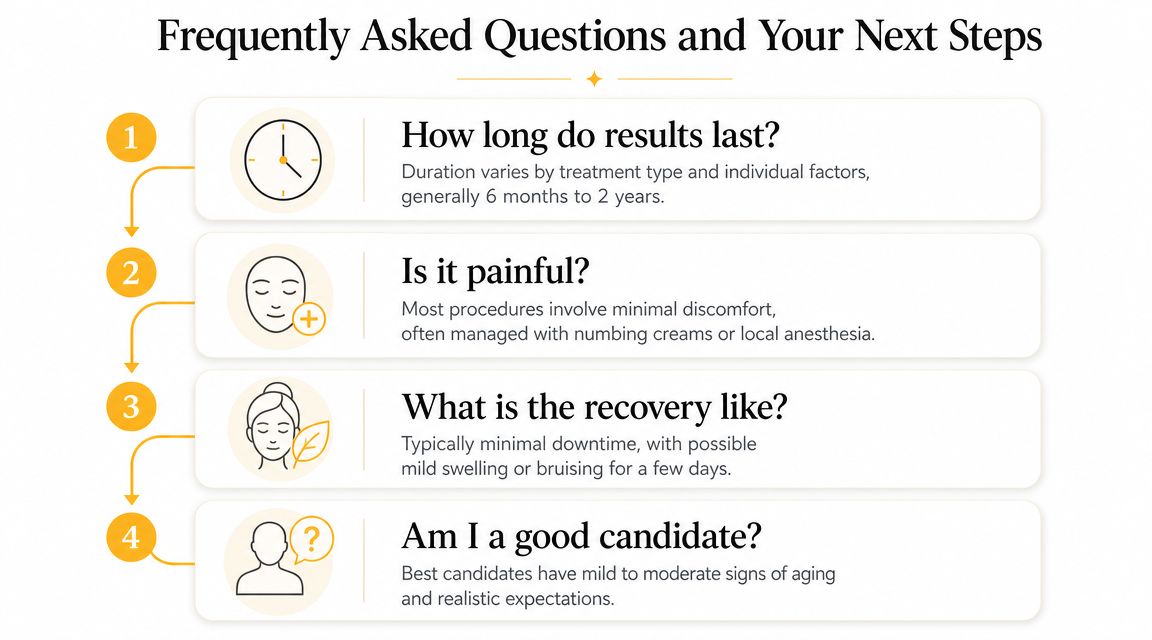
Can a non-surgical face lift fix jowls?
It can improve early jowling, especially when the issue is mild descent, cheek deflation, or skin quality. It won't remove significant excess skin.
How much does it cost?
Cost depends on the treatments used, how many areas are treated, and whether the plan is staged over time. The honest way to price it is after an in-person assessment.
How often do results need maintenance?
That varies by modality and by the way your face ages. Some treatments fade gradually and need periodic upkeep. Others are repeated only when a specific concern returns.
Is it painful?
Most treatments are very tolerable with numbing, ice, local anesthesia, or other comfort measures. You may feel pressure, heat, pinching, or soreness, depending on the procedure.
A good next step is to identify your primary concern before booking anything. If your main issue is flattening through the cheeks, support may matter more than skin tightening. If your concern is etched expression lines, muscle control may matter more than filler. If the complaint is crepey texture and softening along the jawline, a collagen-focused treatment may belong in the plan.
If you're considering a non-surgical face lift and want a treatment plan built around your anatomy rather than a preset package, schedule a consultation with Chernoff Cosmetic Surgery. The goal should be straightforward: identify what's driving the aging changes in your face, choose the right combination of treatments, and keep the result natural.