
Surgical body contouring results can last 10 years or more with stable weight. Non-surgical options such as CoolSculpting have shown durable fat reduction at 6 and 9 years, but the visible result depends heavily on lifestyle maintenance.
So why do some patients still notice changes in their shape after fat cells have been removed or destroyed? The answer is that biological permanence and visible contour longevity aren't the same thing. A procedure may permanently change the treated tissue, while aging, weight fluctuation, skin elasticity, and fat distribution continue to influence what you see in the mirror.
Table of Contents
- Understanding the Two Timelines of Body Contouring
- Surgical Body Contouring Longevity
- Non-Surgical Body Contouring Durability
- Factors That Determine How Long Your Results Last
- What to Expect During the Results Timeline
- Maintenance Strategies to Extend Your Results
- Common Misconceptions About Body Contouring Longevity
- When to Consult a Board-Certified Surgeon
Understanding the Two Timelines of Body Contouring
When patients ask, “How long does body contouring last?” they're usually asking for one date. In practice, I separate the answer into two timelines.
The first is biological permanence. Surgical fat removal takes fat cells out of the body. Cryolipolysis destroys treated fat cells, which don't regenerate. That underlying change can remain for many years.
The second is visible contour retention. Your final appearance also depends on the fat cells that remain, the skin covering the area, your weight, and the way your body changes with age. If remaining fat cells enlarge, the treated area or an untreated area can look fuller even though the removed cells haven't returned.
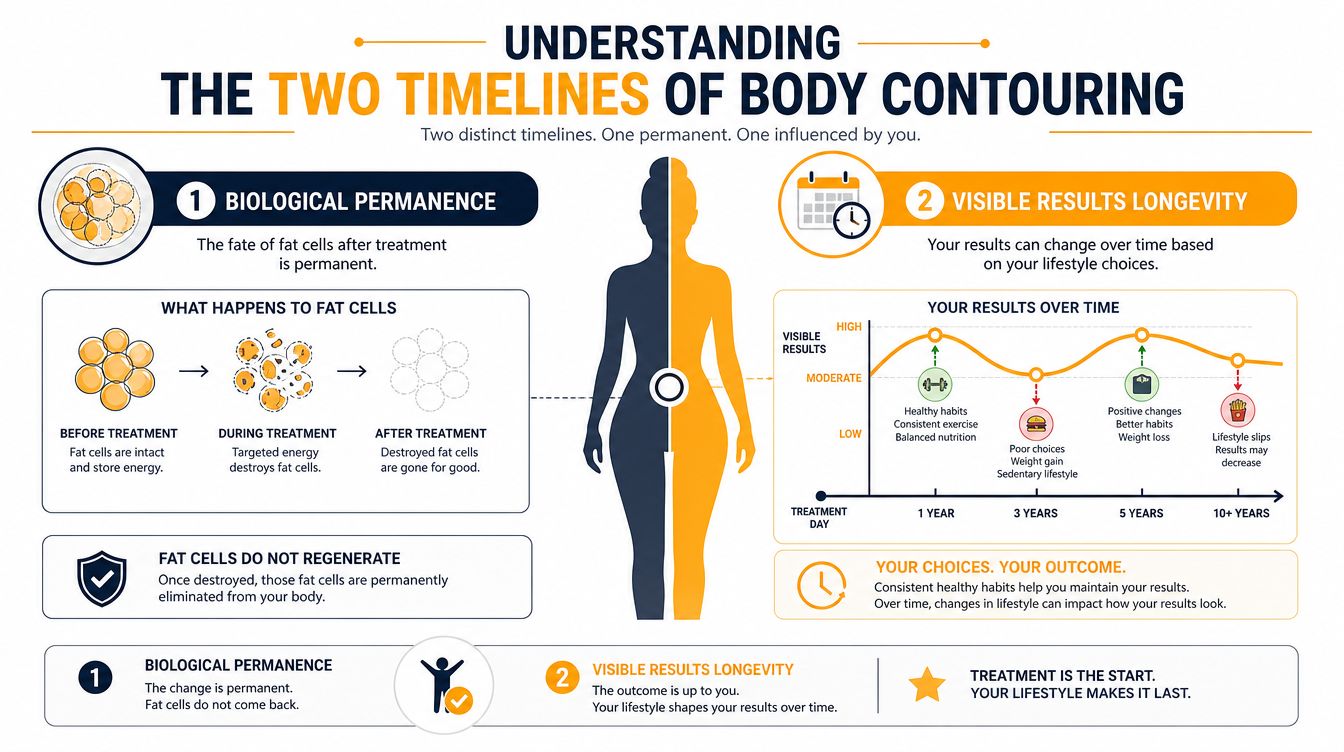
Permanent change versus changing surroundings
Think of fat removal like pruning a tree. The branches you cut away don't grow back in the same form, but the tree continues growing in other directions. Body contouring removes or damages selected fat cells, but it doesn't freeze your metabolism, skin, or future weight.
Long-term follow-up after massive weight loss illustrates the difference. In a cohort of 5,620 patients with 24,604 assessments, those who underwent body contouring maintained improved satisfaction with appearance and health-related quality of life for up to 10 years, while patients without body contouring experienced declines after one to two years. The same literature described mostly moderate to large, sustained improvement across six of seven quality-of-life domains, including physical functioning, appearance, mental well-being, social acceptance, intimacy, and social network. See the long-term body contouring follow-up study for the clinical data.
The practical takeaway is simple: the tissue change may be permanent, but the mirror result remains responsive to your body and your habits.
Surgical Body Contouring Longevity
Surgical procedures create the most substantial and predictable anatomic change because a surgeon can remove fat, excise excess skin, and tighten selected tissues directly. Liposuction removes fat cells from specific areas. A tummy tuck removes excess abdominal skin and may tighten the abdominal wall. A body lift addresses broader tissue excess after major weight loss, while a Brazilian Butt Lift transfers fat to improve proportions rather than reducing volume.
Removed fat cells do not regenerate. The fat cells left elsewhere can enlarge, however, and future weight gain may change the proportions surgery created. Permanent fat-cell removal and lasting mirror results are related, but they follow different timelines.
What surgery changes, and what it cannot
A long-term follow-up study of post-weight-loss body contouring found that improved satisfaction and health-related quality of life remained evident for up to 10 years after surgery. Those findings matter because excess skin after major weight loss often will not resolve through exercise or further weight loss alone. The clinical discussion of body contouring after weight loss explains why skin excision may be appropriate when lax tissue is the main concern.
A distinct surgical issue is scar maturation. Incisions may look firm, red, or uneven during early healing, then soften and fade gradually. The final appearance can take many months to judge, and scars remain permanent even when they become less noticeable. Swelling can also obscure the contour during recovery, so the early mirror result is not the finished result.
Recovery milestones affect how soon results become visible. Walking begins early, while strenuous exercise and heavy lifting usually wait until the surgeon confirms that healing is adequate. After swelling settles, residual skin laxity, asymmetry, or a contour irregularity may become easier to assess. The amount of tissue a surgeon can safely remove is also limited by blood supply, skin quality, and the need to close the incision without excessive tension.
Liposuction reshapes selected areas but does not treat every cause of abdominal fullness. A tummy tuck or body lift may provide a more durable contour when loose skin is the dominant problem, although pregnancy and substantial weight change can alter the abdomen again.
Practical rule: Surgery can permanently remove selected tissue, but stable weight protects the proportions.
The operation lasts, but the body continues to age within it. Skin may loosen gradually, and scars continue to mature long after the initial recovery period.
Non-Surgical Body Contouring Durability
Non-surgical contouring needs more careful interpretation because different technologies produce different tissue effects. Some destroy fat cells. Others tighten skin, stimulate collagen, or create a temporary muscle-toning effect. You shouldn't assume that every device has the same longevity because each is marketed as body contouring.
Cryolipolysis, the technology behind CoolSculpting, is the clearest example of permanent fat-cell destruction without surgery. Treated fat cells are destroyed and don't regenerate. A manufacturer-linked clinical study reported durable results at six and nine years after treatment, including during weight fluctuations. The long-term cryolipolysis follow-up data supports the biological durability, but it doesn't mean every patient will see the same mirror result indefinitely.
Four factors control the visible outcome
The treatment mechanism matters. Permanent destruction of treated fat cells offers a different foundation from a treatment that temporarily contracts tissue or enhances muscle appearance.
The amount of change matters. A review of cryolipolysis found up to a 25% reduction in subcutaneous fat at the treated site after one treatment, with improvements in 86% of treated subjects. Another review reported typical circumference reduction of 2 to 4 cm across a treatment course. These figures come from the review of cryolipolysis outcomes, and they also show why non-surgical results generally have a lower ceiling than surgery.
The result develops gradually. Visible contour improvement is commonly assessed at about 12 weeks, with final results sometimes apparent by about six months, according to the clinical timeline summarized in the long-term follow-up material above.
Weight maintenance still governs the mirror. Untreated fat cells can enlarge with weight gain, changing the overall silhouette even when the treated zone remains improved. For a visual comparison of expectations, review the CoolSculpting before-and-after information.
| Treatment | Fat Reduction | Visible Results Peak | Durability with Stable Weight |
|---|---|---|---|
| Cryolipolysis | Up to 25% at the treated site after one treatment, according to the clinical review | About 12 weeks, with some final results by about six months | Durable fat-cell reduction can remain evident for years, with data reported at six and nine years |
| Skin-tightening energy treatments | Results depend on gradual tissue response rather than a fixed fat-reduction figure | Develops progressively over weeks to months | May require maintenance as skin continues to age |
| Muscle-stimulation treatments | Changes relate primarily to muscle tone and definition | Builds progressively after treatment | Depends on continued activity and any recommended maintenance |
| Multi-session non-surgical plans | Varies by modality and treatment area | Often assessed across several weeks to months | Stable weight preserves the contour, but periodic care may be appropriate |
Factors That Determine How Long Your Results Last
The procedure sets the starting point. Your biology and habits determine how closely your appearance stays to that starting point.
Weight fluctuations
Weight change is the most influential factor patients can usually control. Removing fat cells doesn't remove every fat cell from the body. If the remaining cells enlarge, the treated area's proportions can shift, and untreated areas may become more noticeable.
That doesn't mean a small day-to-day change has erased the procedure. It means substantial or repeated weight changes can alter the overall shape enough to reduce satisfaction.
Natural aging
Skin gradually loses elasticity. Surgery can excise excess skin and create a firmer starting contour, but it can't stop future changes in collagen, tissue support, or gravity. Non-surgical skin tightening can improve mild to moderate laxity, but it also works within the limits of the skin's natural aging process.
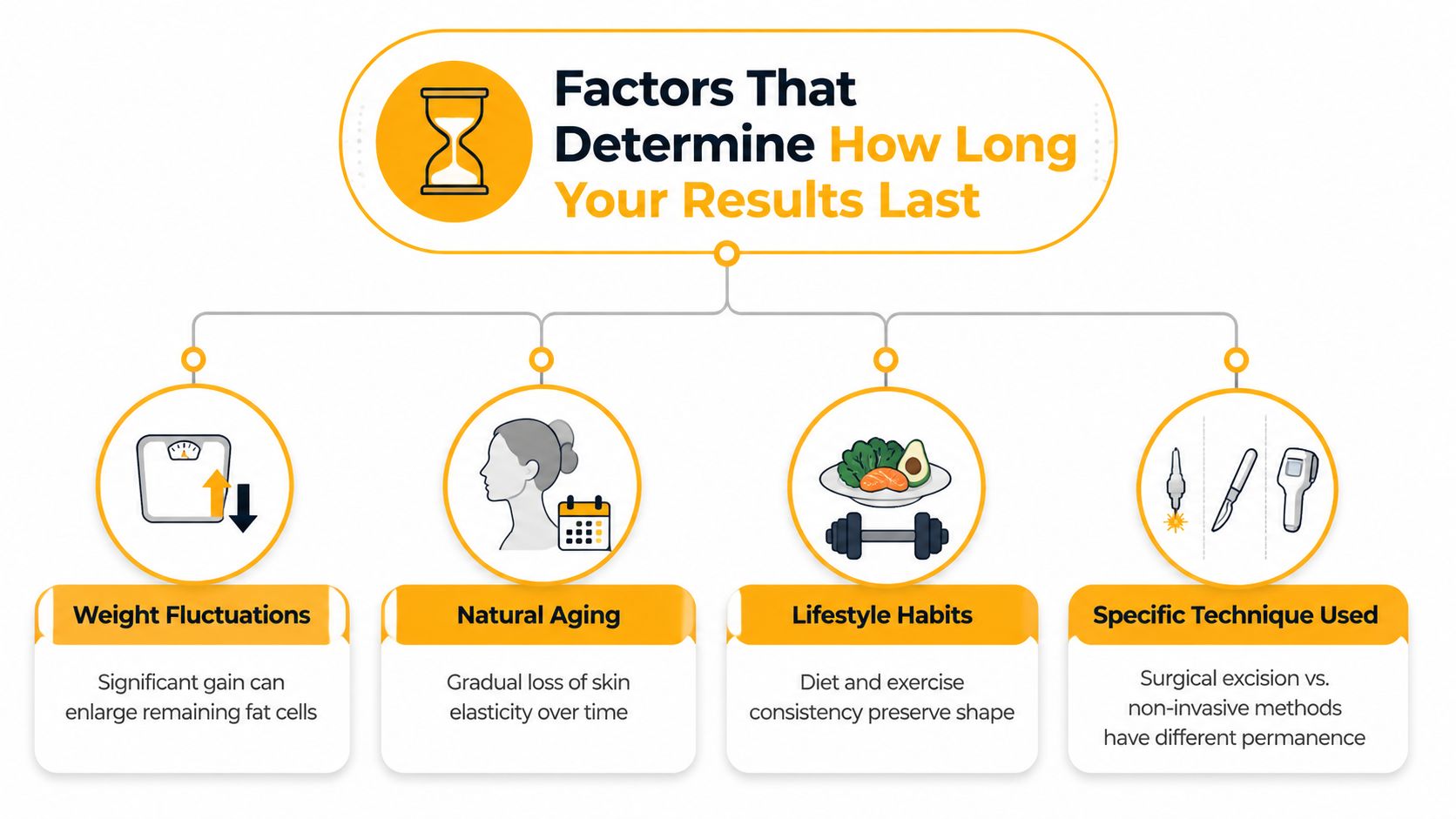
Lifestyle habits
Nutrition and exercise help support a stable body composition, but they're not substitutes for removing excess skin. Smoking can impair tissue quality and healing, while cumulative sun exposure can worsen pigmentation and laxity. These habits matter before and after treatment because skin quality affects how a contour settles and ages.
Technique selection
The technique must match the problem. A patient with a small, localized fat pocket and good skin elasticity may be well suited to non-surgical treatment. A patient with substantial loose skin after weight loss may need surgical excision because energy-based treatment can't remove the same amount of tissue.
The longest-lasting result is usually the one that addresses the actual anatomic problem, not the one with the shortest recovery.
What to Expect During the Results Timeline
Patients often judge the procedure too early. Swelling can obscure a surgical contour, while non-surgical treatment needs time for the body to process damaged fat cells and for tissue changes to develop.
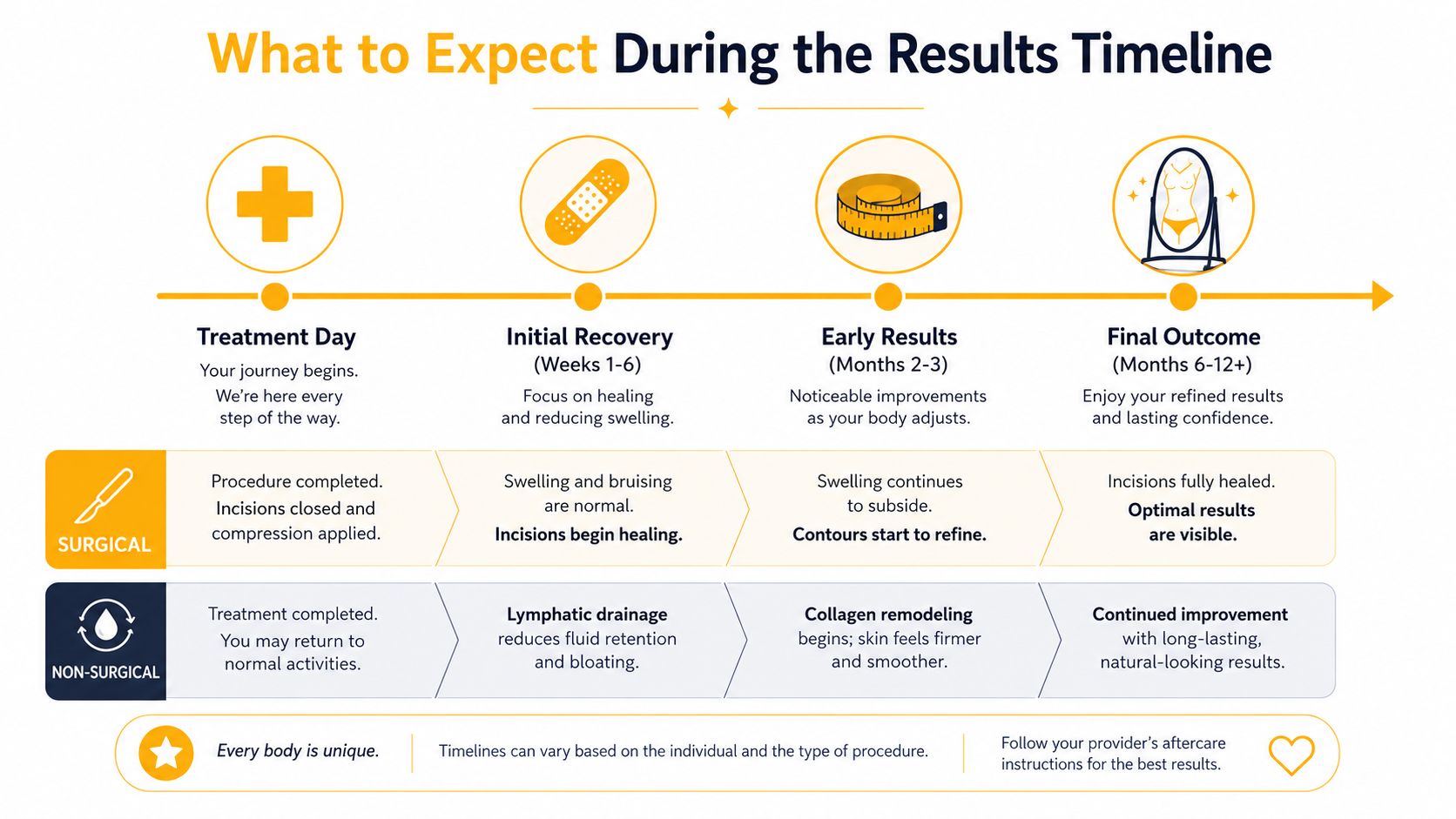
Surgical milestones
On the day of surgery, the contour is present but hidden by swelling, dressings, and normal tissue response. During early recovery, compression garments, activity restrictions, incision care, and scheduled follow-up help protect the repair. Bruising and uneven swelling are common reasons the early appearance doesn't represent the final result.
As swelling subsides, the treated areas become easier to evaluate. Scar maturation, tissue settling, and residual swelling can continue to influence the contour for months, so I advise patients to assess progress through photographs, clothing fit, and follow-up examinations rather than a single early mirror check.
Non-surgical milestones
Non-surgical treatments usually produce a slower visual transition. The body responds to the treatment, clears destroyed fat cells over time, and gradually reveals the contour change. Clinical summaries commonly assess visible cryolipolysis improvement at about 12 weeks, and some patients may see final results by about six months, as described in the long-term cryolipolysis clinical material.
Maintenance isn't an afterthought. Stable weight, sensible activity, and follow-up allow the provider to distinguish a normal gradual response from a result that needs additional treatment. Contact your provider if pain, swelling, skin changes, or asymmetry is unexpected or worsening rather than steadily improving.
Maintenance Strategies to Extend Your Results
The common assumption is that permanent fat-cell destruction means permanent appearance. It doesn't. Permanent cell loss and permanent visual proportions are different promises, so maintenance should be part of the treatment plan from the consultation onward.
Build a practical routine
- Maintain a stable weight: Avoid the large fluctuations that can enlarge remaining fat cells and alter the contour.
- Use exercise strategically: Combine regular cardiovascular activity with resistance training to support muscle tone and body composition.
- Prioritize nutrient-dense meals: Adequate protein, produce, and overall nutritional quality support general tissue health.
- Protect your skin: Sun protection and consistent skincare help reduce avoidable damage to the skin that covers your new contour.
- Keep follow-up appointments: A clinician can assess changes early and determine whether observation, lifestyle support, or a touch-up makes sense.
Weight management deserves individual planning, especially after major weight loss or when repeated weight cycling has affected your shape. Chernoff Cosmetic Surgery provides wellness and weight management support as part of a broader approach to maintaining health and appearance.
Watch for gradual changes rather than waiting for a dramatic reversal. Clothing fit, photographs taken under similar conditions, and a professional assessment can reveal whether the change comes from weight, skin laxity, or a new untreated area.
Common Misconceptions About Body Contouring Longevity
Could body contouring change your shape without changing your weight? Could the mirror change again even after fat cells are permanently removed? These questions expose the difference between a biological change and a result that remains visually stable.
“Body contouring will lower my weight”
Body contouring is designed to reshape selected areas, not treat obesity or produce predictable weight loss. A patient may notice a better waistline while the scale changes little. Judge the procedure by proportion, clothing fit, and the treated contour rather than by a target weight.
“The fat comes back worse”
Treated fat cells do not regenerate after they are removed or destroyed. Remaining cells can enlarge with weight gain, and untreated areas may become more noticeable as proportions change. That pattern reflects expansion and redistribution, not the return of the original cells.
Aging can create the same impression. Skin gradually loses elasticity, muscle tone may change, and ordinary weight fluctuations can soften a contour. Those changes may look like procedural relapse even when the treatment has retained its biological effect.
“Non-surgical equals surgical”
Non-surgical treatment may provide durable localized fat reduction when it destroys fat cells, but the change is usually smaller and develops more gradually than a surgical procedure. Surgery is generally better suited to substantial excess skin or a larger anatomic correction. Choosing between them requires matching the treatment to the tissue causing the concern.
“Permanent means maintenance is unnecessary”
Permanent fat-cell destruction does not guarantee an unchanged appearance. Long-term follow-up after weight loss has documented sustained improvement for up to 10 years, yet aging and future weight changes can still alter the visible result. Ask what the procedure changes, what it cannot correct, when the contour should mature, and which future changes may require reassessment.
When to Consult a Board-Certified Surgeon
A consultation is appropriate when you can describe the problem clearly but aren't sure which treatment can solve it. Localized fat with relatively firm skin may point toward a non-surgical option. Excess skin, significant laxity, or a contour altered by major weight loss may require surgical planning. A surgeon should evaluate the tissue, not recommend the newest device.
During consultation, expect a review of your medical history, previous weight changes, medications, smoking status, pregnancies or planned pregnancies, and your goals. The physical examination should assess fat distribution, skin elasticity, scars, muscle separation when relevant, and whether the area you want treated is the source of the concern.
Bring direct questions:
- Which tissue is causing the problem, fat, skin, muscle, or a combination?
- Will the treatment remove fat cells, destroy them, tighten skin, or temporarily improve muscle definition?
- When should I expect early and final results?
- What happens if my weight changes?
- Will I need staged treatment or future maintenance?
- What risks, scars, recovery limits, and follow-up appointments should I plan for?
A board-certified surgeon should also explain when not to treat. If your weight is still changing, if pregnancy is planned, or if your expectations depend on weight loss from the procedure, postponement or a different plan may be safer and more satisfying. At Chernoff Cosmetic Surgery, Dr. Gregory Chernoff and the clinical team can assess whether surgical body contouring, non-surgical treatment, or weight-management support best fits your anatomy and goals.
Chernoff Cosmetic Surgery offers individualized surgical and non-surgical body contouring consultations, including options for localized fat, excess skin, and post-weight-loss contour changes. Visit Chernoff Cosmetic Surgery to discuss a realistic timeline, expected longevity, and the maintenance plan that will protect your result.