

You notice the horizontal lines first in an unflattering video call or bright bathroom light. They may disappear when your face is relaxed, or they may remain etched across your forehead even when you aren't raising your eyebrows. That difference matters, because forehead wrinkles aren't just a surface-level skin problem. They reflect the interaction between muscle movement, sun exposure, collagen quality, brow position, and the way your upper face is designed to move.
The most reliable answer to how to get rid of forehead wrinkles starts with identifying what created them. A cream may improve texture and protect collagen, but it can't fully neutralize a repeatedly contracting frontalis muscle. A neurotoxin may soften movement-driven lines, but it won't correct severely sun-damaged skin or a low brow. The right plan treats the cause, not merely the most visible symptom.
Table of Contents
- Why Forehead Wrinkles Form in the First Place
- Prevention and At-Home Habits That Actually Move the Needle
- Non-Surgical In-Office Treatments Worth Considering
- How Neurotoxins Like BOTOX Are Used on the Forehead
- When Surgery and Energy Devices Become the Better Answer
- Matching the Right Treatment to Your Wrinkle Pattern and Budget
- Choosing a Specialist and Building a Long-Term Plan
Why Forehead Wrinkles Form in the First Place
A forehead line that appears only when you raise your eyebrows behaves differently from one that remains visible while your face is relaxed. That distinction determines whether the main target should be muscle movement, skin quality, brow position, or a combination of these factors.
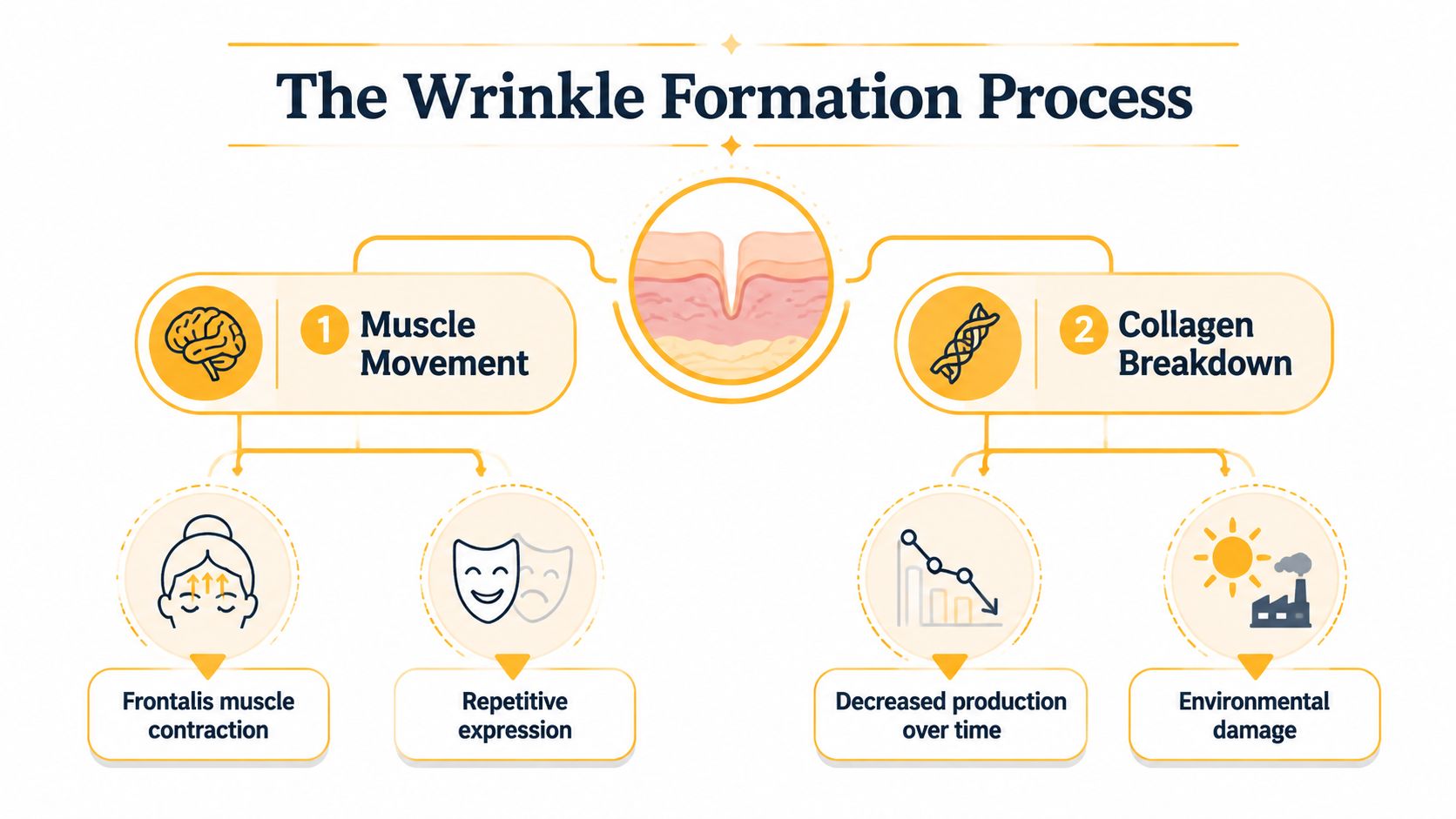
The frontalis muscle lifts the eyebrows and creates horizontal forehead folds. It contracts when you look surprised, concentrate, raise your brows, or compensate for brows that sit lower than you prefer. Younger skin usually springs back after each movement. Over time, repeated folding can leave creases that remain after the expression ends. This muscle-balance issue explains why a one-size-fits-all wrinkle cream list often underperforms.
Sun exposure creates a second pathway. Ultraviolet radiation breaks down collagen and elastin, the structural proteins that help skin stay firm and resilient. A large dermatology review on photoaging estimated that UV exposure accounts for about 80% of visible facial aging signs. The same research reported a marked exposure-response gradient, with wrinkle prevalence around 10% among people reporting less than 30 minutes of daily sun exposure and around 80% among those reporting more than two hours (cross-sectional study on sun exposure and wrinkles). These figures do not predict an individual result, but they clarify why sun protection belongs in any forehead strategy.
Dynamic lines versus static lines
Use a simple mirror test. Relax your forehead, keep your eyes open without lifting your brows, and check your face under even lighting.
- Dynamic wrinkles appear mainly during movement. Muscle activity is likely the dominant cause.
- Static wrinkles remain visible at rest. The skin has developed a more established crease, often with collagen loss and environmental damage.
- Mixed wrinkles are present at rest but deepen substantially with expression. They usually need both skin-quality treatment and movement control.
Stress, habitual squinting, dehydration, and sleep-related compression can make lines look stronger, but each factor responds differently. Genetics, skin thickness, pigment, and facial anatomy also influence when wrinkles become visible. Your forehead cannot be assessed accurately by comparing it with someone else's.
Practical rule: A line that disappears completely with relaxation points toward movement control and skin protection. A line that remains visible usually needs a layered plan rather than a single cream or injection.
Prevention and At-Home Habits That Actually Move the Needle
A disciplined home routine won't erase an etched forehead line, but it can slow progression and improve the surface that every professional treatment must work with. The priority is consistency, not a crowded shelf.
Build the routine around protection
Apply a broad-spectrum sunscreen every morning to the forehead, hairline, temples, and ears. Reapply when you're spending extended time outdoors, sweating, or swimming. Shade, hats, and protective clothing add useful physical protection, especially because many people under-apply sunscreen around the hairline.
A retinoid may help support collagen remodeling and improve texture, but irritation can undermine adherence. Introduce it gradually, use moisturizer strategically, and pause if your skin becomes persistently inflamed. Peptides and antioxidant products can complement that routine, yet they shouldn't displace sunscreen or a well-tolerated moisturizer.
For product selection, use a focused skin-care products resource to compare options by skin type and treatment goal rather than buying several active ingredients at once.
Choose two habits first
Start with sunscreen and a moisturizer that keeps your barrier comfortable. Once those are stable, add one collagen-supporting active and give it time before deciding whether it works. The forehead often looks smoother when the skin is hydrated, but hydration temporarily improves light reflection and softness. It doesn't stop frontalis contraction or rebuild a deep crease by itself.
Sleep posture deserves a realistic approach. Side or stomach sleeping can repeatedly compress facial skin, but changing position may be difficult. A supportive pillow arrangement and a smooth pillowcase may reduce friction and pressure, though neither replaces muscle treatment for expression lines.
Skip aggressive facial exercises that repeatedly raise the eyebrows. Training the frontalis more forcefully can increase the movement responsible for horizontal creasing. Gentle relaxation, stress management, and avoiding habitual brow lifting are more sensible than resistance exercises for this particular area.
Non-Surgical In-Office Treatments Worth Considering
The best non-surgical treatment depends on whether the main problem is movement, skin texture, pigment, or laxity. Clinics often offer several technologies, but a larger menu doesn't automatically produce a better plan. The clinician should first identify the dominant mechanism and then choose the least aggressive tool that can address it.
| Treatment | Best For | Typical Result Duration | Downtime |
|---|---|---|---|
| Neurotoxin injections | Dynamic forehead lines caused by frontalis activity | Temporary, with maintenance required as muscle activity returns | Usually minimal |
| Dermal filler | Selected static depressions or volume-related contour changes | Temporary and dependent on product, placement, and metabolism | Usually minimal, with possible swelling or bruising |
| RF microneedling | Texture, mild laxity, and collagen remodeling | Gradual improvement that may require maintenance | Mild to moderate short-term redness |
| Fractional laser | Sun damage, texture, and established surface lines | Longer-lasting skin improvement with ongoing aging and sun exposure | Varies by treatment intensity |
| CO2 laser resurfacing | More pronounced textural damage and static lines | Durable resurfacing benefit, not permanent prevention | Meaningful recovery |
| IPL | Selected pigment and redness concerns associated with photoaging | Maintenance may be needed | Usually limited |
| Chemical peels | Surface texture and tone | Temporary to progressive improvement depending on peel | Ranges from minimal to several days |
| PDO threads | Selected laxity concerns | Temporary lifting effect with variable longevity | Swelling and bruising are possible |
Neurotoxins are usually the most direct option for dynamic horizontal lines because they reduce the muscle contraction that creates the fold. A filler can soften a static depression in carefully selected patients, but injecting forehead lines requires particular caution because the region contains important vessels and has limited margin for error. Filler isn't a universal substitute for a neurotoxin.
Energy-based treatments work differently. RF microneedling and fractional lasers encourage dermal remodeling, so they make more sense when lines remain visible at rest because skin quality has deteriorated. IPL and peels address selected surface concerns, not the mechanical source of a moving forehead line. PDO threads may help with carefully selected laxity, but they don't directly correct frontalis overactivity.
Combination treatment often makes more sense than forcing one modality to do everything. For example, controlled muscle activity may be paired with resurfacing for a mixed pattern. Patients researching a clinic's operational standards may also find this resource on a HIPAA-compliant website for med spas useful when evaluating how a practice handles patient information and digital communication.
How Neurotoxins Like BOTOX Are Used on the Forehead
You may notice horizontal lines when you raise your brows, then see them remain faintly visible at rest. That pattern reflects both skin change and repeated frontalis activity. Neurotoxins address the muscle component directly by temporarily reducing communication between nerves and selected muscles. The aim is controlled relaxation, not a motionless forehead.
Several botulinum toxin A formulations are used in clinical practice, including BOTOX, Dysport, DAXXIFY, Jeuveau, and XEOMIN. They differ in formulation, handling, and sometimes perceived onset or duration. Injection strategy matters more than brand loyalty. A sound plan considers muscle strength, brow position, asymmetry, and the way your upper face moves during expression.
Why brow balance is the central issue
The frontalis lifts the brows. Weakening it too aggressively can make the brow descend, especially when the brow or upper eyelid already sits low. The glabellar muscles pull the brows downward, so upper-face treatment requires coordination between opposing muscle groups rather than placing product into every visible line.
A multicenter randomized trial found that the 40-unit group had responder rates of 91.2% by investigator assessment and 89.5% by subject assessment, compared with 1.7% and 5.1% for placebo (randomized forehead-line trial). The 30-unit group also outperformed placebo, while the 40-unit dose showed a trend toward longer benefit. Adverse events in that study were generally mild to moderate, with nasopharyngitis and headache among the more common findings.
Those results support neurotoxins for dynamic forehead lines, not a universal dosing formula. Guidance on forehead technique emphasizes individualized dosing, conservative frontalis placement, and appropriate coordination with the glabella to reduce the risk of brow ptosis (forehead injection technique guidance).

What a good result should look like
A good result softens lines while preserving recognizable expression. You should still look like yourself when raising your brows, smiling, or concentrating. Reassessment after the product takes effect can identify asymmetry, residual movement, or an unexpectedly heavy brow. Some findings call for observation, while others may justify a measured adjustment.
Maintenance is part of treatment planning. Muscle activity gradually returns as the neuromuscular effect fades, so repeat sessions are generally needed. An optimized protocol study prioritized placement and brow preservation over increasing volume, and reported no significant change in brow height in its clinical series (optimized forehead injection protocol).
Repeated treatment also deserves a candid discussion. A recent review examines sustained benefit across consecutive treatments while noting unresolved questions about immunogenicity and long-term outcomes (recent review of long-term botulinum toxin use). Before scheduling, review the proposed pattern, timing, and BOTOX cost information with the practice. Ask specifically how the injector will preserve brow support in your anatomy.
When Surgery and Energy Devices Become the Better Answer
A forehead can look wrinkled because the skin is damaged, because the brow has descended, or because both problems exist together. A brow lift addresses brow position and, in selected cases, reduces the need for the frontalis to work constantly to keep the brows raised. It doesn't replace resurfacing when the skin itself has deep textural damage.
Separate skin laxity from skin quality
Look at your brow position in a neutral expression. If the brow sits low, the upper eyelid feels heavy, or you unconsciously lift your brows to see comfortably, brow descent may be contributing to the lines. A surgical consultation can evaluate whether an endoscopic or other brow-lift approach fits your anatomy. The objective should be a balanced upper face, not an artificially high brow.
If the brow position is appropriate but the skin remains crepey, rough, or etched, resurfacing may be more relevant. Fractional laser treatments and CO2 resurfacing can improve texture and stimulate remodeling, with recovery increasing as treatment intensity increases. RF microneedling offers a different balance, often targeting texture and mild laxity with less surface disruption but potentially requiring a series or maintenance.
No surgical result stops chronological aging or sun exposure. Likewise, no energy device permanently prevents new lines. A layered plan may combine brow repositioning with later skin resurfacing, or use conservative neurotoxin treatment to reduce repetitive folding after the structural issue has been addressed.

Set expectations before choosing the procedure
Surgery involves incisions, anesthesia considerations, swelling, bruising, and a recovery period. Energy treatments involve their own downtime, pigment risks, and the possibility of needing multiple visits. Costs vary by provider, anesthesia, geographic location, technique, and whether several areas are treated, so a responsible consultation should produce a written estimate rather than a generic online promise.
A useful discussion of CO2 laser treatment for wrinkles can help you understand why resurfacing is a skin-quality procedure, not a substitute for correcting brow descent. The most appropriate recommendation may be no procedure yet, a staged non-surgical plan, or surgery followed by maintenance. That decision should follow examination, not a promotional package.
Matching the Right Treatment to Your Wrinkle Pattern and Budget
Start with the mirror, not the treatment menu. Raise your eyebrows, relax them, and observe whether the lines vanish, soften, or stay firmly visible. Then look at your brows and upper eyelids without lifting your forehead. This separates a muscle-dominant concern from a mixed problem involving skin quality or brow position.
| Forehead Line Pattern | Recommended Starting Treatment | Average Annual Maintenance | When to Reassess |
|---|---|---|---|
| Early dynamic lines | Sunscreen, skin care, and conservative neurotoxin consultation | Varies by treatment frequency and provider pricing | After the initial treatment response and follow-up |
| Moderate mixed lines | Neurotoxin with a skin-quality plan such as laser or RF microneedling | Varies according to the combination plan | After healing and documented response |
| Deep static lines | Specialist evaluation for resurfacing, selected filler use, or surgery when brow descent contributes | Varies substantially by procedure and maintenance needs | After the primary treatment has fully settled |
The table intentionally avoids a false universal price. Annual maintenance depends on anatomy, dose, treatment intervals, the number of areas addressed, and whether you choose devices or surgery. A clinic that quotes one number without examining your forehead isn't giving you a meaningful plan.
Use a staged decision
For dynamic-only lines, begin conservatively. Build sun protection and skin tolerance first, then discuss a neurotoxin strategy that preserves brow movement. For mixed lines, expect the muscle and the skin to need separate treatment. Relaxing the frontalis can prevent further folding, while resurfacing or collagen-focused treatment addresses the crease that already remains.
For deep static lines, ask whether the line is a groove, a texture problem, a volume issue, or a consequence of brow compensation. Don't request filler just because a line is visible. Ask the clinician to explain why that product belongs in that location and what the vascular and asymmetry risks are.
Bring three questions to your consultation:
- What is driving my lines? Ask whether the dominant cause is frontalis activity, photoaging, laxity, brow descent, or a combination.
- What will you leave untreated? Conservative providers should explain what they won't inject or resurface and why.
- What is the maintenance plan? Request the expected sequence, follow-up timing, downtime, and likely future treatments in writing.
Choosing a Specialist and Building a Long-Term Plan
Forehead rejuvenation rewards restraint. The clinician needs to understand facial movement, brow support, eyelid anatomy, skin quality, and the interaction between upper-face structures. Look for board certification relevant to facial aesthetics, substantial before-and-after experience with upper-face treatment, clear consent discussions, and follow-up that includes assessment of brow position rather than only wrinkle depth.
What to evaluate during the consultation
A strong consultation should include photographs or direct observation at rest and during expression. The provider should ask what you want to preserve, whether you already compensate with your forehead, and whether you have experienced heaviness or asymmetry after previous injections.
Be cautious if a practice:
- Promises permanent correction from a temporary treatment.
- Uses one standard dose without discussing brow anatomy or muscle strength.
- Pushes a package immediately before examining your face.
- Avoids discussing complications, recovery, or what happens if you dislike the result.
- Treats every forehead line with filler without explaining why a safer alternative isn't appropriate.
The best upper-face plan often includes a treatment the patient doesn't need yet.
Think in stages. Daily sun protection and tolerable skin care protect the investment. Neurotoxin controls dynamic folding. Energy devices improve surface quality when appropriate. Surgery enters the conversation when brow position or laxity becomes the structural problem. A clinical series and optimized protocol review found meaningful wrinkle reduction without significant brow-height change and emphasized technique, symmetry checks, and maintenance rather than using more toxin (forehead protocol evidence).
Common questions after treatment
How soon will I know whether the plan worked? Early changes can appear progressively, while the final assessment should wait until the treatment has settled and the clinician has reviewed movement and brow position.
What if my brows feel heavy? Contact the treating provider rather than trying to correct the issue elsewhere. The clinician can assess whether the heaviness reflects dose, placement, pre-existing brow descent, or another upper-face factor.
Should I keep treating indefinitely? Not automatically. Reassess your goals, anatomy, skin health, and tolerance over time. A pause or change in modality may be sensible if the benefit no longer justifies the cost, downtime, or risk.
Chernoff Cosmetic Surgery offers individualized upper-face planning with neurotoxins, lasers, RF microneedling, skin care, and surgical brow-lift evaluation, depending on the patient's anatomy and goals. Visit Chernoff Cosmetic Surgery to request a consultation focused on the cause of your forehead lines and a maintenance plan that preserves natural expression.