
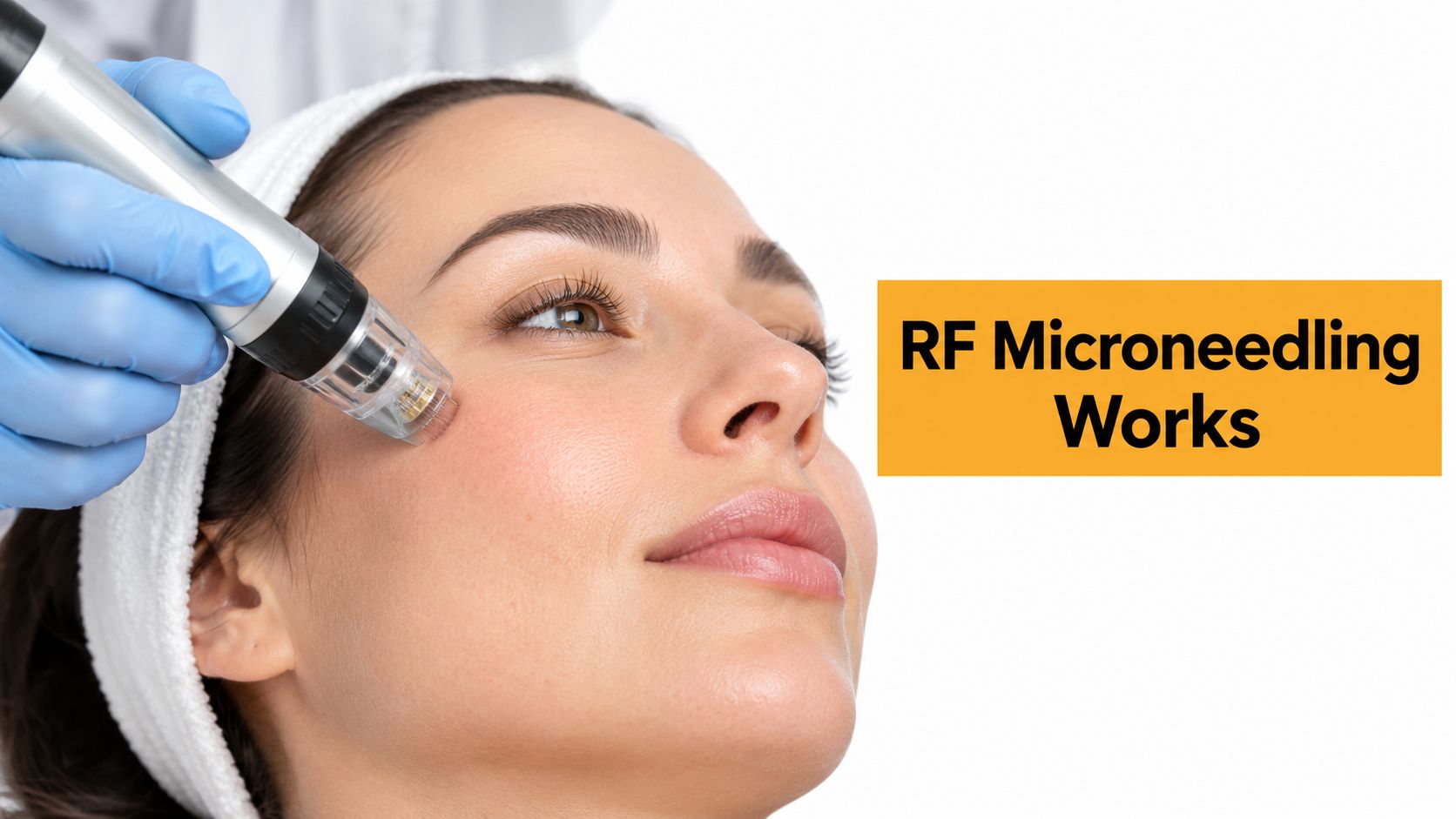
What happens beneath the skin when RF microneedling improves texture or firmness? The answer is not that "needles stimulate collagen." Two different actions occur together: controlled mechanical punctures and radiofrequency heat delivered at selected depths. Understanding the difference helps you judge realistic results, ask better questions, and recognize why treatment settings matter as much as the device name.
Table of Contents
- Why the Question Is More Complicated Than It Sounds
- The Two Mechanisms Behind RF Microneedling
- How Treatment Parameters Shape What Happens Under the Skin
- A Look Inside Popular Devices Like Morpheus8 and INTRAcel
- What the Research Shows About Real Results
- What to Expect Before, During, and After a Session
- The Risks Most Articles Glide Past
- How RF Microneedling Compares to Other Rejuvenation Options
Why the Question Is More Complicated Than It Sounds
What happens when RF microneedling improves texture or firmness? A simple answer might be: tiny needles enter the skin, collagen increases, and the face looks tighter. That description misses the feature that separates RF microneedling from conventional microneedling. The needles also deliver electrical energy into the dermis, so the treatment combines controlled punctures with heat placed beneath the surface.
The needle is the road and the heat is the cargo. The needle creates a controlled path to a chosen layer, while radiofrequency energy travels through the electrode until tissue resistance converts it into heat. The clinician can adjust the depth of that path, the amount of energy delivered, and the time the tissue remains heated.
The patient question behind the question
Two people may have similar-looking fine lines but need different treatment settings. One may benefit from a relatively superficial approach aimed at texture. Another may have thicker skin, acne-scar depressions, or mild laxity that calls for a different depth and energy pattern. The same branded handpiece does not make those treatments equivalent.
A useful consultation therefore goes beyond asking, “What device do you use?” Ask:
- How deep will the needles go?
- Where will the RF energy be released?
- How much power and pulse time will be used?
- How will settings change across thinner and thicker areas?
- What tissue is the treatment intended to affect, and what tissue must be protected?
These choices involve a depth and risk tradeoff. Greater depth may address tissue farther below the surface, but it also places more demands on accurate technique and protection of surrounding structures. A superficial setting may produce less downtime while targeting a different concern.
The biology also points to gradual change rather than an instant facelift. Heat can contract existing collagen, while the later healing response activates fibroblasts and encourages new collagen and elastin formation. Visible improvement depends on creating enough controlled injury to stimulate remodeling without causing excessive damage to healthy tissue.
A careful provider treats RF microneedling as an adjustable medical procedure, not a fixed spa protocol. The machine's name matters less than whether the chosen parameters match your skin, anatomy, concern, and tolerance for downtime.
The Two Mechanisms Behind RF Microneedling
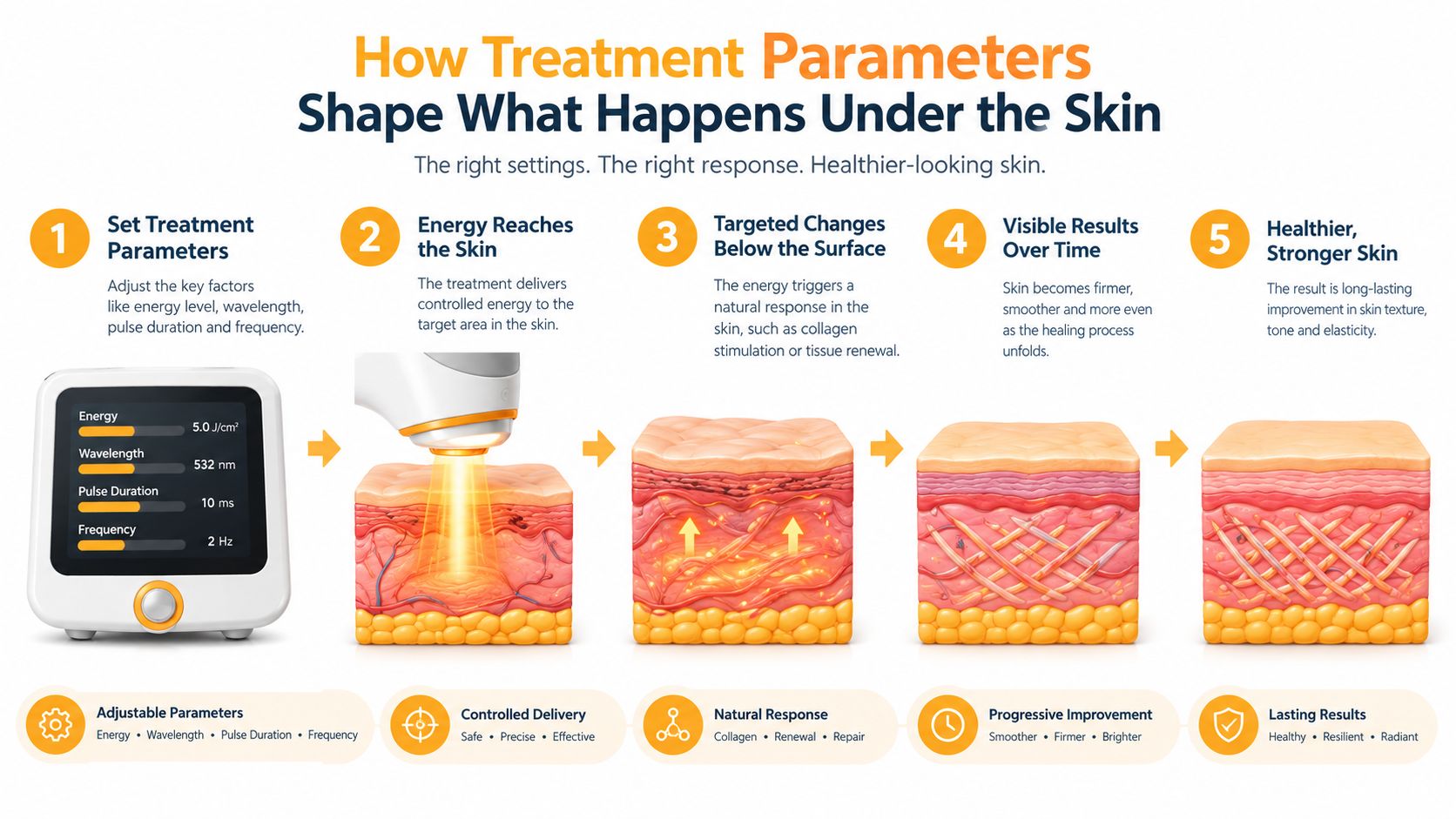
RF microneedling works through two separate but coordinated signals: mechanical micro-injury and fractional radiofrequency heating. Tiny electrodes first enter the skin to a selected depth. They then release RF energy within the dermis, where tissue resistance converts the current into heat. A 2024 physics review explains how this energy creates localized thermal zones and initiates a wound-healing response.
Each electrode behaves like a tiny thermostat, creating a narrow column of controlled thermal injury while the tissue between columns remains viable. That arrangement explains the word “fractional.” RF microneedling treats separated zones rather than heating every millimeter of the surface evenly.
Why leaving tissue untreated matters
The untreated spaces between thermal columns provide surrounding tissue that remains available for repair. They help preserve more of the skin while the treated zones begin healing. This fractional pattern can reduce surface disruption compared with procedures that heat or remove a continuous layer, although it does not eliminate risk.
The punctures supply their own biological signal. They disrupt the skin in a controlled way and activate wound-healing pathways. RF adds a deeper stimulus, altering collagen structure through heat rather than relying only on the needle injury.
Two effects occur on different timelines:
- Immediate contraction. Heat changes collagen's molecular bonds, shortening some existing fibers and producing an early tightening effect.
- Delayed remodeling. Fibroblasts respond to the controlled injury and help form new extracellular matrix, including collagen and elastin, as the dermis repairs itself.
The main action occurs below the surface, not through sanding away the outer layer. That makes the treatment relevant to concerns rooted in the dermis, but accurate placement still matters. Energy released too close to the surface can irritate the epidermis. Energy delivered too deeply can affect tissue the clinician intended to protect.
Practical rule: The needle creates access, while RF settings determine where the biological work occurs.
For collagen support alongside professional treatment, VitzAi supplement guidance on collagen covers supplements and topical care that complement, but do not replace, controlled thermal injury.
How Treatment Parameters Shape What Happens Under the Skin
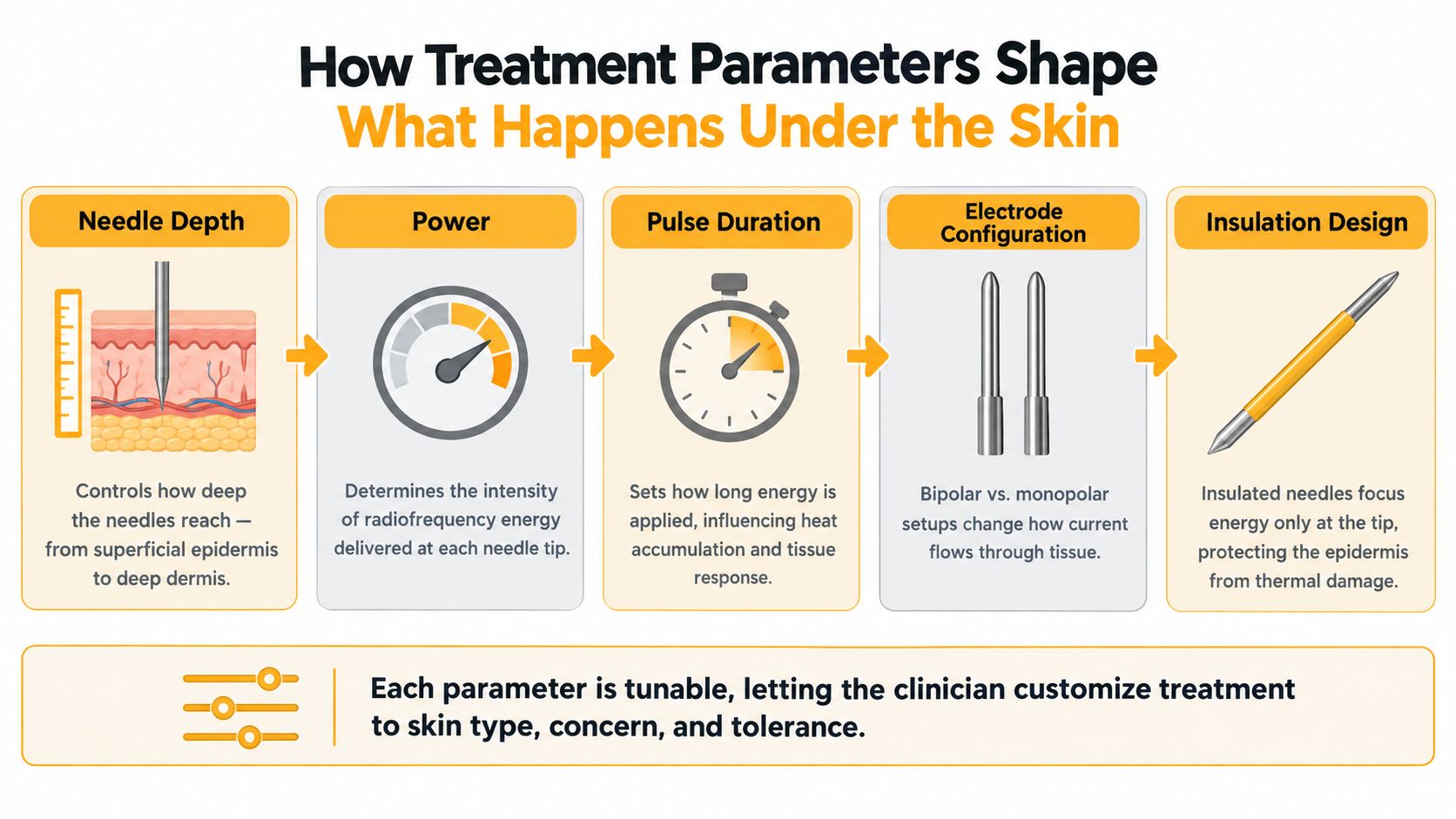
"Customized" should describe specific decisions, not just a reassuring label. Needle depth, power, pulse duration, electrode configuration, and insulation design determine where RF energy travels and how broad the heated zone becomes. The same device can therefore behave differently on the cheeks, jawline, neck, or another area with thinner tissue.
Needle depth sets the target layer. A shallow setting may address superficial dermal texture. A deeper setting can reach thicker dermal tissue, but may approach subcutaneous fat if selected without enough regard for anatomy. Skin thickness, treatment area, and the concern being addressed all influence the appropriate depth.
Power determines RF intensity. Pulse duration determines how long heat continues accumulating. Together, they work like the temperature and cooking time of an oven: changing either can alter the final tissue response.
Small changes can create larger thermal zones
In an experimental porcine-skin model using 49 insulated microneedles, increasing power from 8 to 12 W or pulse duration from 100 to 300 milliseconds significantly enlarged dermal coagulation zones. Those findings are reported in the experimental study on RF microneedle energy delivery.
This helps explain why identical platforms can produce different sensations, healing periods, and results. More energy or longer exposure can create a stronger thermal response, while also increasing inflammation and the chance of injury. Too little exposure may provide an inadequate remodeling signal.
Electrode configuration changes the route current takes through tissue. Insulation determines which part of the needle releases energy. An insulated shaft can concentrate delivery near the tip and reduce direct epidermal exposure. Another design may spread heat along more of the needle path. Settings cannot be transferred reliably between handpieces without understanding how each one delivers RF.
Why depth requires restraint
Deeper treatment is not automatically better. A deeper thermal zone may suit one anatomical area but be inappropriate where the fat layer is thin or facial volume matters. The FDA has reported serious complications with certain RF microneedling uses, detailed in the dedicated risk discussion below. The FDA safety communication describes these risks and emphasizes the importance of trained medical providers.
Ask the provider to identify the intended target layer in plain language. A useful explanation should connect the depth and energy settings to your specific concern, anatomy, and tolerance for downtime, rather than treating stronger settings as automatically superior.
A Look Inside Popular Devices Like Morpheus8 and INTRAcel
Patients often think they're choosing between brand names. A more useful approach is to compare the features that determine treatment behavior: needle depth, insulation, electrode arrangement, energy delivery, and the clinician's control over each setting.
Morpheus8 and INTRAcel are both used for RF microneedling, but a brand name doesn't predict the final result on its own. The same platform can be used differently across the cheeks, lower face, neck, or areas with thinner skin. Treatment planning matters more than a logo on the handpiece.
What to ask about device architecture
For example, insulated electrodes may release energy mainly at the tip, concentrating heat at the selected depth and helping reduce direct epidermal exposure. A platform designed for deeper treatment may be considered when the clinical objective involves thicker tissue or contouring, but deeper delivery also increases the importance of anatomy, energy control, and operator training.
INTRAcel is commonly discussed for texture and acne-scar concerns, while Morpheus8 is known for adjustable depth and applications that may include skin laxity and deeper tissue contouring. These descriptions don't establish that one device is universally superior. They indicate why a consultation should begin with your concern rather than with a package menu.
| Device | Typical Depth Range | Needle Type | Energy Delivery | Best-Suited Indications |
|---|---|---|---|---|
| Morpheus8 | Varies by handpiece and treatment area | Insulated or device-specific electrode configurations | Fractional RF delivered through needle electrodes | Texture, acne scars, and selected laxity concerns |
| INTRAcel | Varies by tip and treatment plan | Device-specific needle electrodes | RF delivered at controlled dermal depths | Acne scars, texture refinement, and selected rejuvenation goals |
| Other RF microneedling platforms | Varies by device architecture | Insulated or non-insulated designs | Bipolar, monopolar, or other fractional configurations | Determined by anatomy, indication, and provider protocol |
Patients considering Morpheus8 can review an example of what to understand before and after treatment, then use the consultation to ask why a particular depth and energy plan fits their skin.
Ask directly: “Why is this device and needle design appropriate for my concern, and how will you protect the surrounding tissue?”
The right comparison isn't a contest between machines. It's a discussion about target depth, thermal control, expected improvement, and the provider's ability to adjust treatment across different parts of the face.
What the Research Shows About Real Results
RF microneedling's proposed mechanism has been examined through clinical observation and histology, not only through before-and-after photographs. The evidence describes early collagen contraction followed by slower dermal remodeling, which explains why a patient shouldn't judge the final result immediately after treatment.
In a 2025 randomized split-face trial, 30 women aged 60 years or older received four consecutive treatments, with conventional microneedling on one side of the face and microneedle radiofrequency on the other. Twenty-nine participants completed the trial, and histological analysis was available for 26. The RF-treated sides showed more non-senescent fibroblasts, fewer senescent fibroblasts, and increased collagen and elastin compared with the microneedling-only sides. The full trial report describes these histological findings.

The result develops in stages
A separate clinical-histological study of 15 Korean participants, with a median age of 46 years, found partially denatured collagen fibers and dermal shrinkage immediately after one treatment. At 4 months, the investigators found increased collagen and elastin, supporting the idea that early contraction and later remodeling are different events.
The inflammatory response also unfolds over time. Inflammatory cells appeared around RF thermal zones as early as 24 hours after treatment. Neutrophils appeared first, while lymphocytes and histiocytes became more prominent after approximately 3 days and could persist for up to 1 month. This doesn't mean every patient experiences the same visible recovery, but it illustrates why the skin continues responding after the appointment.
Experimental tissue findings reinforce the mechanism. In porcine skin, histology at day 28 showed improved collagen I and III density and organization. The collagen I/III ratio reached 7.05 ± 1.21 in treated tissue compared with 3.90 ± 0.37 in surrounding dermis. The reported collagen remodeling findings are available in the prospective research record.
Human measurements are less uniform. In a prospective study of 23 patients, measured collagen density increased from 2,257,106.4 ± 1,197,611.6 to 3,009,894.6 ± 1,541,382.2 at 8 weeks, but the change wasn't statistically significant. That distinction matters. RF microneedling can stimulate remodeling, yet the magnitude of visible improvement varies with treatment parameters, session count, skin condition, and individual biology.
A realistic expectation: The treatment may begin the process in one appointment, but the dermis needs time to remodel. Early swelling or contraction isn't the same as mature collagen formation.
What to Expect Before, During, and After a Session
A well-planned appointment starts before the handpiece touches your skin. During consultation, the provider should review your goals, medical history, previous procedures, skin condition, and the areas to be treated. Standardized photographs can help distinguish genuine remodeling from changes caused by lighting, swelling, or facial expression.
Most practices apply topical numbing cream before treatment. The device then stamps or glides across the planned areas, creating a sensation of pressure, prickling, and heat. RF microneedling is usually well tolerated, but it isn't completely painless, particularly when treating sensitive areas or using deeper settings.
Recovery is part of the treatment
Redness, swelling, tightness, pinpoint bleeding, and grid-like marks can appear after treatment. Some patients describe the first phase as similar to a sunburn. Your provider may advise you to keep skincare gentle, avoid irritating active ingredients, and protect the skin from sunlight while the barrier recovers.
Makeup may need to be avoided until the surface has closed and your clinician says it's appropriate. Contact the office if pain worsens instead of improving, if swelling becomes pronounced, or if you notice blistering, unusual discharge, fever, or another change that doesn't resemble ordinary recovery.
Some practices also discuss platelet-rich plasma or other adjunctive approaches. If that comes up, you can review this overview of PRP injections for skin rejuvenation and then ask whether adding another treatment is appropriate for your skin and objective.
The Risks Most Articles Glide Past
What can go wrong when a treatment is designed to injure skin in a controlled way? The answer depends on where that injury lands. RF microneedling combines puncture with heat, so problems usually come from depth, energy, contact, anatomy, or aftercare, not from a single abstract idea of “risk.”
This is the section where the full FDA complication list belongs, because the tradeoff is straightforward. Pushing treatment deeper or hotter may aim at a deeper problem, but it also brings the device closer to structures you do not want to injure.
- Burns: Excessive energy, poor needle contact, or too much heating in one area can create unintended thermal injury.
- Scarring: Overly aggressive treatment, infection, or delayed healing can shift a controlled wound into abnormal scar formation.
- Fat loss: Excessive depth or energy can reach subcutaneous fat, especially in areas with limited facial volume, and change contour.
- Nerve damage: Treatment placed too deep or too close to vulnerable anatomy can injure small nerves and cause significant complications.
- Disfigurement: Uncontrolled thermal injury or fat loss in visible areas can permanently alter contour and appearance beyond the expected recovery period.
Milder problems still matter. Prolonged redness, irritation, infection, herpes reactivation, pigmentary changes, and post-inflammatory hyperpigmentation can all affect the final result. Pigment shifts deserve extra care in darker skin tones, but inflammation can trigger them in any skin tone.
A useful way to judge risk is to ask whether the plan is custom or copied. Facial skin is not equally thick everywhere. The under-eye area, cheek, jawline, and forehead do not tolerate the same settings. A safer treatment adjusts depth, energy, number of passes, and recovery advice by area and by patient.
Before booking, ask:
- What layer are you targeting? The answer should match your actual concern.
- Which settings will change by area? Skin thickness and underlying anatomy vary.
- What experience do you have with my skin tone? Ask how pigment risk is reduced.
- What happens if healing is abnormal? You should know who manages complications.
- How will you avoid unwanted fat or nerve injury? The answer should address depth, energy, anatomy, and technique.
If a provider cannot explain those choices clearly, you do not have enough information to consent with confidence.
How RF Microneedling Compares to Other Rejuvenation Options
RF microneedling occupies a middle position among rejuvenation treatments. It reaches deeper than surface skincare and standard microneedling because it adds controlled dermal heating. It generally creates less surface disruption than more aggressive resurfacing, but it still can't replace the structural changes produced by surgery.
Match the treatment to the problem
Traditional microneedling relies on mechanical punctures without RF heat. It may be useful for selected texture concerns, but it doesn't create the same controlled thermal zones at depth. RF microneedling may offer a stronger rationale for dermal remodeling and mild laxity, while results still depend on the treatment plan.
Fractional lasers deliver energy through the skin surface. They can be powerful for texture and surface damage, but surface heating can make pigment management more demanding, particularly for people prone to post-inflammatory hyperpigmentation. For readers comparing natural facial resurfacing options, the important questions are how deep the treatment acts, how much surface injury it creates, and what recovery it requires.
Fillers and biostimulators address a different problem. Fillers can restore or reshape volume in selected areas, while biostimulatory products aim to encourage a longer-term tissue response. Neither approach uses RF microneedling's needle-delivered thermal columns, and neither is a substitute for treating every type of texture or laxity.
Know where surgery fits
A facelift or neck lift changes tissue position and removes or repositions excess tissue. RF microneedling changes skin quality and may create modest firming, but it doesn't reposition descended facial structures. People with mild laxity and texture concerns may consider a non-surgical treatment, while significant jowling, heavy neck laxity, or substantial volume loss may call for a surgical assessment.
Chernoff Cosmetic Surgery offers non-surgical skin rejuvenation alongside surgical options, allowing the discussion to focus on the actual anatomy and desired change rather than on a single device.
Use these questions at consultation:
- Is my main concern texture, laxity, pigment, or lost volume?
- How deep must treatment act to address it?
- What recovery and pigment risks should I expect?
- Will the improvement be gradual, modest, or structurally meaningful?
- Would another treatment or surgery address the problem more directly?
RF microneedling can be a useful option when the goal is gradual improvement in skin quality, acne-scar texture, or mild laxity. It becomes a poor choice when marketing promises a surgical lift, when the planned settings aren't individualized, or when the expected result exceeds what dermal remodeling can realistically provide.
Chernoff Cosmetic Surgery offers RF microneedling with platforms such as Morpheus8 and INTRAcel, alongside lasers, injectables, and surgical procedures. Visit Chernoff Cosmetic Surgery to schedule an individualized consultation, discuss the treatment depth and safety considerations for your skin, and determine whether RF microneedling matches your actual concern.