
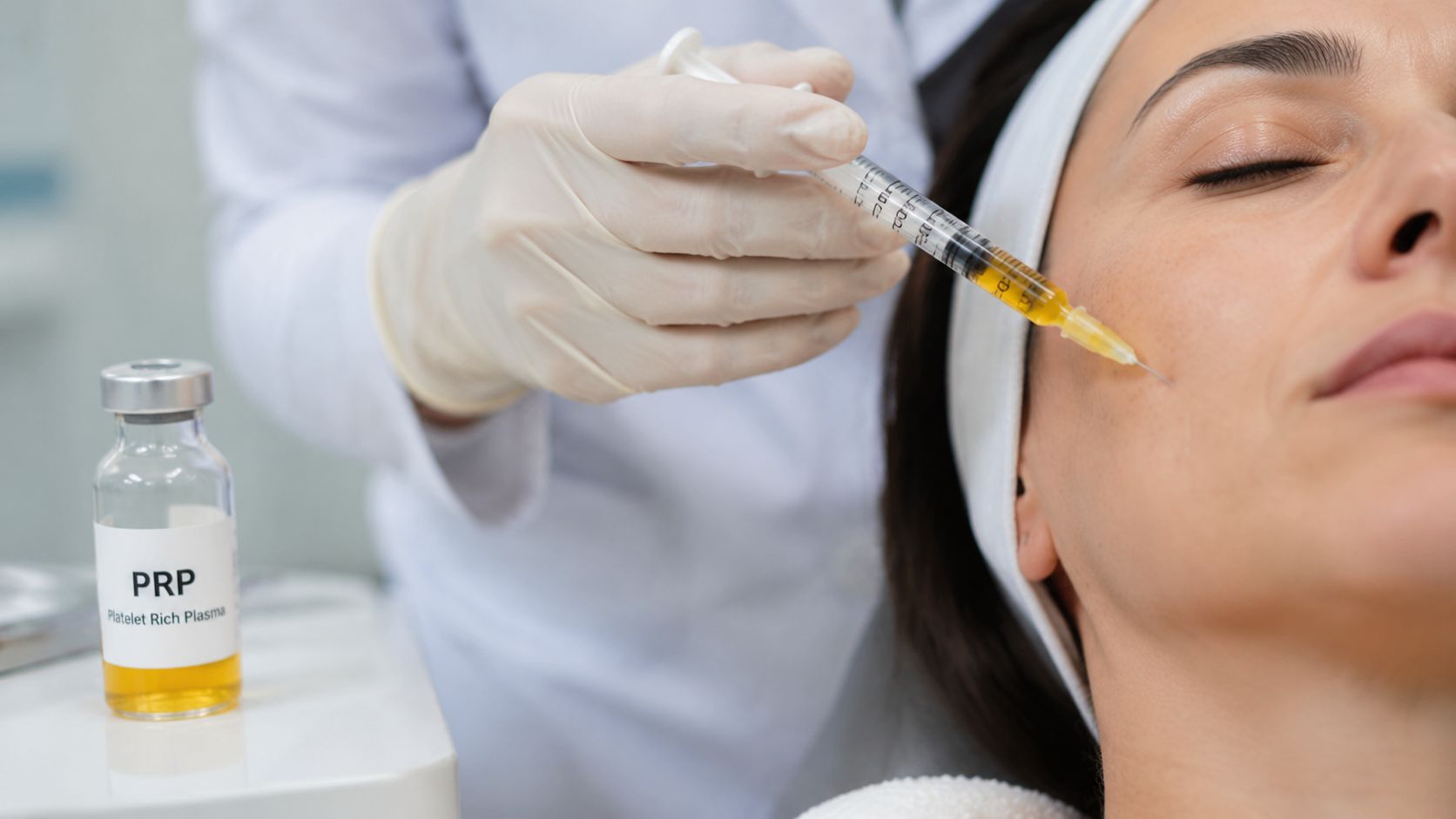
You may be looking in the mirror and seeing changes that don't feel dramatic enough for surgery, yet don't respond to skincare alone. The skin may seem thinner, less vibrant, a bit more creased around the eyes or mouth, and generally less resilient than it once was. That's where many patients start. They want improvement that looks natural, feels medically sound, and doesn't depend on adding something artificial just to create a temporary effect.
A PRP injection for skin rejuvenation sits in that middle ground. It isn't a cream, and it isn't surgery. It's a regenerative treatment that uses your own biology to support healthier skin structure over time. For the right patient, that's the appeal. We're not trying to mask aging. We're trying to encourage the skin to repair and rebuild in a more intelligent way.
In aesthetic medicine, that distinction matters. Regenerative treatments work best when they're chosen carefully, performed precisely, and integrated into a broader plan rather than treated like a one-off trend. That's why patients who are exploring PRP often benefit from understanding the larger context of regenerative medicine and cellular therapy before deciding what belongs in their treatment plan.
Table of Contents
- A New Era of Natural Skin Rejuvenation
- How PRP Taps Into Your Body's Healing Power
- Your PRP Treatment Journey Step by Step
- What Results to Expect and How Long They Last
- Is PRP the Right Rejuvenation Choice for You
- Powering Up Your Results with Combination Therapy
- Your PRP Questions Answered
A New Era of Natural Skin Rejuvenation
Patients often come in saying the same thing in different words. They don't want to look different. They want to look healthier, fresher, and more like themselves. They're not necessarily ready for surgery, and they're tired of spending money on products that make promises but don't change the skin in any structural way.
That's why PRP has become part of modern facial rejuvenation. It uses a concentrated portion of your own blood, prepared for treatment and placed back into the skin to stimulate repair. The appeal is straightforward. It's autologous, which means it comes from you, and the goal is to support collagen production and tissue renewal rather than solely creating a temporary surface effect.
Why patients are drawn to PRP
A good candidate usually wants improvement in areas such as:
- Fine lines and crepey texture
- Dullness and loss of radiance
- Mild skin laxity
- Uneven tone or roughness
- A more rested look without a dramatic change
PRP is attractive because it fits people who value subtlety. The result, when it works well, doesn't announce itself. Skin looks stronger, smoother, and more alive.
Clinical perspective: The best PRP outcomes usually happen when the patient's goals match the biology of the treatment. This is not an instant lifting procedure. It's a gradual skin-quality procedure.
Why expertise matters
PRP is often described casually online, but it shouldn't be approached casually in practice. The quality of the treatment depends on patient selection, preparation, technique, injection depth, and whether PRP is being used appropriately by itself or as part of a broader rejuvenation strategy.
That larger plan matters because facial aging is rarely a one-problem issue. Some patients need texture improvement. Others have volume loss, laxity, pigment change, or sun damage that PRP alone won't fully address. In those cases, regenerative treatment can still play an important role, but it has to be placed in the right sequence and combined thoughtfully.
In other words, PRP works best when it's treated as one tool in an expert-led plan, not a catch-all answer.
How PRP Taps Into Your Body's Healing Power
A patient may look in the mirror and feel that her skin seems thinner, less vibrant, and slower to recover than it did a few years ago. In that setting, PRP can be useful because it works with normal healing biology rather than trying to create an artificial effect on the surface.
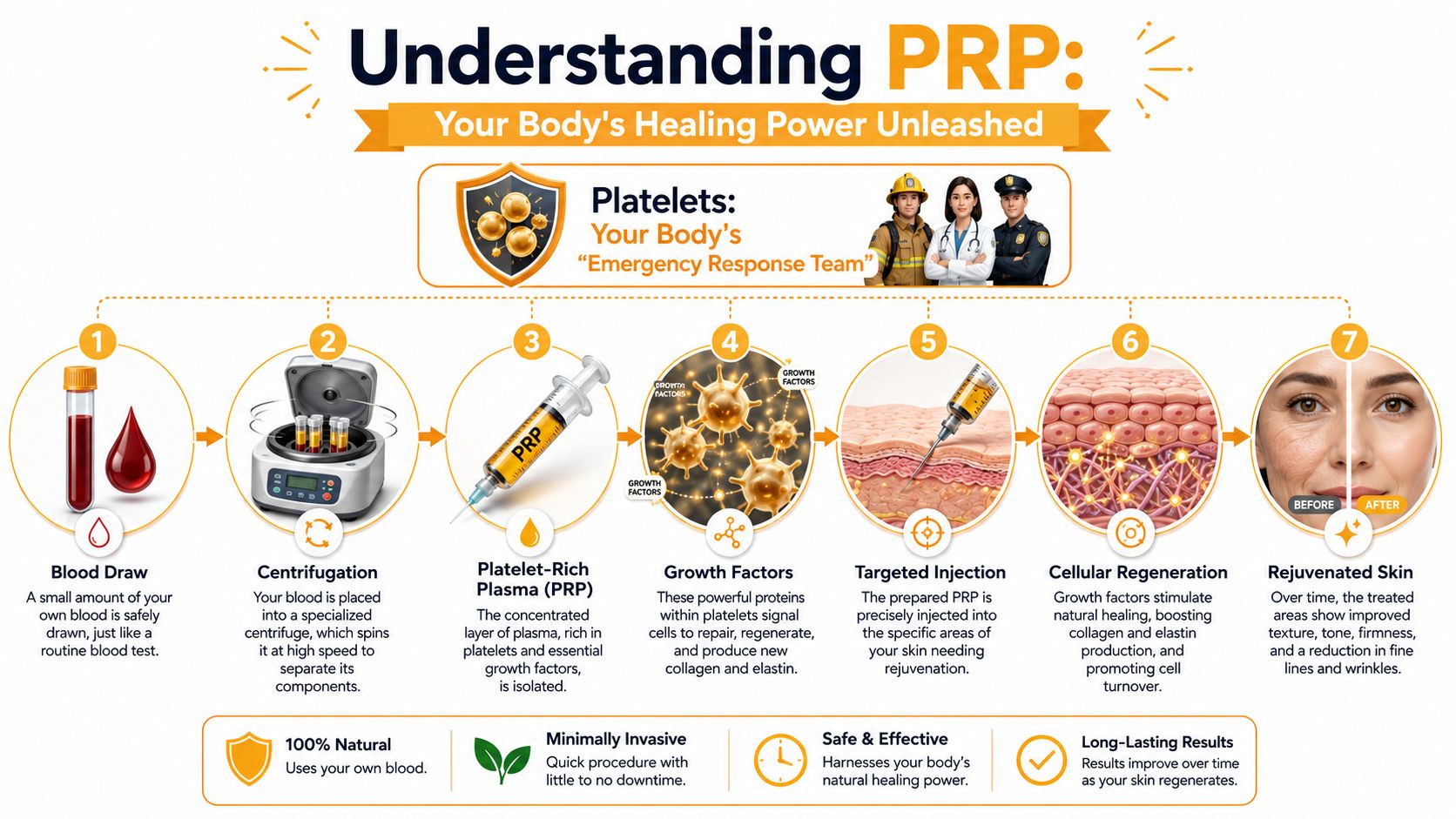
Why platelets matter
Platelets are part of the body's repair system. When they are concentrated and placed into carefully selected areas of the skin, they release growth factors and signaling proteins that support collagen production, tissue remodeling, and improved skin quality over time.
That mechanism helps explain where PRP fits well and where it does not. PRP is most useful for concerns tied to skin quality, such as fine lines, crepey texture, dullness, and early thinning. It does not reposition descended tissue or restore facial structure in the way surgery or filler can. Good treatment planning depends on making that distinction early.
In my practice, PRP is rarely treated as an isolated idea. It is part of a larger facial rejuvenation plan based on the condition of the skin, the degree of volume loss, and whether the patient will benefit from pairing regenerative treatment with options such as microneedling with PRP or other in-office therapies designed to improve skin quality in a natural-looking way.
What the evidence supports
Published clinical reviews have found that PRP can improve several measures of skin quality after a series of treatments, including texture, fine lines, elasticity, and overall appearance. That matters because facial aging rarely shows up as one isolated issue. The skin often loses brightness, resilience, and smoothness at the same time.
PRP appears to help by improving the environment within the skin itself. In practical terms, that can mean better tone, stronger texture, and a healthier look that develops gradually.
A few trade-offs are worth understanding:
- PRP improves skin quality gradually. Results build over weeks as the skin remodels.
- PRP does not replace volume. Hollowing and contour loss usually need a different solution.
- PRP results depend on technique and treatment plan. Processing, placement, and whether it is combined with another modality all influence the outcome.
- PRP works best in the right patient. Mild to moderate aging changes respond more predictably than advanced laxity.
The right way to view PRP is as a regenerative tool. Used well, it helps the skin repair and refresh itself. Used thoughtfully within a physician-led plan at Chernoff Cosmetic Surgery, it can strengthen the results of other treatments while keeping the overall look natural.
Your PRP Treatment Journey Step by Step
A common first reaction in consultation is relief. Patients often expect PRP to feel complicated or intimidating, then find that the treatment itself is straightforward when it is planned well and performed with clear goals.
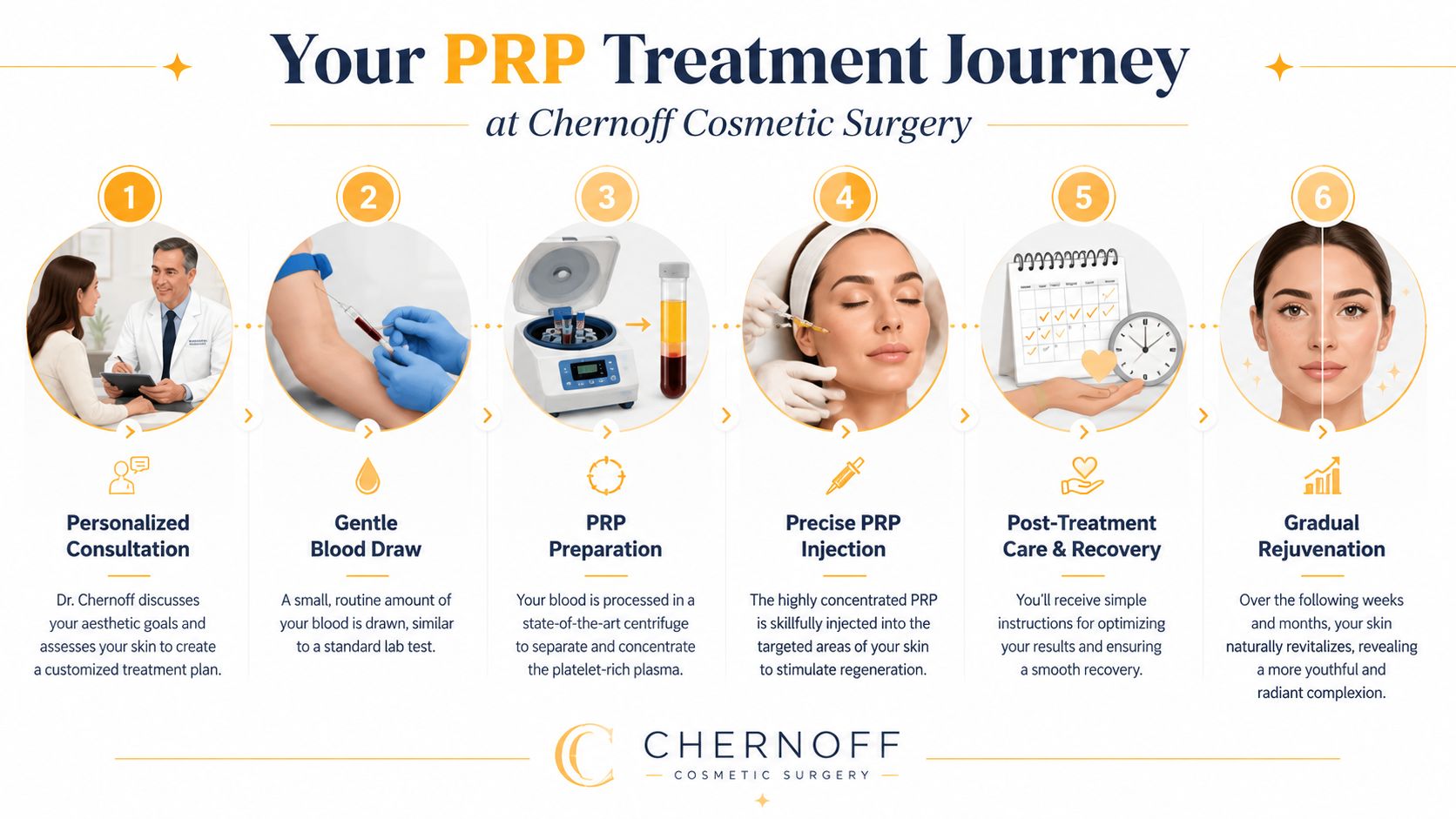
What happens in the office
The process starts before any blood draw. I evaluate skin quality, areas of volume change, texture concerns, laxity, and your overall facial balance. That step helps determine whether PRP should stand on its own or serve as one part of a broader rejuvenation plan at Chernoff Cosmetic Surgery. In many patients, the best result comes from treating the right layers and combining treatments thoughtfully rather than applying the same approach to every face.
A typical visit includes four parts:
Consultation and treatment design
The skin is examined closely, photographs may be taken, and the treatment zones are mapped. This is also when we decide whether PRP is best for fine lines, crepey skin, under-eye skin quality, or recovery support after another procedure.Blood draw
A small blood sample is taken, similar to routine lab work.Processing the PRP
The sample is placed in a centrifuge so the platelet-rich portion can be separated for treatment. Technique matters here. How the PRP is prepared affects consistency.Placement
The PRP is then delivered to selected areas with careful, physician-directed technique. The exact method depends on the treatment plan, the thickness of the skin, and whether the goal is skin quality improvement, healing support, or a combination of both.
For some patients, PRP is used with microneedling treatment options. That combination can improve collagen stimulation and help recovery, especially when the goal is better texture and a fresher overall skin surface rather than added volume.
Why treatment is usually done as a series
PRP tends to work best as a sequence of treatments, not a one-time event. Skin remodeling is gradual, and repeated treatments generally produce a more reliable response than a single session.
The exact schedule varies by age, skin quality, sun damage, and whether PRP is being combined with another modality. Many patients do better with an initial series followed by maintenance treatments based on how their skin responds. That is one reason I build PRP into a larger treatment plan instead of presenting it as an isolated quick fix.
There is a real trade-off here. A series asks for more patience and more commitment than a single office visit, but it gives the skin more opportunity to respond in a meaningful way. Patients who understand that from the start are usually much happier with the process.
Recovery is usually manageable. You may see mild redness, swelling, pinpoint bruising, or tenderness for a short time, depending on how the PRP is delivered and whether it is paired with another treatment. Most patients return to normal activity quickly, with a few practical aftercare instructions.
The goal is steady improvement that still looks like you. That is how regenerative treatment should be used.
What Results to Expect and How Long They Last
A common scenario is this: a patient looks in the mirror a few days after PRP and wonders whether anything happened. That is a fair question, because PRP is a gradual treatment. It does not produce the kind of instant shift you might see with filler or surgery. Its value is in progressive improvement in skin quality.
What changes first
The first thing to understand is that early redness, swelling, or mild irritation does not represent the final result. That is the short-term response to treatment.
Meaningful changes tend to appear in stages:
| Time frame | What patients often notice |
|---|---|
| Early period | Skin may look a little fresher or more hydrated after the initial irritation settles |
| Following weeks | Texture may start to feel smoother, and the skin often looks less dull |
| Over the next few months | Fine lines, tone, firmness, and overall skin quality can continue to improve as collagen remodeling develops |
This timeline matters during consultation. Patients who expect PRP to act like a fast cosmetic cover-up are usually disappointed. Patients who want natural-looking improvement and understand that skin renewal takes time are usually much better candidates.
What kind of longevity is realistic
Results vary. The patient's age, baseline skin quality, degree of sun damage, overall health, and whether PRP is used alone or as part of a broader treatment plan all affect how much change is visible and how long it holds.
In practice, the improvement is often subtle to moderate rather than dramatic. Skin can look healthier, reflect light better, and feel less crepey. That can be very satisfying, especially in patients who want to look rested and refreshed without looking treated.
The trade-off is straightforward. PRP asks for patience, and in many cases a series of treatments, in exchange for a softer, more natural result. It is not the right tool for someone seeking major lifting or immediate correction.
Longevity is also best viewed in context. Results do not usually stay fixed forever because the skin continues to age. At Chernoff Cosmetic Surgery, I treat PRP as one part of a physician-directed rejuvenation plan, not a stand-alone promise. Used thoughtfully, it can help maintain skin quality, support healing, and improve the result of other treatments that address texture, tone, laxity, or volume more directly.
A good consultation should leave you with a clear expectation. PRP can improve the way skin behaves and looks over time. It should never be presented as overnight tightening or a substitute for procedures designed to correct structural aging.
Is PRP the Right Rejuvenation Choice for You
PRP is a strong option for some people and the wrong tool for others. The question isn't whether it's trendy. The question is whether it fits your anatomy, your timeline, and your expectations.
Who tends to do well
The ideal patient usually wants natural-looking improvement rather than a dramatic change in facial shape. This person may notice early aging, mild crepiness, textural decline, or skin that no longer reflects light the way it used to.
PRP often makes the most sense for patients who:
- Prefer biologic treatment because they like the idea of using their own blood components
- Can be patient while results build gradually
- Want better skin quality more than they want instant volume or lifting
- Are comfortable with a treatment series instead of one appointment
It can also appeal to patients who want to support healing after other skin treatments, provided the overall plan is appropriate.
Who should pause and reassess
PRP is less satisfying when the main concern is heavy laxity, significant jowling, deep folds caused by volume loss, or the desire for a fast, highly visible transformation. In those situations, PRP may still have a role, but not as the centerpiece.
A more cautious discussion is also warranted for anyone with blood-related medical issues, active skin infection in the treatment area, or expectations that don't align with regenerative therapy.
A simple way to think about candidacy is this:
| Good fit | Poor fit |
|---|---|
| Wants subtle, progressive skin improvement | Wants instant lifting |
| Accepts staged treatment | Wants one treatment and done |
| Focused on texture, tone, and fine lines | Focused on major sagging or substantial volume loss |
One reason PRP remains appealing is safety. Because the material comes from your own blood, the treatment is generally viewed as low risk from an allergy standpoint. That doesn't mean technique stops mattering. It means the biologic material itself is familiar to your body.
Powering Up Your Results with Combination Therapy
PRP doesn't have to stand alone. In fact, some of the most thoughtful rejuvenation plans use it as a support treatment that strengthens the skin's response to other procedures.
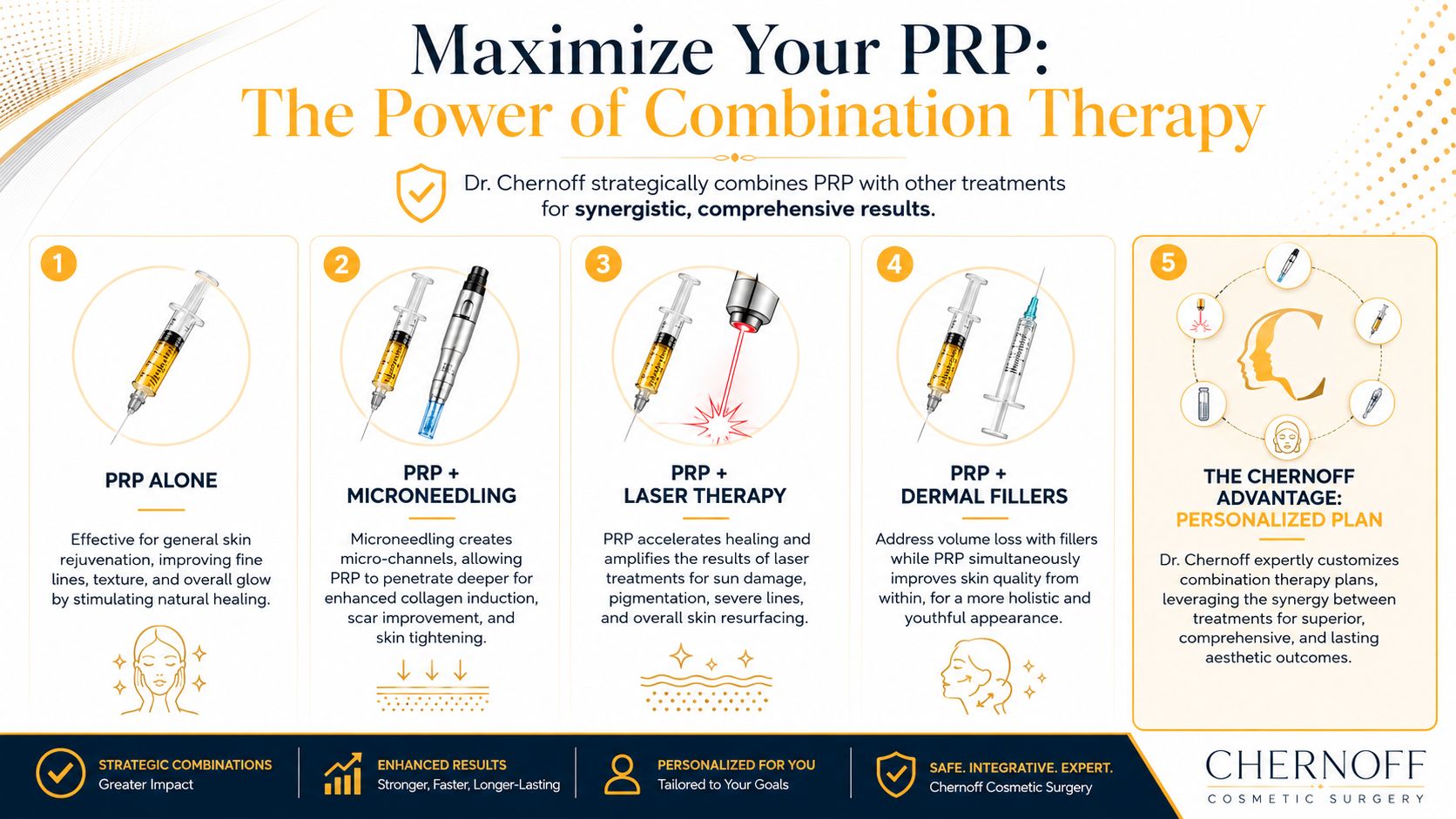
When PRP works well on its own
On its own, PRP can be a reasonable choice for patients whose main goals are healthier tone, smoother texture, and softer fine lines. That approach can be especially appealing when a patient wants a more conservative entry point into aesthetic treatment.
There are also patients who prefer a regenerative strategy first. That's a valid approach, as long as they understand the pace and limits of the result.
When combination treatment makes more sense
Combination therapy becomes more compelling when aging shows up in more than one layer of the face. Skin quality, pigment, laxity, scars, and volume loss don't respond to the same intervention in the same way.
Here's how the logic usually works:
- PRP plus microneedling can make sense when the goal is collagen stimulation and textural refinement. If you want a visual overview of how microneedling changes can present over time, this beautysecrets.agency microneedling guide gives a useful patient-friendly look at the before-and-after pattern many people are trying to understand.
- PRP after energy-based resurfacing may help support recovery and tissue renewal when the skin has sun damage or roughness.
- PRP with fillers can be useful when the skin itself needs improvement but there's also volume loss that regenerative treatment alone won't replace.
- PRP with radiofrequency microneedling may be appropriate when the plan needs both collagen stimulation and a tightening component, such as with Morpheus8 skin remodeling.
At Chernoff Cosmetic Surgery, PRP is offered as one regenerative option within a broader menu that can also include topical PRP-based skin treatments and combination protocols, depending on the patient's goals and anatomy.
Treatment principle: Don't ask whether PRP is better than another procedure in the abstract. Ask what problem you are trying to solve, and which combination addresses that problem most precisely.
A brief note on PRF also helps. Patients sometimes ask whether PRP and PRF are interchangeable. They're related, but they aren't identical preparations. In practice, the choice depends on how the material will be used, the release profile desired, and the treatment area. That decision should come from the treatment plan, not from a buzzword.
Your PRP Questions Answered
A consultation for PRP usually becomes practical very quickly. Patients want to know what the treatment feels like, how much recovery to expect, how many sessions make sense, and whether PRP is enough on its own. Those are the right questions, because good rejuvenation planning is not about chasing a trend. It is about choosing the right tool, or combination of tools, for your skin, anatomy, and goals.
Common practical questions
What does PRP cost?
Pricing varies based on the treatment area, the technique used, and whether PRP is performed alone or paired with another procedure. In my practice, I want patients thinking beyond the cost of a single visit. The better question is what plan is most likely to produce a worthwhile result. PRP can be very reasonable for the right patient, but it often works best as part of a staged rejuvenation strategy rather than a one-time fix.
How many treatments will I need?
Some patients do well with one session. Many need a series, especially when the goal is gradual improvement in skin quality rather than a short-term refresh. The answer depends on the starting condition of the skin, the treatment area, and whether PRP is being combined with microneedling, laser resurfacing, or another regenerative option. If you are sorting through the financial side of treatment, this healthcare payment solutions guide gives a practical overview of how patients often approach medical and aesthetic expenses.
What do the injections feel like?
PRP injections are usually tolerable, but they are not painless. The experience depends on where we are treating, the depth of PRP placement, and your own sensitivity. Topical numbing, cold application, and careful technique make a noticeable difference. Around the eyes and mouth, patients tend to feel more than they do in broader areas of the face.
Is there downtime?
Recovery is usually manageable. Expect temporary redness, swelling, tenderness, and sometimes small bruises at injection sites. Many patients return to routine activities quickly, but I still advise avoiding treatment right before a wedding, photo event, or important social obligation. If PRP is part of a broader plan with resurfacing or microneedling, recovery may be longer.
Questions worth asking at your consultation
A strong consultation should clarify the treatment plan, not just the procedure name. Ask questions that help you understand why PRP is being recommended and what role it plays in the larger rejuvenation strategy.
- Am I a good candidate for PRP alone, or would another treatment improve the result?
- What specific problem are we treating. Skin texture, fine lines, pigment, laxity, or healing support?
- How many sessions do you expect I will need in my case?
- Where will the PRP be placed, and what is the reason for that approach?
- What recovery should I expect based on my skin and treatment plan?
- What result is realistic for me?
At Chernoff Cosmetic Surgery, those answers come from a medical evaluation, not a canned package. PRP is one useful regenerative tool, but natural-looking facial rejuvenation often depends on how it is integrated with other non-surgical treatments over time. That is where experience matters. The goal is not to do more. The goal is to do what fits your face, your skin, and your long-term result.
If you're considering a personalized plan for skin quality, texture, and natural facial rejuvenation, schedule a consultation with Chernoff Cosmetic Surgery. A careful evaluation can help determine whether PRP fits your goals on its own or works better as part of a broader regenerative and non-surgical treatment strategy.