
You catch your reflection in a car window, on a video call, or under the bright bathroom light and notice something has changed. Maybe your skin looks a little less even. Maybe the lines between your brows seem to stay even when you're not frowning. Maybe your jawline feels softer than it used to. You're not looking for a dramatic transformation. You just want to look like yourself on a well-rested day.
That's where many people start. They've tried creams, maybe a facial or two, but they're not ready for surgery. They want a middle ground. They want treatments that can soften, refresh, tighten, and refine without taking them out of daily life for weeks.
Non-surgical skin rejuvenation lives in that middle ground. It includes injectables, lasers, light treatments, microneedling, and other office-based options that target texture, tone, wrinkles, volume loss, and mild skin laxity. Its popularity isn't hard to understand. The global non-surgical cosmetic procedures market reached 20.5 million procedures in 2024, and those treatments made up the majority of all aesthetic treatments performed worldwide. From 2020 to 2024, non-surgical treatments increased by over 40%, with botulinum toxin injections alone accounting for nearly 8 million procedures in 2024, according to these worldwide non-surgical procedure statistics.
If you're still trying to sort out what “aging” means beneath the surface, this plain-English guide to ageing is a useful companion. It explains the biological changes that shape what you see in the mirror, which makes treatment choices much easier to understand.
Table of Contents
- Your Introduction to Modern Skin Rejuvenation
- The Three Pillars of Non-Surgical Treatments
- Exploring Your Treatment Options
- What to Expect from Your Rejuvenation Journey
- Creating a Long-Term Rejuvenation Plan
- How to Choose Your Provider and Take the Next Step
Your Introduction to Modern Skin Rejuvenation
A common first visit sounds like this: “I don't think I need surgery, but I also know skincare alone isn't doing enough.” That's a very reasonable place to be. Most faces don't age in one single way, so one single treatment usually isn't the answer either.
Some changes come from muscle movement. Some come from volume loss. Others come from sun exposure, pigment, rough texture, or collagen decline. Non-surgical skin rejuvenation works by matching the treatment to the type of change happening in your face.
Good treatment planning starts with one question: what exactly are you trying to change?
If your forehead lines bother you, a muscle-relaxing injectable may help. If under-eye hollows or flattening in the cheeks make you look tired, a filler may be more relevant. If your skin looks dull, crepey, or uneven, resurfacing or collagen-stimulating treatments may do more than an injectable ever could.
That's why the field can feel confusing at first. Patients often hear a long list of brand names and device names without being told the bigger logic behind them. Once you understand the categories, the choices become less intimidating.
A simpler way to think about results
Think of your face the way you'd think about a home that needs a refresh.
- Movement issues are like repeated creases in the same spot.
- Volume issues are like support that has thinned out over time.
- Surface issues are like wear on paint, texture, and finish.
- Skin laxity is different again. It's more about structural looseness.
When people expect one treatment to fix all four, they're usually disappointed. A laser can't replace lost cheek support. A filler won't erase sun damage. A relaxer doesn't tighten loose skin.
Why this middle ground appeals to so many patients
The appeal is practical. These treatments can fit into real life. Many involve little downtime, gradual improvement, and adjustments over time rather than a single all-or-nothing decision.
Practical rule: The best non-surgical result usually looks refreshed, not “done.”
That subtle goal matters. For many patients, success means looking less tired, less stern, or more even-toned without anyone being able to name the treatment.
The Three Pillars of Non-Surgical Treatments
A simpler way to understand your options
Most patients don't need more names. They need a mental map. I teach non-surgical skin rejuvenation in three pillars because it helps people understand what a treatment is meant to do before they worry about which specific product or device is being used.
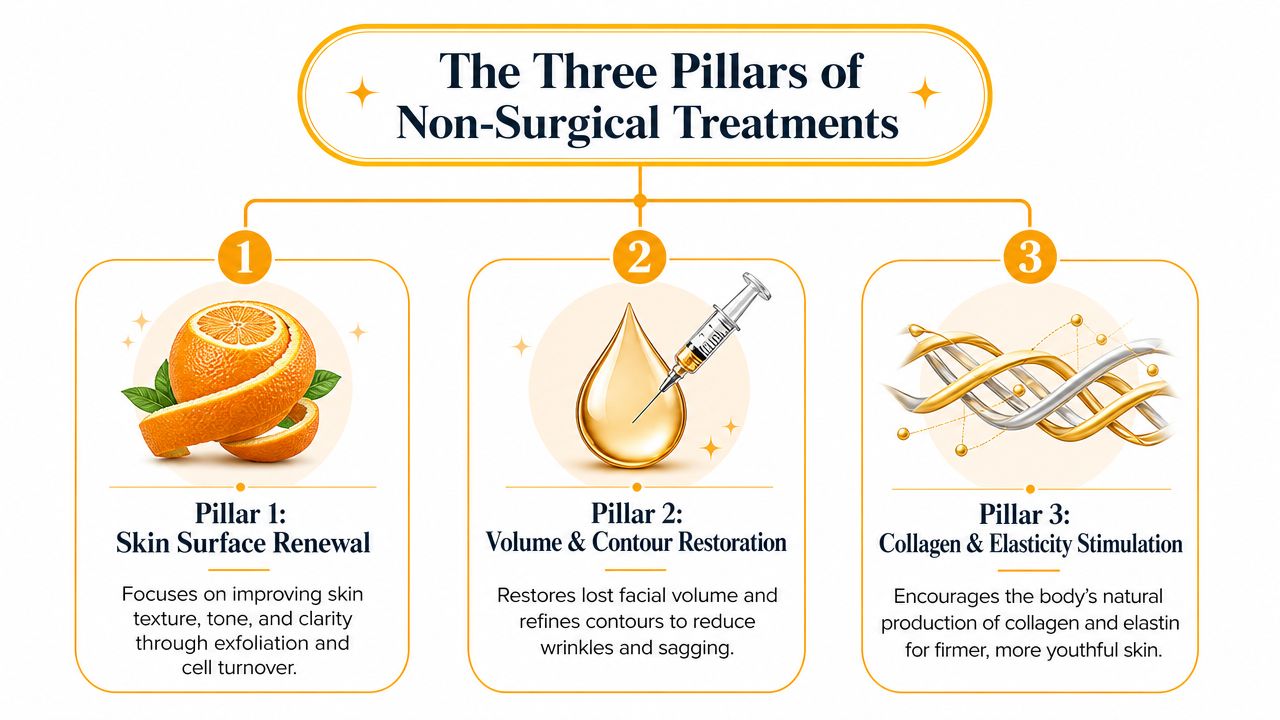
The process resembles renovating a room. One step smooths what keeps creasing. Another restores what has lost support. The last improves the finish and strengthens the material itself.
The three pillars are:
- Relaxers
- Fillers
- Resurfacers and Tighteners
If you like a broader overview of options for patients who want improvement without an operation, this discussion of being not ready for surgery fits well with that decision point.
How each pillar solves a different problem
Relaxers
Relaxers target dynamic lines. These are wrinkles created by repeated movement, such as frowning, squinting, or raising the eyebrows. When carefully used, they reduce the pull of specific facial muscles so the overlying skin doesn't crease as strongly.
This category is best for lines that deepen with expression. It's less useful for folds caused by sagging tissue or volume loss.
A simple example helps. If a sheet of paper gets folded in the same place every day, that crease becomes permanent over time. Relaxers don't rebuild the paper. They reduce the repeated folding.
Fillers
Fillers address loss of support, contour, and volume. Aging isn't only about wrinkles. In many patients, the bigger shift is flattening in the cheeks, hollowness under the eyes, thinning around the mouth, and less definition along the jawline or temples.
Fillers work more like restoring the frame beneath the surface. In the house analogy, fillers shore up the beams, rather than repainting the walls.
Patients often get confused here. They hear “filler” and picture an overfilled face. Good filler placement should do the opposite. It should restore proportion and support, not create puffiness.
Resurfacers and Tighteners
This pillar covers treatments that improve the skin itself. These options can target pigmentation, roughness, enlarged pores, fine lines, acne changes, and mild laxity. Some remove damaged surface layers. Others create controlled heat or tiny injuries below the surface to encourage repair and collagen remodeling.
This category matters because many people don't need more volume. They need better skin quality.
A face can have good structure and still look tired if the surface is blotchy, rough, or lax.
The “tightening” part also deserves honesty. These treatments can help with mild looseness, especially when started earlier, but they don't recreate the structural repositioning that surgery can provide.
Why patients often need more than one pillar
A person with forehead lines, cheek flattening, and sun-related texture changes doesn't have one problem. They have three different aging patterns happening at once.
That's why a thoughtful plan often combines categories:
- Relaxers to soften movement-based lines
- Fillers to restore support where volume has changed
- Resurfacers or tighteners to improve skin texture, tone, and mild laxity
When you view treatment through these pillars, consultations become much clearer. Instead of asking, “Which procedure is best?” you start asking, “Which part of aging am I trying to treat?”
That's a much better question.
Exploring Your Treatment Options
Some treatments become popular because they solve a very specific problem well. Others stay useful because they're versatile. The point isn't to chase what's trendy. It's to match the tool to the concern in front of you.
The skin-tightening side of this field continues to grow quickly. The global non-surgical skin tightening market is projected to expand from USD 3.17 billion in 2024 to USD 13.53 billion by 2035, according to this market projection for non-surgical skin tightening. That growth reflects strong interest in treatments such as fractional lasers and RF microneedling for patients who want visible change without surgery.
Relaxers for expression lines
This group includes well-known neuromodulators such as BOTOX, Dysport, DAXXIFY, Jeuveau, and XEOMIN. Their job is straightforward. They soften muscle activity in areas where repeated motion creates lines.
Patients usually ask what they feel like. The appointment is typically quick, and the injections are brief. They are often described as small pinches. The more important part is not the moment of treatment. It's the treatment plan. Tiny differences in placement can affect brow shape, forehead motion, and whether the result looks natural.
These are commonly used for:
- Forehead lines that show with eyebrow lifting
- Frown lines between the brows
- Crow's feet around the eyes
- Selected lower-face concerns in carefully chosen patients
Fillers for support and shape
Most modern facial fillers used for rejuvenation are designed to replace lost volume, smooth transitions, and improve contour. Hyaluronic acid fillers are widely used because they can be selected for different tissue depths and goals. A soft product may suit delicate areas, while a firmer option may support cheeks or define the jawline.
Patients often ask if filler “fills wrinkles.” Sometimes it does, but the better use is often structural. If the cheek has flattened, placing product only into a fold lower down may miss the underlying issue. Supporting the midface can improve the fold more naturally than chasing the line itself.
You may also hear about regenerative approaches such as PRP injection for skin rejuvenation, which some practices include as part of a broader treatment plan for skin quality and recovery support.
Resurfacers and tighteners for skin quality
This category is broad because skin quality has many dimensions.
CO2 and fractional lasers are often used when texture is the main issue. They can help with roughness, fine lines, and signs of accumulated sun damage by resurfacing the skin and stimulating repair.
RF microneedling, including platforms such as Morpheus8 and INTRAcel, combines tiny needle penetration with radiofrequency energy. Patients usually choose it when they want collagen stimulation, refinement, and some tightening effect with less surface disruption than an ablative laser.
IPL is different. It's commonly used for visible redness, sun-related discoloration, and uneven tone rather than deeper wrinkles or laxity.
A practice such as Chernoff Cosmetic Surgery may offer these categories alongside injectables and other non-surgical treatments, which can be helpful when a patient needs a combination plan rather than a single modality.
The treatment that sounds most advanced isn't always the right one. The right one is the one that matches the problem.
Non-Surgical Treatment Comparison
| Treatment | Primary Target | Typical Downtime | Results Seen In |
|---|---|---|---|
| Relaxers | Expression lines caused by muscle movement | Often minimal | Days to a couple of weeks |
| Hyaluronic acid fillers | Volume loss, contour, facial support | Often mild swelling or bruising | Often visible soon, with settling afterward |
| CO2 or fractional laser | Texture, fine lines, sun damage, surface renewal | Can range from several days to longer depending on intensity | Gradual improvement as skin heals |
| RF microneedling | Collagen stimulation, mild laxity, pores, textural refinement | Often a short recovery period with redness | Gradual improvement over weeks |
| IPL | Pigment and redness concerns | Usually limited, depending on settings and skin response | Series-based improvement |
A table like this is useful, but it still simplifies reality. Downtime varies with treatment intensity, skin type, treatment area, and your tolerance for visible recovery. “Results seen in” also differs because some treatments work by immediate placement, while others depend on your own healing response.
What to Expect from Your Rejuvenation Journey
The first consultation is less about picking a product and more about sorting your goals. Patients often arrive saying they want to “look younger,” but that phrase can mean very different things. One person means less redness. Another means lifting a tired jawline. Another wants softer frown lines without looking frozen.

A good consultation narrows that down. It looks at skin quality, facial movement, volume distribution, and the amount of laxity present. It also includes your schedule, your comfort with downtime, and how subtle or noticeable you want the change to be.
Who tends to do well with non-surgical treatment
Non-surgical skin rejuvenation tends to work best for patients with mild to moderate concerns who want refinement, maintenance, or early correction. These patients usually understand that improvement can be real without being dramatic.
People often do especially well when they want to:
- Soften early lines rather than erase etched folds
- Refresh tired features without changing their identity
- Improve skin quality through a series rather than one major event
- Maintain results over time with periodic treatment
After treatment, aftercare matters. That may include sun protection, gentle skincare, avoiding unnecessary irritation, and giving swelling or redness time to settle before judging the result.
Understanding the longevity ceiling
This is the part many marketing materials skip. Non-surgical treatments can be very helpful, but they have limits. Clinical reviews note that non-invasive results are “modest and inconsistent” and may last “mere months,” while surgical outcomes may last “several years,” as discussed in this clinical review on non-invasive facial rejuvenation.
That doesn't mean non-surgical treatment isn't worth doing. It means you should use it for what it does well.
If the issue is early movement lines, mild loss of volume, uneven pigment, or mild laxity, office-based treatment can make sense. If the issue is substantial tissue descent, marked neck laxity, or heavier jowling, there may come a point where repeated non-surgical treatment gives smaller and smaller returns.
There's a ceiling to what non-surgical treatment can accomplish. Knowing that early prevents frustration later.
I often explain it this way. Non-surgical treatment can polish, support, and maintain. Surgery can reposition and remove excess tissue. Those are different jobs.
Patients feel most satisfied when they understand which side of that line they're on.
Creating a Long-Term Rejuvenation Plan
The most natural-looking results usually don't come from treating everything at once. They come from pacing. A long-term plan lets you decide what matters most, what can wait, and what combination will give the most balanced improvement.
Why combination treatment often makes more sense
Many faces benefit from what patients sometimes call stacking treatments. The idea is simple. Different concerns need different tools, and those tools often complement one another.
For example:
- Movement plus texture might call for a relaxer paired with resurfacing.
- Volume plus laxity may need structural support and collagen stimulation.
- Pigment plus dullness often responds better to surface-focused care than to injectables.
The visual below reflects the broader med spa environment where these plans are often built and adjusted over time.
A strategic plan also protects you from overtreatment. When patients chase one line, one fold, or one photo angle in isolation, they often end up with treatment that doesn't match the whole face. A broader plan keeps proportion in view.
Skincare protects the work you pay for
Office procedures matter, but your daily habits still shape the result. Sun exposure, irritation, dehydration, and inconsistent skincare can blunt the benefits of treatment.
Professional guidance helps here. If you've ever wondered whether higher-level products make a meaningful difference, this review of whether professional skincare products are worth the price gives useful context.
Even simple ingredients need good judgment. For readers curious about essential-oil-based skincare and where it may or may not fit, Aroma Warehouse's guide to tea tree oil is a practical read on benefits, uses, and safe practices.
Good rejuvenation isn't just about what happens in the treatment chair. It's also about what you stop doing to sabotage your skin afterward.
Cost belongs in this conversation too. Non-surgical rejuvenation is often better understood as an ongoing investment rather than a one-time purchase. Some patients prefer periodic maintenance because it spreads treatment over time and allows gradual decisions. Others eventually decide that a surgical option is more efficient for a structural problem. Neither approach is automatically right. The right plan fits your goals, timeline, and tolerance for upkeep.
How to Choose Your Provider and Take the Next Step
The skill of the person evaluating your face matters as much as the treatment itself. The right provider doesn't just know how to inject or operate a device. They know when not to treat, when to combine approaches, and when a patient has reached the point where surgery may make more sense.
A short checklist for choosing wisely
Use a practical filter when you book a consultation:
- Look at credentials: Training, board certification, and scope of practice matter because non-surgical work still requires deep anatomical knowledge.
- Ask how they assess aging: You want someone who evaluates movement, volume, skin quality, and laxity instead of recommending the same treatment to everyone.
- Review before-and-after photos carefully: Natural-looking results are usually a sign of restraint and planning.
- Notice how expectations are handled: A trustworthy provider explains limitations, downtime, maintenance, and alternatives.
- Pay attention to the consultation itself: You should feel educated, not rushed.
If a provider promises that non-surgical treatment can do everything surgery can do, be careful. That's usually where disappointment starts. The strongest plans come from honesty, precision, and a clear understanding of what each treatment can realistically achieve.
If you're thinking about non-surgical skin rejuvenation and want a plan based on your actual anatomy, goals, and tolerance for downtime, schedule a consultation with Chernoff Cosmetic Surgery. A personalized assessment can help you decide whether relaxers, fillers, resurfacing, skin tightening, or a surgical option makes the most sense for your next step.