
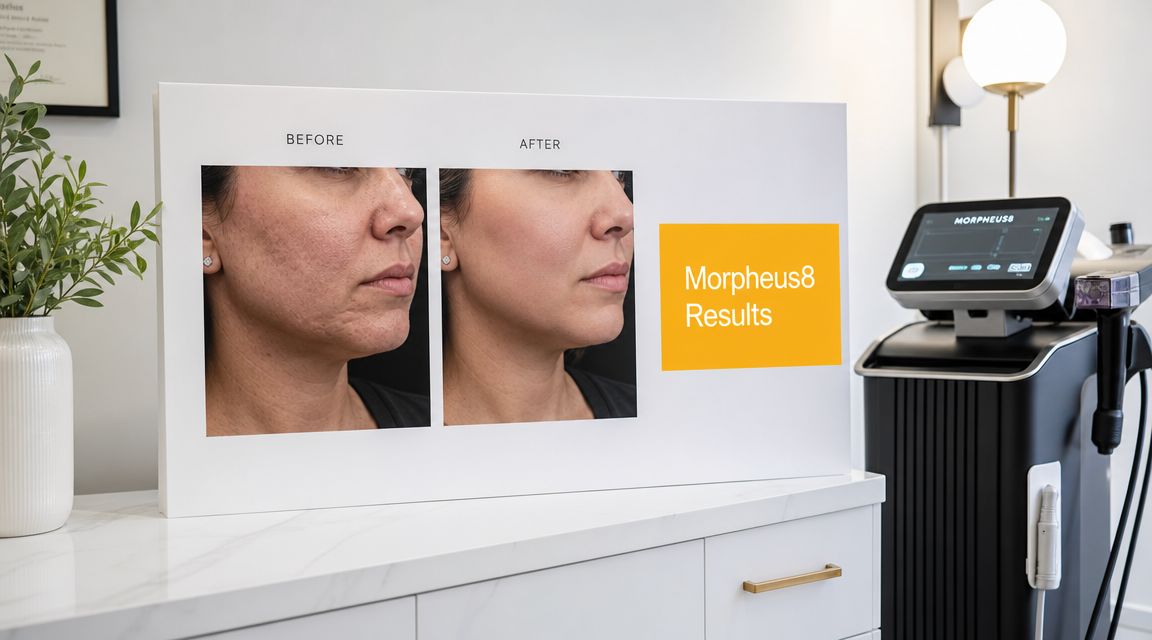
Most Morpheus8 before and after galleries answer the wrong question. They show an “after,” but they often don't tell you when that photo was taken, how many sessions the patient had, or whether you're looking at true remodeling versus early swelling. That gap is where patients get misled.
Morpheus8 can improve laxity, texture, and contour, but it works by combining microneedling with radiofrequency energy to stimulate collagen and elastin production in deeper layers of skin, so the best changes usually build gradually rather than appearing overnight. Provider education sources commonly describe the main improvement window as about 3 to 6 months, and many practices use 3 sessions spaced 4 to 6 weeks apart, which is why early photos may understate the final result and later comparison photos often reveal the full story (clinical timing overview from Derm Experts).
This guide looks at seven galleries with a more critical eye, including real patient results from Chernoff Cosmetic Surgery. The goal isn't just to admire polished images. It's to help you evaluate Morpheus8 before and after results the way a practitioner does, so you can spot strong evidence, ask better consultation questions, and set realistic expectations for your own RF microneedling plan.
Table of Contents
- 1. Morpheus8 Before and After Pictures
- 2. RealSelf – Morpheus8 Before & After Photo Library
- 3. SkinSpirit – Morpheus8
- 4. Premier Dermatology Wellesley MA – Morpheus8 Gallery
- 5. Bitar Cosmetic Surgery Institute Fairfax VA – Morpheus8 Photos
- 6. Chicago Aesthetics – Morpheus8 Before & After
- 7. Body+Beauty Lab Philadelphia PA – Morpheus8 Gallery
- Morpheus8 Before & After, 7 Gallery Comparison
- Your Next Step Planning for Natural-Looking Morpheus8 Results
1. Morpheus8 Before and After Pictures
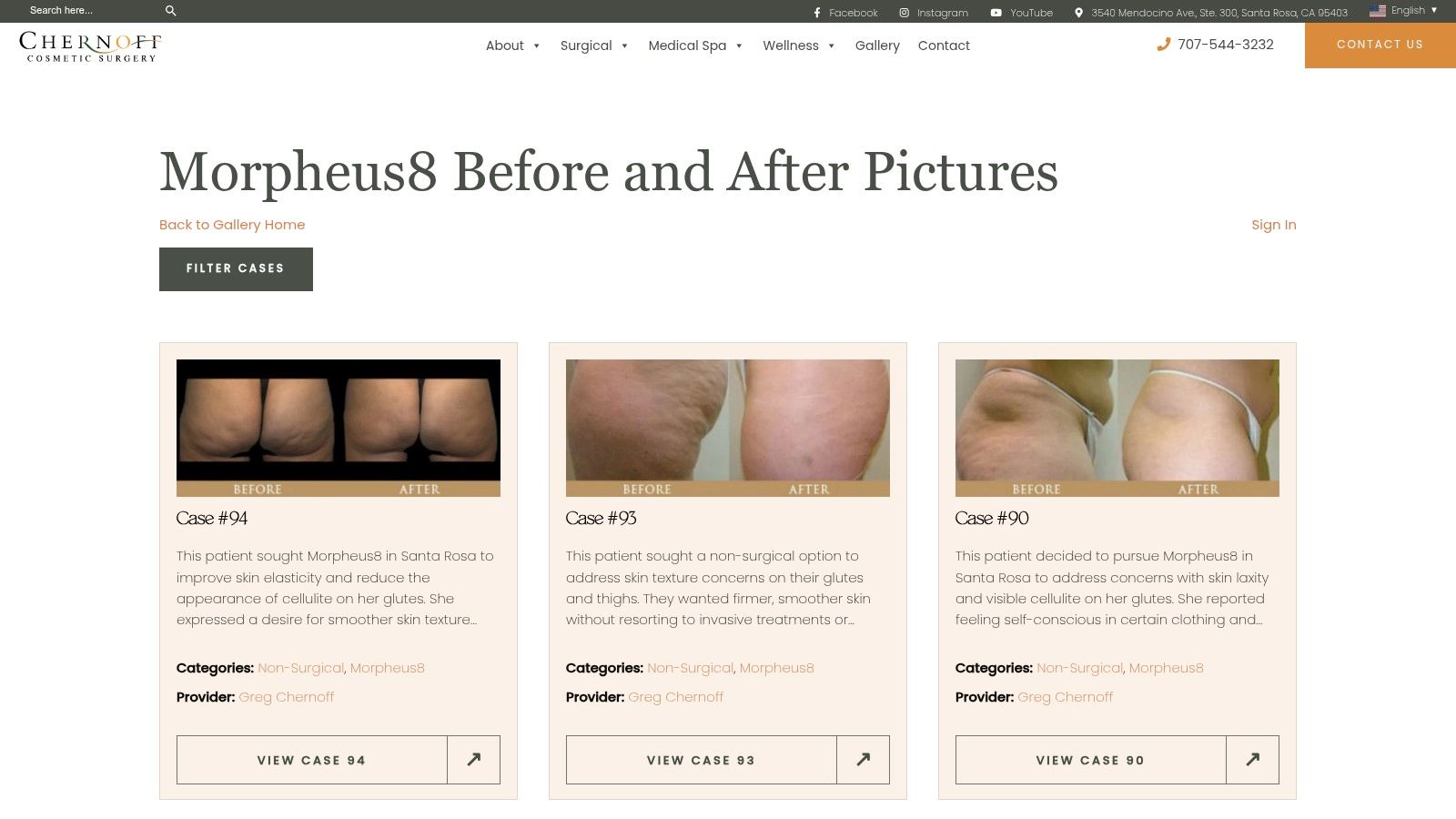
Chernoff Cosmetic Surgery's Morpheus8 before and after gallery is the strongest starting point here because it behaves more like a clinical reference than a generic beauty gallery. The side by side format is clean, cases are individually identifiable, and the range of treatment areas shows that Morpheus8 isn't limited to one “Instagram result” type.
That matters because Morpheus8 can be used for tightening, texture refinement, acne-scar improvement, and contour work across the face, neck, jawline, and body. A gallery that shows only one angle or one patient profile usually hides more than it teaches.
Why this gallery stands out
What I like most is the combination of visual clarity and traceability. When a gallery includes case numbers and provider attribution, patients can reference a specific result during consultation instead of vaguely saying they liked “the third photo down.”
If you're comparing providers, this kind of organization also signals a practice that takes documentation seriously. In aesthetics, consistent documentation usually travels with better planning, better follow-up, and more honest conversations about what a treatment can and can't do.
Practical rule: The best Morpheus8 before and after galleries don't just show improvement. They help you identify which kind of improvement you're seeing, whether that's skin texture, lower-face tightening, scar blending, or body-area smoothing.
Chernoff's educational pages also help connect the gallery to the treatment itself. If you want the procedural background behind those images, the practice's Morpheus8 treatment page explains where RF microneedling fits within a broader non-surgical skin-tightening plan.
What to look for in each case
Use this gallery actively, not passively:
- Check the treatment area: Lower face, neck, abdomen, and acne-scar cases should not be judged by the same standard.
- Look for structural changes: Better jawline definition or softer jowls usually matter more than temporary post-treatment plumpness.
- Ask what's missing: Photos rarely show passes, energy settings, or downtime details, so use the image as evidence of possibility, not a full protocol map.
- Notice consistency: Similar lighting and framing make it easier to trust what you're seeing.
One practical point patients often miss is presentation. A practice that handles visual proof well is also thinking about how patients review results online. Good galleries are part of the larger work of delivering client photos on a website in a way that's organized, understandable, and consultation-ready.
The limitation is the same one every curated gallery has. You're still seeing selected cases, not every outcome. That doesn't make the results unreliable, but it does mean your own treatment plan should be based on your anatomy, laxity level, skin quality, and goals, not on a single favorite photo.
2. RealSelf – Morpheus8 Before & After Photo Library
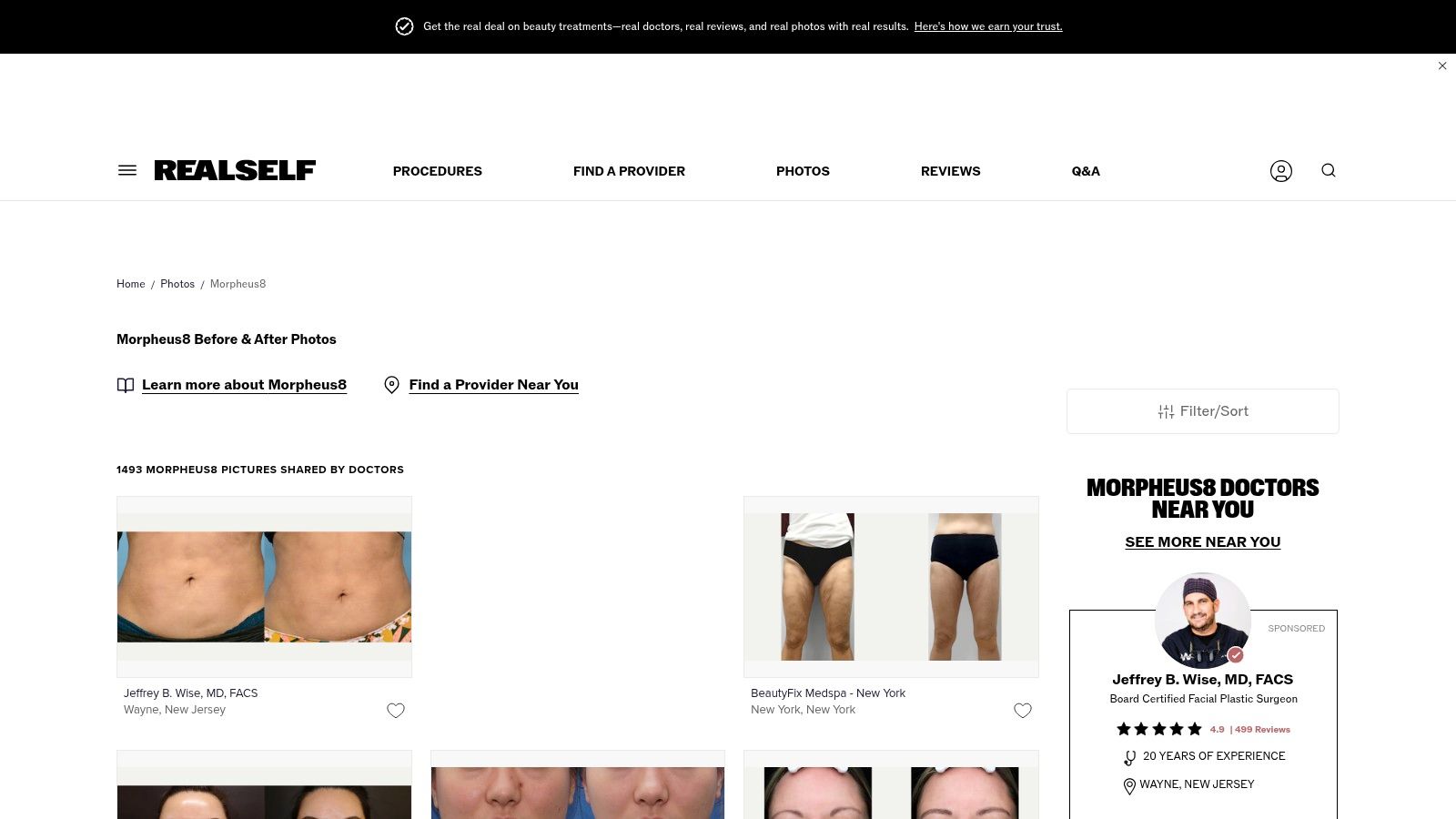
What can a large public gallery show you that a private practice gallery cannot? Range. RealSelf's Morpheus8 photo library lets you compare many different faces, concerns, and treatment areas in one place, which makes it useful early in your research.
Its value is not polish. It is comparison. You can scan results across acne scarring, crepey skin, mild lower-face laxity, and post-inflammatory texture changes without being limited to one office's patient mix or photography style.
How to use RealSelf well
Use this gallery to match your starting point as closely as possible. Look for patients with similar skin thickness, degree of laxity, scar pattern, and treatment area. A strong result on a younger patient with early textural change does not tell you much about what to expect if your main issue is heavier jowling or deeper acne scarring.
Timing matters just as much as anatomy. Morpheus8 usually works as a series, not a one-visit fix, so the most informative photos are the ones that clearly state how many sessions were done and how long after treatment the after image was taken. If that detail is missing, treat the photo as a preview of potential, not proof of a typical endpoint.
At Chernoff Cosmetic Surgery, this is one reason we advise patients to learn the mechanics of radiofrequency microneedling treatment for skin tightening and texture improvement before they judge photos. Once you understand that needle depth, energy delivery, and treatment spacing all affect outcome, the gallery becomes easier to read critically.
For patients who are still learning the technology, Chernoff's overview of Morpheus8 skin rejuvenation is a useful companion because it explains the treatment in a more controlled clinical context than a public review platform can.
Where it can mislead you
RealSelf combines doctor-submitted and patient-submitted images, and that creates uneven evidence quality.
Some photos are taken with consistent lighting, neutral expression, and repeatable angles. Others are not. A slight chin lift, softer light, makeup, or a different camera distance can make lower-face tightening look stronger than it is. In consultation, I tell patients to trust changes in contour, scar edges, and skin creping more than changes in glow.
The practical takeaway is simple. Use RealSelf for pattern recognition and question-building. Then verify what you saw with a practice-specific gallery, where technique, treatment planning, and follow-up are easier to assess.
3. SkinSpirit – Morpheus8
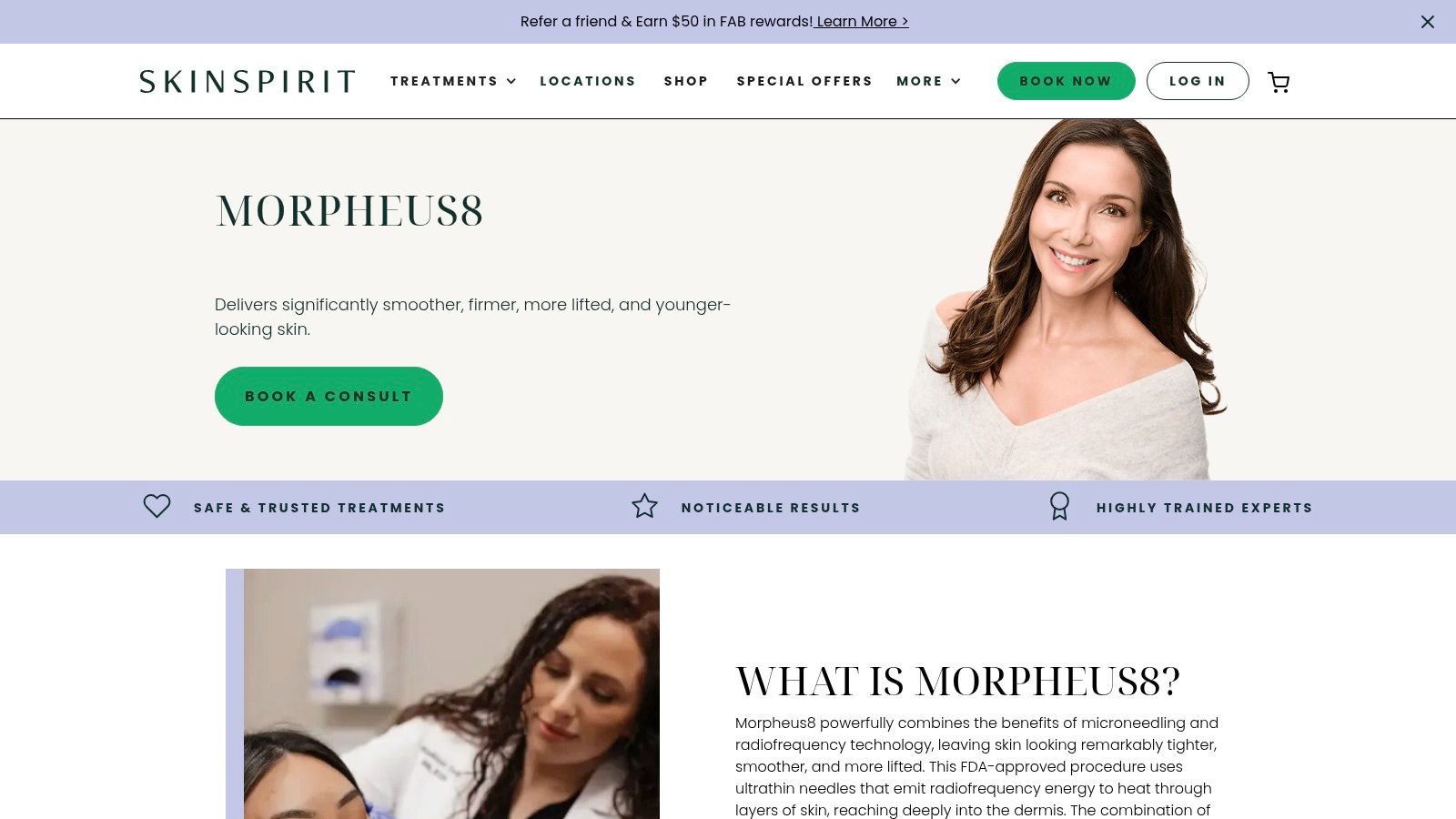
SkinSpirit's Morpheus8 page is useful for a different reason. It gives you the feel of a multi-location system that aims for protocol consistency, and that helps when you're trying to compare outcomes across more than one office.
For patients who move often, travel, or want a med spa network rather than a solo practice, that consistency has practical value. Standardized education and photography can make browsing easier.
Why network consistency helps
When photos are curated under one brand standard, the before and afters are easier to read. You're less distracted by wildly different formatting, and that makes it simpler to focus on the clinical question: did the skin get firmer, smoother, or more even?
Treatment depth directly affects the entire result profile. Morpheus8 is reported to reach up to 4 mm on the face and up to 7 to 8 mm with deeper handpieces for body or fat remodeling, which helps explain why some galleries show mainly textural change while others show more contour-related improvement (evidence-based protocol summary from La Belle Vie Med Spa).
If you're comparing Morpheus8 with other RF microneedling options, Chernoff's RF microneedling overview is helpful because it frames where this technology sits among neighboring treatments rather than treating every device as interchangeable.
What still needs confirmation
The weakness of network pages is that they often smooth out local variation. One office may have excellent technique and another may offer the same device under the same brand umbrella.
So if you like what you see on SkinSpirit, don't stop there. Ask who performs the treatment at your specific location, what concerns they treat most often, and whether the gallery reflects that exact office or the larger brand.
4. Premier Dermatology Wellesley MA – Morpheus8 Gallery
Premier Dermatology's Morpheus8 gallery is a good example of a smaller physician-led gallery that rewards careful viewing. It won't give you the volume of a national platform, but that's not always the point.
Some of the best educational galleries are smaller because they emphasize controlled photography and incremental change instead of dramatic marketing.
Good for subtle-result readers
If you tend to distrust flashy afters, this style is worth your time. Morpheus8 often produces gradual improvement in firmness, texture, and scar blending over months, especially when treatment is performed as a series rather than judged after a single early follow-up.
That's why subtle but believable changes can be more informative than dramatic transformations. In real practice, many patients aren't trying to look different. They want the jawline a bit cleaner, the skin a bit firmer, and acne scarring less obvious in normal lighting.
Why dermatology context matters
Dermatology-led practices can also be especially useful for patients with pigment concerns, acne-scar history, or skin-of-color questions. Independent dermatology commentary on RF microneedling notes that the technology is often used in darker skin because insulated needles and controlled depth may reduce epidermal thermal injury, but outcomes still depend heavily on settings, operator skill, and aftercare (skin-tone and PIH discussion from Sculpted Contours).
If a gallery says “safe for all skin tones” but doesn't show varied skin tones or discuss pigment risk, treat that as incomplete education, not reassurance.
Premier's gallery won't answer every question by itself, but the dermatology setting is a plus for patients who care as much about safety and complication avoidance as they do about tightening.
5. Bitar Cosmetic Surgery Institute Fairfax VA – Morpheus8 Photos
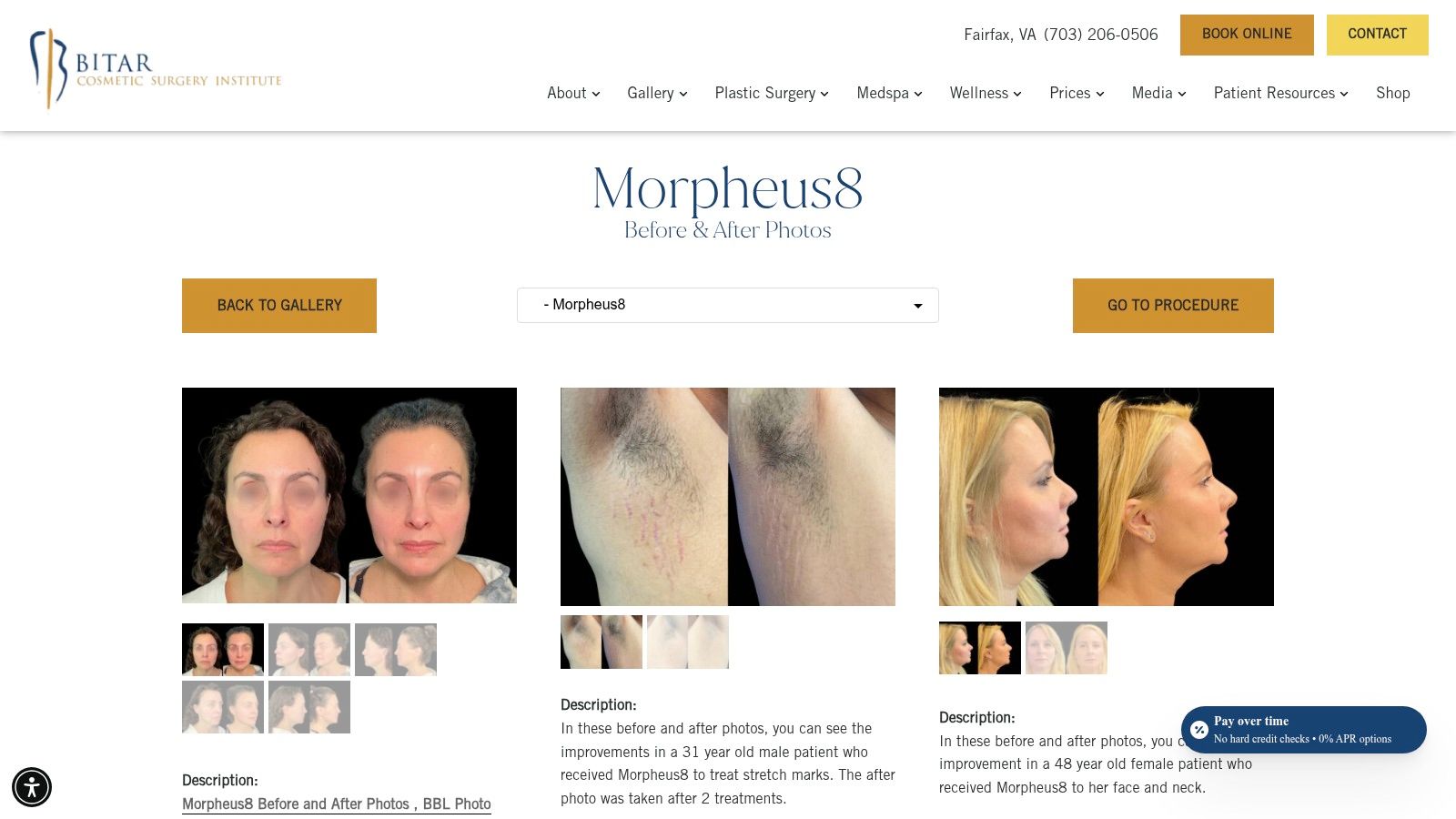
Bitar Cosmetic Surgery Institute's Morpheus8 gallery is especially useful if you're trying to answer a harder question: should I keep this non-surgical, or am I really a surgery candidate?
That's where plastic surgery practice galleries often outperform med spa galleries. They place Morpheus8 in the context of other options instead of implying that one device should solve every degree of laxity.
Useful for surgery versus non-surgery decisions
The strongest use case here is lower face, neck, and body comparison, including male cases and non-facial concerns. That broader case mix helps patients avoid a common mistake, which is assuming every area responds with the same level of improvement.
Clinical literature supports that more cautious reading. In a multicenter retrospective study of lower-face and neck treatment using a combination protocol that included a Morpheus8-modified fractional bipolar RF handpiece, the pretreatment Baker Face/Neck Classification mean improved from 2.62 to 1.84, and the overall model was statistically significant (multicenter study in PMC).
How to read moderate-impact results honestly
That same study is useful for setting expectations because it reinforces that RF microneedling is best viewed as a moderate-impact remodeling tool for mild-to-moderate laxity or as an adjunct to surgery, not a replacement for a facelift in advanced jowling or neck laxity.
Patients appreciate honesty here. If your issue is early looseness, skin crepiness, or modest contour blur, Morpheus8 may fit well. If you have heavier tissue descent, a gallery inside a surgical practice can help you recognize when a device result is respectable but not equivalent to lifting surgery.
One operational point also matters. Practices that offer both paths often get better at optimizing patient interactions because consultations center on matching the procedure to the anatomy, not pushing every patient toward the same menu item.
6. Chicago Aesthetics – Morpheus8 Before & After
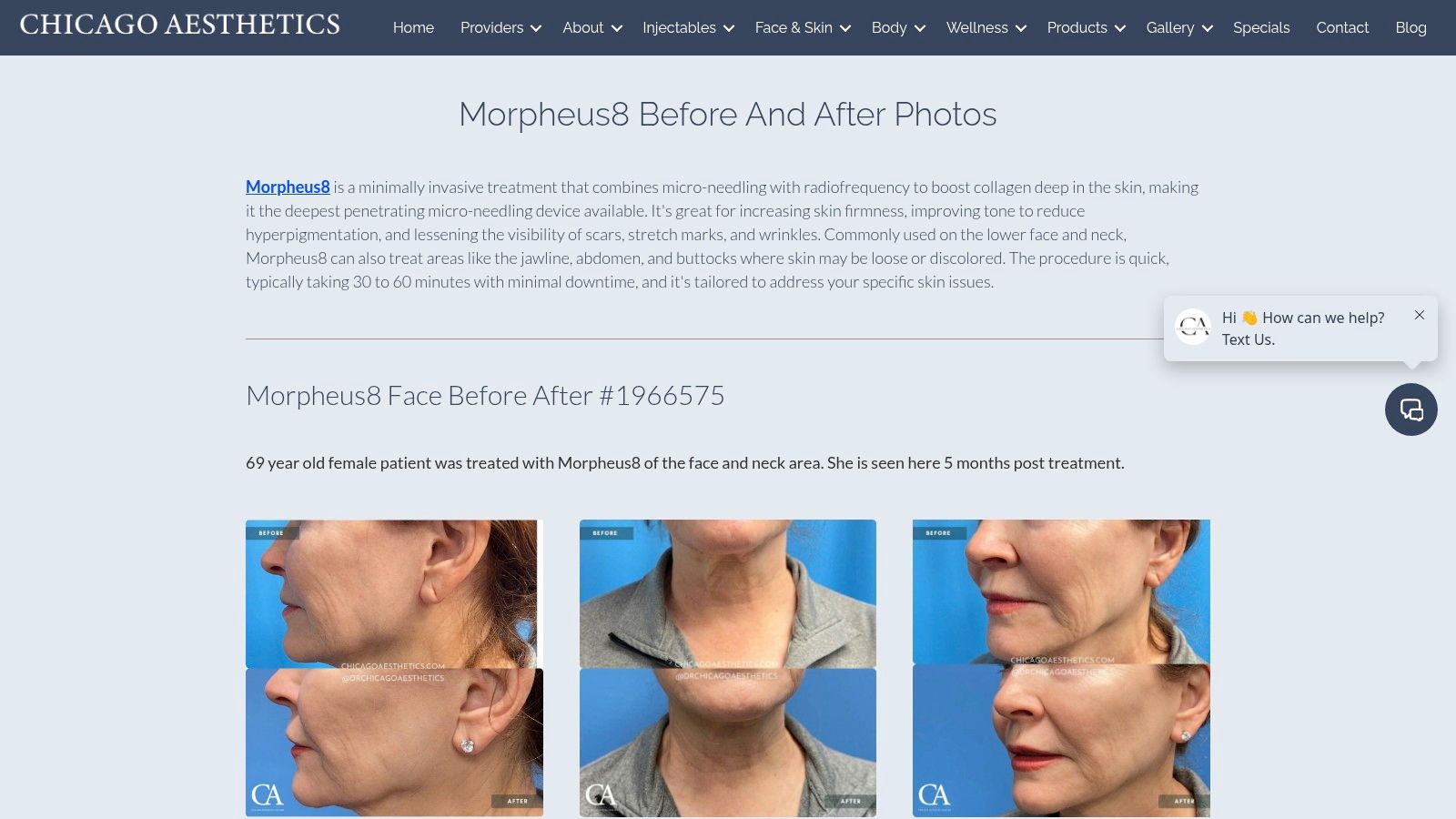
Chicago Aesthetics' Morpheus8 gallery earns its place because it labels treatment areas clearly. That sounds simple, but it solves one of the most common gallery problems. Too many practices show a result without telling you what was treated.
When a gallery distinguishes lower face from abdomen or buttocks, patients can make better comparisons and avoid expecting body-skin changes to look like facial contour changes.
Helpful for body-area comparisons
This is one of the better formats for readers researching non-facial applications. Many Morpheus8 galleries lean heavily toward jawline photos because they're familiar and marketable. Body cases are often more relevant for patients with textural change, mild laxity, or stretch-mark concerns, yet they're underrepresented.
The value here is practical, not glamorous. If you're deciding whether Morpheus8 makes sense beyond the face, labeled body cases help you compare what the device appears to do on thicker skin and larger treatment areas.
What photo labeling does well
There's another advantage to specific area labeling. It encourages more realistic discussions about sequencing and timing. Clinical guidance commonly recommends a series of 1 to 3 sessions spaced about 4 to 8 weeks apart, with visible improvement continuing for up to three months or longer after treatment (timing guidance from Cosmetic Skin Clinic).
That's exactly why a single “after” image can be misleading if the timeline isn't obvious. Clear labels aren't enough on their own, but they push the gallery in the right direction by grounding the result in a specific treatment target.
7. Body+Beauty Lab Philadelphia PA – Morpheus8 Gallery
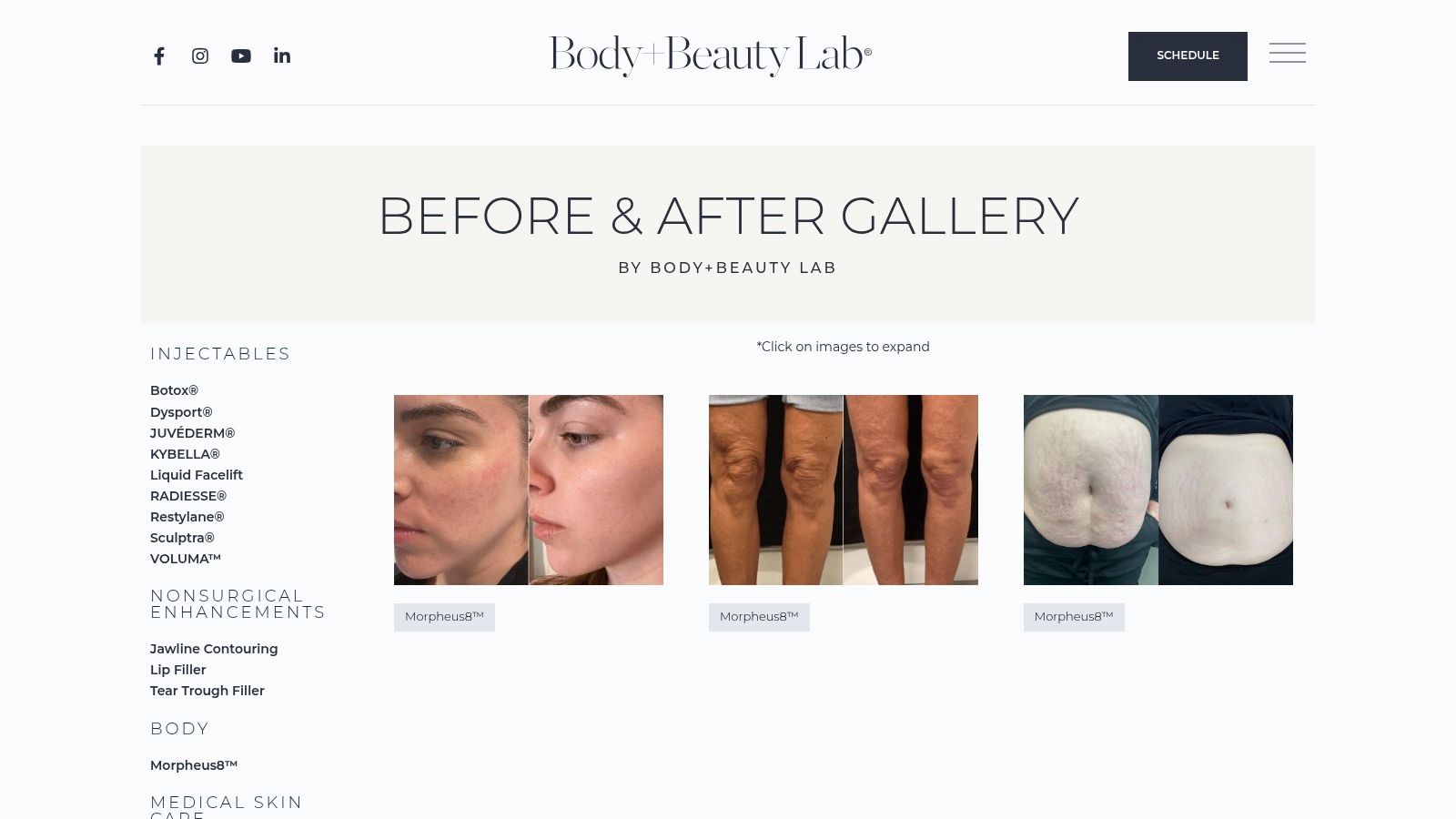
What can a med spa gallery tell you that a surgical gallery may not? Often, it shows how Morpheus8 is presented in real maintenance planning, where patients are treating texture, mild laxity, or acne scarring as part of a longer skin program rather than chasing a single dramatic endpoint.
Body+Beauty Lab's Morpheus8 gallery is useful for that reason. The gallery sits in a practice setting where combination care, repeat visits, and treatment sequencing are part of the patient journey. For readers comparing before-and-after photos critically, that context matters. At Chernoff Cosmetic Surgery, I would view this type of gallery less as proof of maximum change and more as evidence of how providers frame Morpheus8 in ongoing care.
Best for patients evaluating long-term treatment planning
This gallery is a reasonable stop if you want to see Morpheus8 across more than one treatment area and understand where it may fit alongside other aesthetic options. That can help patients ask better questions during consultation, especially if their goal is gradual improvement in skin quality rather than a major one-time change.
The clinical trade-off is straightforward. Maintenance-focused galleries often give you a broader view of how the treatment is used, but less detail about session count, settings, or exact timing of each photo. Those details shape outcomes. Morpheus8 relies on radiofrequency energy delivered through microneedling depths that vary by concern and by body area, so a face result and a body result should not be judged by the same standard.
How to read this gallery carefully
Use this gallery for pattern recognition, not for prediction.
Check whether the photos make the treatment area obvious. Then ask whether the visible improvement looks like textural refinement, skin tightening, scar softening, or a mix of those changes. If the gallery does not clearly tell you how many sessions were performed or when the after photo was taken, keep your expectations conservative. As noted earlier in the article, visible change often builds over a series and continues to develop after treatment rather than appearing all at once.
The strongest before-and-after photos do more than show improvement. They show enough context for you to judge whether the result matches your concern, your timeline, and your skin quality.
That is where med spa galleries can still be helpful. They often reflect actual questions patients bring into consultations: Will I need maintenance? Will I combine this with other treatments? Is my goal tightening, resurfacing, or both? If you use the gallery with those questions in mind, it becomes more informative than a simple collection of attractive after photos.
Morpheus8 Before & After, 7 Gallery Comparison
| Source | Complexity 🔄 | Resources ⚡ | Expected outcomes ⭐ | Ideal use cases 💡 | Key advantages 📊 |
|---|---|---|---|---|---|
| Morpheus8 Before and After Pictures (Chernoff) | Low, easy gallery browsing | Low, practice‑hosted images, no vetting needed | Clear, clinic‑curated examples of tightening/resurfacing across areas | Patient education; consult preparation | Transparent case IDs and provider credits for traceable examples |
| RealSelf – Morpheus8 Photo Library | Moderate, many filters and submissions to sort | Moderate–high, large, mixed‑quality dataset | Wide range of real‑world results across skin types and timelines | Broad visual research and cost/clinic comparison | Scale and robust filters for finding comparable cases |
| SkinSpirit – Morpheus8 (med‑spa network) | Low, consistent site format across locations | Moderate, multi‑state clinics with brand protocols | Consistent, brand‑standard outcomes for easier comparison | Users seeking repeatable protocols and easy booking | Standardized photography and national access/booking |
| Premier Dermatology – Morpheus8 Gallery | Low, focused dermatology gallery | Moderate, physician‑led protocols and medical oversight | Standardized photos emphasizing pigment‑safe RF microneedling | Patients prioritizing medical oversight or combo medical treatments | Physician‑directed care and consistent imaging for comparison |
| Bitar Cosmetic Surgery Institute – Morpheus8 Photos | Low, institute gallery, surgeon‑led | Moderate, access to surgical pairing and body cases | Examples including male and body applications (stretch marks) | Evaluating body treatments or surgical + RF combinations | Surgeon access and portfolio for non‑facial indications |
| Chicago Aesthetics – Morpheus8 Before & After | Low, straightforward regional gallery | Low, regional clinic resources | Clear labeled examples of facial and non‑facial areas | Midwest users seeking in‑person evaluation | Focused layout and labeled treated areas for quick comparison |
| Body+Beauty Lab – Morpheus8 Gallery | Low, med‑spa style gallery | Moderate, med‑spa add‑ons and maintenance plans | Examples oriented to body tightening and texture improvement | Researching body outcomes and ongoing maintenance plans | Mix of body/face cases and multi‑modality maintenance options |
Your Next Step Planning for Natural-Looking Morpheus8 Results
Once you know how to read Morpheus8 before and after photos critically, the consultation becomes much more productive. You're no longer asking, “Does Morpheus8 work?” You're asking the right questions: Was this lower-face laxity or mainly texture? How many sessions did this person likely need? Is this the ceiling for a non-surgical result, or would surgery create a more proportional outcome?
That shift matters because Morpheus8 works best when it's matched to the right anatomy and the right goal. It's a strong option for patients who want progressive collagen remodeling, modest tightening, textural improvement, and better contour without surgery. It's a weaker fit for advanced tissue descent where lifting, not remodeling, is the main need.
At consultation, focus on a few things. Ask to see patients with concerns that match yours. Ask when the after photos were taken. Ask whether your plan is likely to be a single treatment, a short series, or part of a longer maintenance strategy. And ask what the provider would recommend if Morpheus8 were not the best answer, because that question often reveals how objective the consultation really is.
At Chernoff Cosmetic Surgery, that broader perspective is one of the practice's biggest strengths. Dr. Greg Chernoff leads a practice built around both surgical and non-surgical rejuvenation, which means treatment planning doesn't have to force every patient into the same lane. For some people, Morpheus8 is the right way to improve skin quality and mild laxity. For others, it works better as part of a combined plan or as a complement to another procedure.
Patients usually get the most natural-looking outcomes when the plan respects the difference between skin texture, skin quality, volume loss, and tissue descent. Those aren't the same problem, and one gallery photo won't tell you which one you have.
If you're ready to move from browsing to planning, a personalized consultation is the next step. That's where your anatomy, your timeline, your skin type, and your tolerance for downtime come together into a treatment plan that fits.
If you're considering Morpheus8 and want a clear, honest opinion on whether it matches your goals, schedule a consultation with Chernoff Cosmetic Surgery. The team can help you interpret before and after photos realistically, compare non-surgical and surgical options when appropriate, and build a plan focused on safe, natural-looking results.