
You may be looking in the mirror and seeing acne that has long since healed, but the marks it left behind still change how your skin catches light. Makeup settles into shallow depressions. Bright bathroom lighting makes old breakouts look newer than they are. You've probably tried creams, exfoliants, and “scar fading” products, only to find that texture doesn't respond the way discoloration sometimes does.
That frustration is real. So is the good news. Acne scar laser treatment can make scars significantly less noticeable, improve skin texture, and soften the uneven surface that often keeps skin from looking smooth. What it can't do is promise total erasure. The American Academy of Dermatology states that laser treatment “cannot get rid of a scar” and instead replaces it with a “less-noticeable scar,” with most patients seeing about 30% to 70% improvement rather than perfection, as explained in the AAD guidance on laser treatment for scars.
That's the mindset that leads to better decisions and better results. If your goal is realistic improvement, not a sales-pitch fantasy, laser treatment becomes much easier to understand. It's one part of a thoughtful scar revision plan, often layered with other treatments depending on your scar pattern, skin tone, and tolerance for downtime.
Table of Contents
- Erasing the Echoes of Acne for Smoother Skin
- How Lasers Resurface Skin and Remodel Scars
- A Comparison of Leading Acne Scar Lasers
- Determining If You Are a Candidate for Treatment
- Your Laser Treatment Journey From Consultation to Recovery
- Combining Therapies for Superior Scar Revision
- Choosing Your Expert and Taking the Next Step
- Frequently Asked Questions About Laser Treatment
Erasing the Echoes of Acne for Smoother Skin
Acne scars often bother patients long after breakouts stop. The inflammation is gone, but the skin still shows pits, edges, redness, or waviness that skincare alone can't reliably correct. That's because a scar is a structural change, not just a surface stain.
Many people start treatment after they've done everything that seemed reasonable at home. If you're still dealing with active breakouts, it can help to review the basics first in this acne 101 guide, because controlling acne and treating scars are related, but they are not the same task.
Improvement matters more than the word erase
The most important expectation to set at the beginning is simple. Laser treatment is designed to improve scars, not delete them. When patients understand that from day one, they're much more likely to be satisfied with the process and to choose the right treatment intensity.
Clinical reality: The best outcomes come from pursuing smoother, more even skin, not chasing the impossible idea of flawless, never-scarred skin.
A thoughtful acne scar plan usually aims to reduce contrast. Less shadow. Softer edges. Better texture. More uniform tone. Those changes can make a face look dramatically fresher even when some scar evidence remains.
Why treatment plans work better than one-off sessions
Scars don't all behave the same way. Some are tethered down. Some are sharply edged. Some are red. Some are broad and shallow. A single laser setting won't fix every one of those problems.
That's why evaluation matters. A provider has to decide whether your skin would benefit most from resurfacing, collagen stimulation, scar release, or a combination of these approaches. For a broader look at options patients commonly consider, this overview of acne and acne scarring treatments is a helpful starting point.
How Lasers Resurface Skin and Remodel Scars
A patient often comes in expecting a laser to erase years of acne damage in one treatment. The more accurate goal is smoother texture, softer scar edges, and less visible shadowing over time. That distinction matters, because laser resurfacing works through controlled repair, and good results usually come from a plan rather than a single procedure.
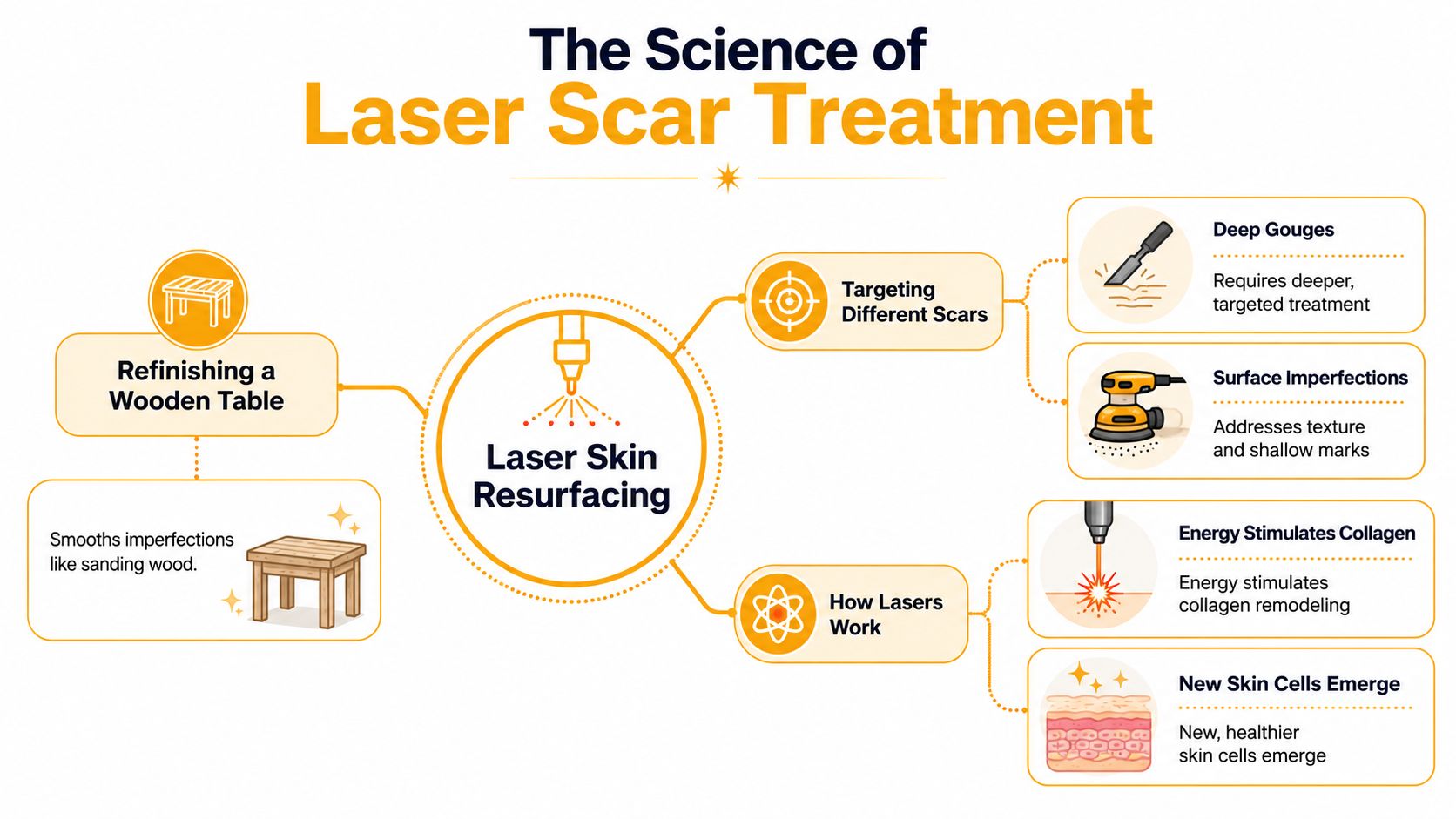
Laser energy creates precise injury in the skin so the body replaces disorganized scar tissue with healthier collagen. The surface may become smoother, but the main change occurs as the dermis remodels during healing. That is why results develop gradually, and why scar improvement depends on both the device and the biology of your skin.
Ablative lasers work by resurfacing and stimulating repair
Ablative lasers remove microscopic columns or layers of skin and trigger a stronger wound-healing response. In acne scarring, that makes them useful for deeper textural change, especially when scars are sharply defined or the skin surface feels uneven to the touch.
Fractional ablative resurfacing has been studied for acne scar revision because it treats only a fraction of the skin at a time while leaving surrounding tissue intact to speed healing. A review in Seminars in Plastic Surgery describes fractional photothermolysis as a method that creates controlled zones of injury to promote collagen remodeling while shortening recovery compared with fully ablative resurfacing. You can read that review here: fractional laser resurfacing in plastic surgery.
These treatments can produce meaningful improvement, but they ask more of the patient. Redness, swelling, crusting, and several days of social downtime are common. In the right candidate, that trade-off is often reasonable.
Nonablative lasers work deeper with less surface disruption
Nonablative lasers heat tissue below the surface while keeping the outer layer more intact. They are generally less aggressive per session, but recovery is easier and the visible healing period is shorter. That makes them useful for patients who cannot take much downtime or who need a more cautious approach because of pigment risk.
This does not make nonablative treatment weaker in every situation. It makes it different. For mild to moderate textural change, early scars, or maintenance after stronger procedures, nonablative devices can play an important role.
The laser starts the process. Your healing response determines how much remodeling you see.
What happens after treatment
The first phase is inflammation. Then fibroblasts begin laying down new collagen, and the scar architecture starts to reorganize. Over the following weeks and months, depressed scars may look less sharp because the contour has improved.
This timeline is one reason I spend so much time on expectations. If a scar is tethered, rolling, or very deep, laser treatment alone may not be enough to release it or raise it adequately. Those scars often improve more when resurfacing is paired with other procedures selected for the scar pattern. Patients exploring different medical spa laser treatments should understand that the best plan usually combines the right technology with the right sequence.
The goal is significant improvement that looks natural and safe for your skin type. That is how laser treatment should be judged.
A Comparison of Leading Acne Scar Lasers
Two patients can sit in my office with the same complaint and need very different treatment plans. One has deep boxcar scars and can take a week of visible recovery. The other has milder textural change, darker skin, and needs to be back at work quickly. In acne scar revision, the best laser is the one that fits the scar pattern, skin tone, and downtime a patient can realistically accept.
Fractional CO2 laser
Fractional CO2 is still one of the strongest tools for atrophic acne scars, especially when texture change is pronounced and the scar edges are more sharply defined. It removes columns of damaged skin and creates enough thermal effect to drive meaningful collagen remodeling over time.
That strength comes with trade-offs. Recovery is more noticeable, redness can last longer, and pigment changes are a bigger concern in some skin types. Patients who choose CO2 usually do so because they want stronger correction and understand that treatment is a process of improvement, not total removal of every scar.
For patients considering carbon dioxide resurfacing specifically, this overview of fractionated CO2 laser treatment explains how that category is commonly used in practice.
Picosecond and erbium-based options
Picosecond devices can help selected atrophic scars, particularly when the goal is visible improvement with a more conservative recovery profile than traditional aggressive resurfacing. In practice, I view them as useful in the right patient, not as a universal replacement for ablative resurfacing. Scar depth, skin tone, and prior treatment history still determine how much improvement is realistic.
Erbium-based fractional resurfacing also has a place. It is often chosen when an ablative treatment makes sense but a somewhat lighter approach than CO2 is preferable. That can be a reasonable middle ground for patients who want resurfacing benefits while limiting heat-related risk and downtime.
Nonablative Nd:YAG laser
The 1,064 nm Nd:YAG laser is often a practical option for mild to moderate scarring, especially in patients who want minimal interruption to daily life. It tends to be better tolerated, and it is commonly favored when pigment safety is a major priority.
The limitation is straightforward. Results are usually more gradual and often less dramatic per session than stronger ablative resurfacing. For the right patient, that is an acceptable exchange. A safer course with lower downtime can be the better decision than pushing intensity and creating avoidable risk.
Quick comparison table
| Laser Type | Best For | Average Downtime | Typical Improvement |
|---|---|---|---|
| Fractional CO2 | Deeper atrophic scars, stronger texture change | Visible recovery often required | Often produces the strongest textural improvement, but usually needs recovery time and careful aftercare |
| Picosecond | Selected atrophic scars when balancing improvement and pigment safety | Usually less disruptive than aggressive ablative resurfacing | Can improve scar appearance in well-chosen cases, often as part of a staged plan |
| Nonablative 1,064 nm Nd:YAG | Mild-to-moderate scarring, darker skin tones, low downtime goals | Minimal downtime | More gradual improvement, often best for patients prioritizing safety and convenience |
| Erbium-based fractional resurfacing | Selected textural scars when a less aggressive ablative option fits | Moderate recovery depending on settings | Useful middle-ground option in carefully selected patients |
No single laser is best for every acne scar.
The practical question is which device can improve your scars meaningfully while keeping recovery time and pigment risk within reason. In many cases, the strongest result does not come from one laser alone. It comes from choosing the right laser, using the right settings, and fitting it into a treatment plan that may also include other procedures for tethering, depth, or contour irregularity.
Decision rule: Match the device to the scar, the skin tone, and the patient's recovery tolerance. Don't choose a laser by brand familiarity alone.
Determining If You Are a Candidate for Treatment
A patient may sit in my office convinced that laser treatment will erase years of acne scarring in one session. The better starting point is accuracy. Good candidates can see meaningful improvement, but the right plan depends on scar type, skin tone, acne control, healing history, and how much downtime is realistic.
Scar pattern matters
Candidacy starts with diagnosis, not device selection. Acne scars do not all respond to laser treatment in the same way, and surface resurfacing has clear limits.
- Ice pick scars: Narrow, deep scars that often extend beyond the depth a laser can fully remodel. These commonly need a staged approach and may improve more with focal techniques than with laser alone.
- Boxcar scars: Wider depressions with sharper edges. These often respond better to resurfacing because the scar shape is more accessible to controlled skin remodeling.
- Rolling scars: Broad, sloped depressions caused by fibrous bands pulling the skin downward. If that tethering is not released, laser treatment alone may soften texture without adequately lifting the scar.
That distinction matters because the goal is not to force every scar into a laser-only plan. The best result often comes from matching each scar feature to the treatment that addresses it directly.
Skin tone changes treatment choice
Skin tone affects safety as much as appearance. Patients with more melanin in the skin can have a higher risk of post-inflammatory hyperpigmentation after aggressive resurfacing, especially if the skin is recently tanned, irritated, or prone to lingering discoloration.
That does not mean darker skin tones cannot be treated. It means settings, device choice, and pre-treatment preparation need to be more conservative and more deliberate. In practice, I often frame this as a trade-off between speed and margin of safety. More aggressive treatment may promise faster textural change, but it can also raise the chance of pigment problems that take months to settle.
Active acne and healing history matter
Laser scar treatment works best when the acne itself is under control. If new inflamed breakouts are still forming, it is often smarter to stabilize the skin first. Treating scars while fresh acne continues can blur the result and make timing less predictable.
Medical history also changes the plan. Extra caution is warranted in patients with a history of abnormal scarring, delayed healing, frequent cold sores, active skin infections, or medication use that affects recovery. Recent sun exposure matters too. Skin that is irritated or tanned is less forgiving.
A good candidate has realistic goals
The strongest predictor of satisfaction is not scar severity alone. It is whether expectations match what treatment can deliver.
Laser treatment can improve texture, soften edges, and make scars less noticeable in normal social distance and everyday light. It does not usually return scarred skin to untouched skin. Patients who understand that often do very well, especially when they are open to a plan that may involve several sessions and more than one procedure type.
The right candidate is not the person chasing perfect skin. It is the person ready for a careful plan that improves scars significantly while protecting skin health.
Your Laser Treatment Journey From Consultation to Recovery
The actual process is usually less mysterious than patients expect. Anxiety often comes from not knowing what happens before, during, and after treatment. Once the sequence is clear, patients feel far more prepared.
The consultation sets the direction
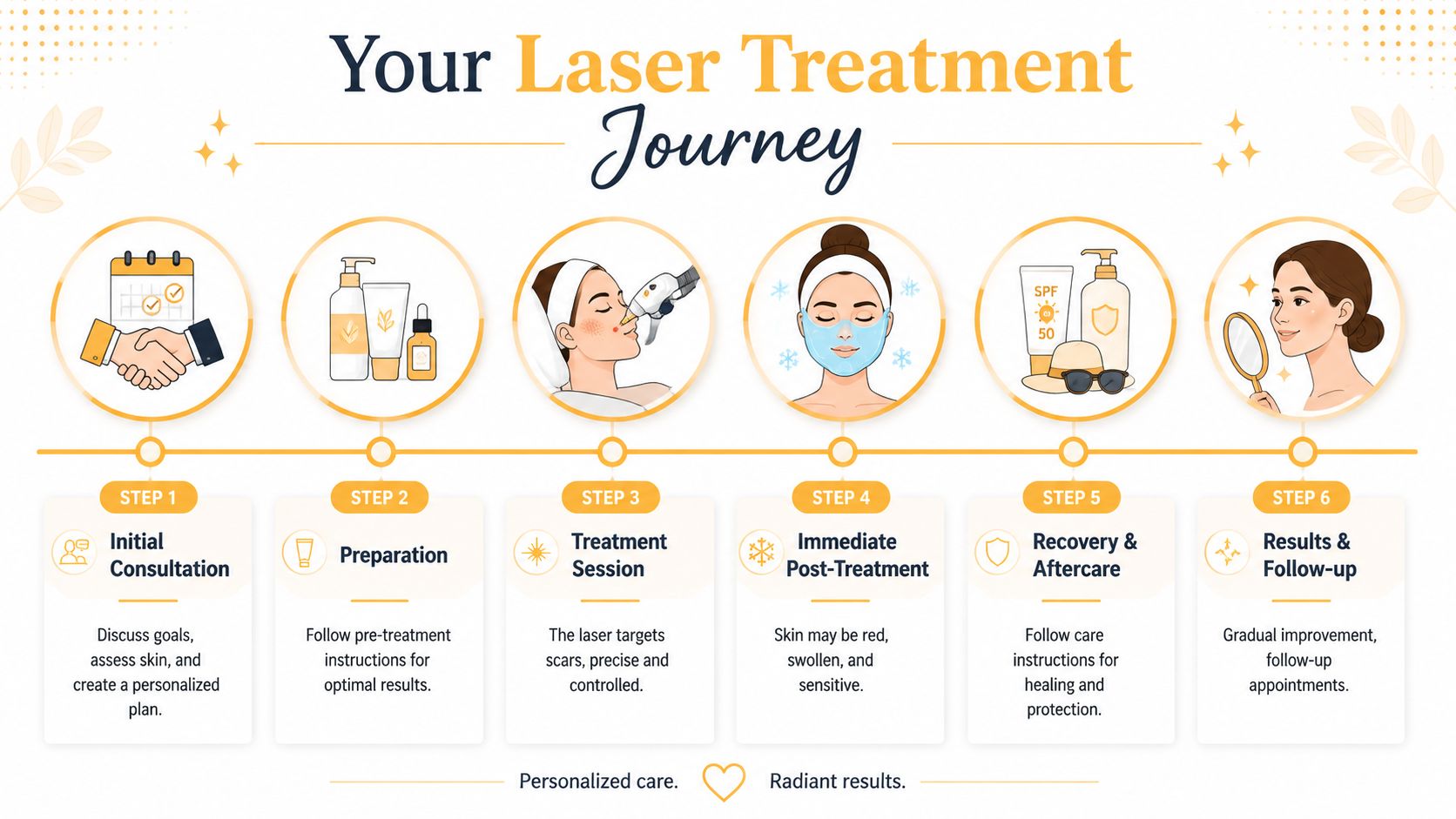
A proper consultation looks at more than scar depth. The provider should examine scar type, skin tone, current acne activity, pigment history, medical history, and your tolerance for visible recovery. That's how a realistic treatment plan gets built.
Bring clear questions. Ask what type of scars you have. Ask whether laser is the main treatment or only one part of the plan. Ask what kind of improvement is realistic for your skin, not for a generic online before-and-after gallery.
Before treatment
Pre-treatment instructions vary by laser and skin type, but the principle is consistent. The skin should be calm, protected, and well-prepared. You may be asked to avoid excess sun exposure and to pause irritating products.
This isn't busywork. Preparation lowers the chance of preventable complications and helps the skin heal more predictably.
During the session
Most laser sessions are performed in office. Depending on the device and intensity, topical numbing, cooling, or other comfort measures may be used. Patients describe the sensation in different ways, but many say it feels sharp, hot, or prickly in brief bursts.
The treatment itself is controlled and methodical. The provider adjusts settings based on the area being treated and the skin's response.
Right after and in the recovery window
Immediately after treatment, the skin may look red, swollen, and feel warm or tight. More intensive resurfacing can also bring crusting, bronzing, or peeling as the skin sheds and renews itself.
Recovery is not one-size-fits-all. Some patients return to routine quickly after gentler treatment. Others need a more social recovery period with visible redness and swelling. The key is following aftercare precisely, especially around cleansing, moisturization, and sun protection.
Healing skin is vulnerable skin. The quality of your aftercare influences the quality of your result.
When results become visible
Results don't arrive all at once. Early changes may include smoother feel or better light reflection. Further improvement develops gradually as collagen remodeling continues.
That delayed improvement is one reason patients shouldn't judge a result too quickly. What matters is the trend over time, not how the skin looks in the first few days.
Combining Therapies for Superior Scar Revision
A patient may come in asking for “laser scar removal,” then I examine the skin and find three separate problems in the same area. One scar is tethered. Another has broad shallow edges. A third is mostly leftover redness. That patient does not need one stronger laser session. That patient needs the right sequence of treatments.
This matters for expectations as much as results. Laser treatment can produce meaningful improvement in texture, contour, and overall skin quality, but acne scars are rarely erased completely. The best plans aim to make scars far less noticeable in normal light and at conversational distance.
Why combination plans make sense
Acne scarring is a mixed-condition problem. Rolling scars often need release under the skin. Boxcar scars may respond well to resurfacing. Red marks behave differently from true depressions. Post-inflammatory pigment changes are a tone issue, not a depth issue.
Using one tool for all of that usually leaves part of the problem untreated. In practice, I match the treatment to the scar behavior, then decide what order makes sense and how much downtime and pigment risk the patient is willing to accept.
A patient with darker skin, recent acne activity, or a history of post-inflammatory hyperpigmentation may need a more measured plan. Slower treatment is sometimes the safer treatment.
Treatments that often complement lasers
- Subcision: Often the first step for rolling scars that are pulled downward by fibrous bands. If the scar is tethered, resurfacing the top layer alone will not release that pull.
- Fillers: Useful in selected depressed scars, either as a temporary test of contour improvement or as part of a staged correction plan.
- RF microneedling: Helps remodel collagen at different depths and can be a good option for patients who want improvement with a different recovery profile than ablative resurfacing.
- Peels or pigment-directed treatments: Better for uneven tone, lingering discoloration, and superficial irregularity than for deep textural defects.
- Medical acne control: Necessary when breakouts are still active. Creating new scars while treating old ones undermines progress.
One practical example is fractionated carbon dioxide resurfacing for acne scar texture, including options such as the DOT laser offered at Chernoff Cosmetic Surgery, paired with other treatments when scars are tethered, vascular, or mixed in pattern.
The best acne scar plan usually improves scars layer by layer, not device by device.
Patients tend to do best when they understand the process before starting. Several treatments, spaced thoughtfully, often outperform a single aggressive session. That approach asks for patience, but it usually gives more even improvement and a safer recovery path.
Choosing Your Expert and Taking the Next Step
The laser matters. The person using it matters more. Acne scar treatment is full of judgment calls about energy, depth, skin response, and when not to treat. That's why provider selection isn't a detail.
What to look for in a consultation
Choose a qualified professional who does four things well:
- Diagnoses the scar correctly: Not every indentation is treated the same way.
- Explains trade-offs clearly: Stronger treatment may mean more downtime and more risk.
- Sets realistic goals: Improvement is the standard. “Perfect skin” is not.
- Offers more than one path: A thoughtful consultation doesn't force every patient into the same device.
A board-certified cosmetic surgeon with extensive facial aesthetic experience brings a deeper understanding of skin healing, contour, and scar behavior. That matters when balancing visible improvement against pigment risk, recovery, and long-term skin quality.
If you're considering treatment, the next step should be a consultation that leaves you more informed, not more pressured.
Frequently Asked Questions About Laser Treatment
A common consultation starts the same way. A patient points to a scar that catches the light and asks whether a laser can erase it. The right answer is more useful than the easy one. Laser treatment can soften edges, reduce depth, and make scars blend better with surrounding skin, but the goal is meaningful improvement, not flawless skin.
Does laser treatment remove acne scars completely
Laser resurfacing improves texture and shadowing. It does not remove every scar completely. Some scars respond well to laser alone, while deeper tethered scars often need other treatments added to the plan for the best result.
How painful is treatment
Discomfort depends on the device, the depth of treatment, and the size of the area being treated. Patients usually describe heat, stinging, or a snapping sensation. Topical anesthetic, cooling, and careful treatment settings make the procedure tolerable for most patients.
How many sessions do most people need
More than one session is common. Scar remodeling takes time, and mixed acne scarring usually does not improve evenly after a single treatment. A realistic plan is built around scar type, skin tone, recovery tolerance, and whether techniques such as subcision, fillers, or microneedling should be combined with laser treatment.
Can I have laser treatment if I still have active acne
Sometimes, but active inflamed acne often needs to be controlled first. Treating scars before breakouts are stabilized can limit results and make it harder to judge which scars are permanent. Once the skin is quieter, treatment planning becomes more accurate.
What should patients of color ask during consultation
Ask how your skin type affects laser selection, settings, pretreatment, and aftercare. Pigment change is one of the main concerns in darker skin tones, so treatment should be planned with caution and adjusted to lower that risk. Recovery can also look different, including more noticeable redness or swelling for a longer period in some patients, which is one reason conservative settings and staged treatment are often the safer approach.
How much does acne scar laser treatment cost
Cost depends on the treatment area, the severity and type of scarring, the device selected, and the number of sessions required. Combination treatment also changes pricing. An in-person evaluation is the only accurate way to estimate cost because the best plan is based on your scars, not a standard package.
If you're ready to explore a realistic, medically guided plan for smoother skin, schedule a consultation with Chernoff Cosmetic Surgery. A careful evaluation can determine which scars may respond to laser resurfacing, which may need combination treatment, and what kind of improvement is reasonable for your skin.