
You may be staring at the mirror and noticing the same few things every morning. Uneven tone that makeup doesn't quite cover. Fine lines that look deeper in certain light. Old acne scars that flatten your confidence more than your skin. Or hair growth that keeps pulling you back into shaving, waxing, and irritation.
That's usually when people start searching for med spa laser treatments, and it's also where the confusion begins. The names sound technical. The before-and-after photos can be misleading. One treatment promises glow, another resurfacing, another tightening, another pigment correction. Most patients don't need a longer list. They need a way to decide.
Laser treatments can do a great deal when they're selected for the right problem, the right skin type, and the right tolerance for downtime. Interest in these devices isn't slowing down either. The global medical laser market was valued at USD 5.83 billion in 2025 and is projected to reach USD 14.88 billion by 2034, with North America holding 43.57% of the market in 2025, according to Fortune Business Insights' medical lasers market report. That growth reflects real demand, but demand alone doesn't make a treatment appropriate.
Good laser care is less about chasing a brand name and more about matching technology to anatomy, skin behavior, and goals. If your main concern is unwanted hair, the discussion should look different than it would for acne scars, sun damage, or texture. If you want a stronger correction, you may need more recovery. If your skin is prone to pigment changes, safety has to drive every decision from the start.
Table of Contents
- What Can Laser Treatments Achieve for Your Skin
- Understanding the Science of Light-Based Rejuvenation
- Comparing Your Laser Options From CO2 to IPL
- Your Laser Treatment Journey From Consultation to Recovery
- Minimizing Risks and Ensuring Safe Laser Treatment
- How to Choose a Qualified Laser Treatment Provider
- Your Laser Treatment Questions Answered
What Can Laser Treatments Achieve for Your Skin
Med spa laser treatments work best when you start with the problem you want to solve, not the machine you've heard about online. That sounds simple, but it changes everything. A patient asking for “laser” may instead need resurfacing for texture, pigment-directed treatment for sun spots, vascular treatment for redness, or hair reduction for chronic ingrowns.
For the right candidate, lasers can improve a broad range of concerns:
- Texture changes: roughness, enlarged pores, and acne scarring
- Tone irregularity: sun damage, patchy pigmentation, and some discoloration
- Fine lines: especially when they're tied to surface damage and photoaging
- Unwanted hair: on the face or body through repeated follicle targeting
- General skin quality: when the goal is smoother, brighter, more even skin
A useful example is laser hair removal. The treatment goal isn't “better skin” in a vague sense. It's targeted reduction of hair growth in selected follicles over time. That makes it very different from resurfacing, where the goal is controlled skin injury and remodeling.
What lasers do well
Lasers excel when a concern has a clear target. Pigment, water in the skin, blood vessels, or melanin in the hair follicle can all absorb energy differently. When that target is identified correctly, treatment becomes more precise and more predictable.
Patients often do well when they want one of three outcomes:
- Less visible damage from sun exposure or age-related texture change
- A smoother surface after acne scars or rough skin
- A maintenance plan for recurring issues like hair growth or redness
Practical rule: The best laser treatment is the one that matches your skin problem, your skin type, and the amount of recovery you're actually willing to accept.
What lasers don't do well
Lasers aren't a cure-all. They don't replace a facelift when laxity is the primary issue. They won't erase every scar in one session. They also won't give a safe result if someone glosses over your history of melasma, easy pigmentation, active irritation, or recent sun exposure.
That's why a thoughtful plan matters more than a trendy device. Natural-looking improvement usually comes from choosing the least aggressive treatment that can still move the needle in a meaningful way.
Understanding the Science of Light-Based Rejuvenation
The central idea behind laser treatment is straightforward. A specific type of light is chosen because a specific target in the skin absorbs it better than the surrounding tissue. Think of it as a key fitting a particular lock. If you choose the wrong key, the treatment becomes less effective and less safe.
For hair reduction, the technical principle is selective photothermolysis. The wavelength is selected because melanin in the hair follicle absorbs that light, converts it to heat, and damages the follicular unit while largely sparing surrounding skin. A discussion of intense pulsed light and related light-based treatment options often starts here, because understanding the target explains why one device suits one concern better than another.
How light creates change
Different devices aim at different skin components. That's why the same treatment room can contain technologies used for very different jobs.
- Pigment-targeting treatments focus on excess melanin in spots or lesions
- Hair-removal systems aim at follicular melanin
- Resurfacing lasers often target water in the skin to create controlled injury
- Vascular-oriented systems can target redness or visible vessels
This is also why settings matter so much. A laser isn't just “on” or “off.” Pulse duration, energy level, spot size, and coverage pattern all influence how much heat is delivered and where it goes.
Ablative and non-ablative approaches
An ablative laser removes part of the skin surface as it treats. That usually means a stronger effect on texture and wrinkles, along with more recovery. It's often the category used when someone needs meaningful resurfacing rather than a mild refresh.
A non-ablative laser heats tissue without removing the top layer in the same way. Downtime is usually easier, but results are often more gradual and may require repeated sessions.
The trade-off is simple. More correction usually asks more of your recovery.
Fractional and full-field treatment
A fractional device treats skin in tiny columns or zones instead of removing the entire surface uniformly. That creates islands of untreated skin between treated areas, which can speed healing while still stimulating remodeling.
A full-field approach treats the entire surface more completely. That can be powerful, but it also raises the stakes for downtime and aftercare.
Why wavelength choice matters for skin type
Modern hair-removal platforms often combine Alexandrite and Nd:YAG wavelengths because that expands treatment options across different skin types. Nd:YAG penetrates further and has lower epidermal melanin absorption, which makes it a safer choice for darker skin tones than many older single-wavelength systems, as explained in Fusion Medispa's guide to laser treatments.
That one point has practical value. Device choice isn't cosmetic branding. It directly affects safety, comfort, and who should or shouldn't be treated with a given setting.
Comparing Your Laser Options From CO2 to IPL
The most common mistake patients make is comparing device names as if they all solve the same problem. They don't. CO2, IPL, Nd:YAG, and pigment-focused systems can all be useful, but they answer different clinical questions.
CO2 and Er:YAG for texture-first problems
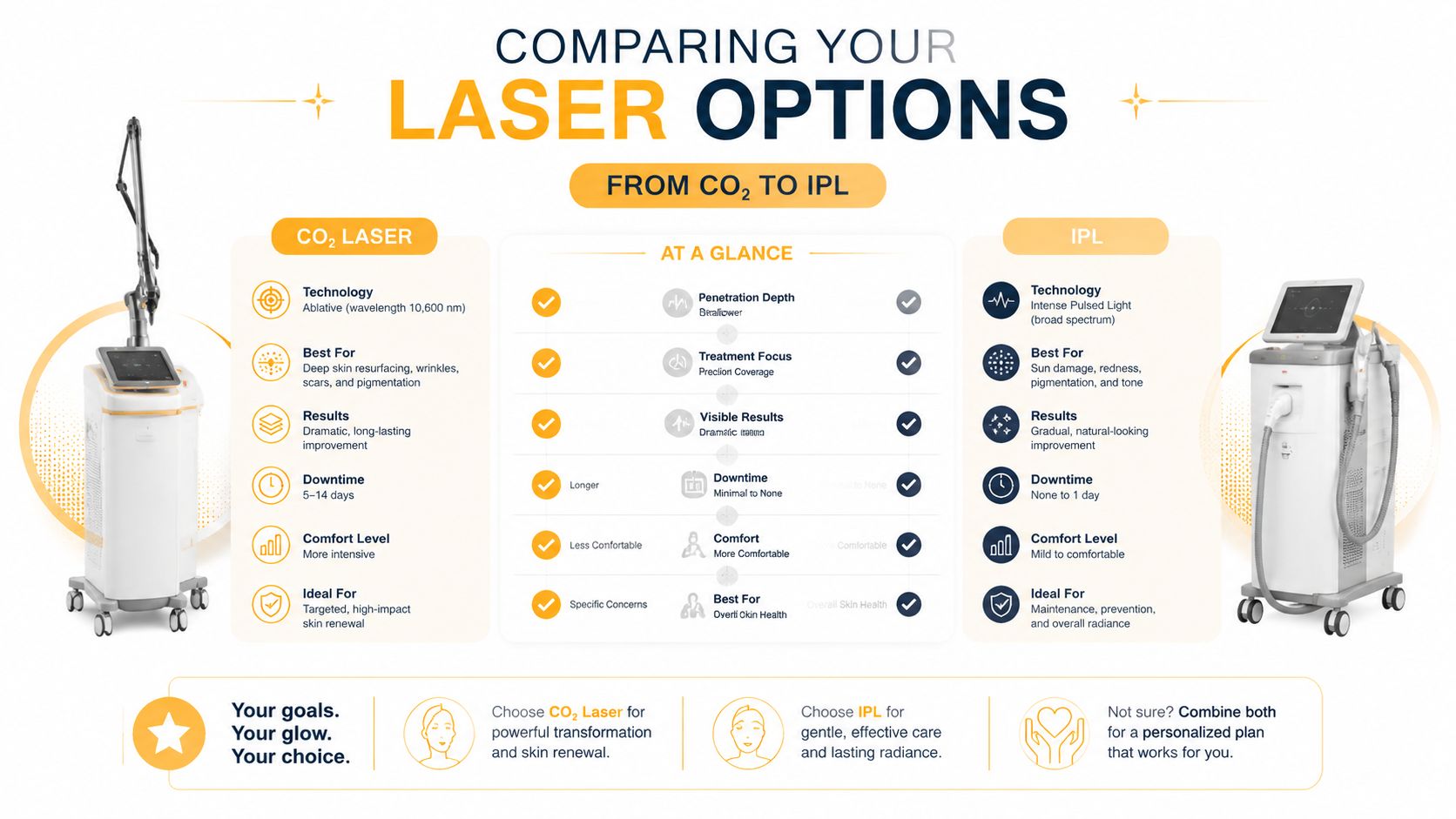
If the main issue is etched-in texture, acne scarring, fine lines, or significant sun damage, resurfacing devices move to the front of the conversation. Fractional CO2 and Er:YAG lasers create controlled micro-injuries that trigger collagen remodeling, which is why they're often chosen for texture change rather than simple brightening, as described in this overview of common laser treatments.
That's the lane where CO2 laser resurfacing becomes relevant. It's not a casual lunchtime treatment. It's a resurfacing option for patients who want stronger correction and understand that stronger correction usually comes with more visible recovery.
IPL for tone and redness
IPL isn't the same as a classic single-wavelength laser. It uses broad-spectrum light and is often selected when the concern is more about pigment irregularity, redness, and overall discoloration than deep textural change.
This makes IPL a common choice for patients who say things like:
- “My skin looks blotchy.”
- “I have sun spots and redness.”
- “I want brighter skin, but I can't disappear for a long recovery.”
IPL can be a good fit when the skin needs cleanup rather than major resurfacing. It is not the first choice when deep acne scarring is the true complaint.
Nd:YAG and dual-wavelength hair systems
When hair reduction is the goal, the right question isn't “Which laser is strongest?” It's “Which wavelength can treat the follicle effectively and safely in my skin?” That's where Alexandrite and Nd:YAG systems often enter the picture.
Nd:YAG is especially important in patients with more epidermal pigment because it offers a safer profile than many older devices in darker skin. This is one of the clearest examples of why med spa laser treatments must be individualized rather than sold as one-size-fits-all packages.
Pigment and specialty platforms
Some devices are selected for more focused pigment work, tattoo-related concerns, or lesions that need a different interaction with the skin. Others are chosen because they can be paired with non-laser treatments in a broader plan.
At Chernoff Cosmetic Surgery, one example is the Aerolase LightPod Neo, a non-ablative platform used for selected rejuvenation and skin concerns. That doesn't make it the answer for every patient. It shows how different tools fit different clinical jobs.
The best consultation narrows the field quickly. It should tell you what not to do just as clearly as what to do.
Quick Guide to Common Laser Treatments
| Treatment Type | Primary Targets | Typical Downtime | Average Sessions |
|---|---|---|---|
| Fractional CO2 | Texture, acne scars, fine lines, sun damage | More downtime than lighter treatments | Varies by goal |
| Er:YAG | Surface irregularity, fine lines, rejuvenation | Often moderate, depends on settings | Varies by goal |
| IPL | Redness, discoloration, sun-related pigment | Usually lighter downtime | Varies by goal |
| Nd:YAG or dual-wavelength hair systems | Unwanted hair, especially when skin-type matching matters | Usually limited to temporary irritation | 6–8 sessions is a common benchmark for hair removal |
| Pigment-focused specialty systems | Selected pigment concerns and focal issues | Depends on device and target | Varies by condition |
Your Laser Treatment Journey From Consultation to Recovery
A patient may come in asking for “laser treatment” as if it were a single service. By the end of a good consultation, the decision is much narrower. Ultimately, the question is what you want to improve, how much downtime you can accept, and what your skin can handle safely.
That process matters because the treatment itself is only one part of the result. Device choice, settings, timing, preparation, and aftercare all shape what your skin looks like weeks later.
The consultation that shapes the outcome
The visit should start with your skin history, not the device menu. Skin type, recent sun exposure, active acne or rash, cold sore history, medications, prior procedures, and any tendency toward pigment changes all affect the plan. Melasma deserves special caution. So do irritated skin, self-tanner, and recent exfoliating products.
Goals also need to be specific. “I want my skin to look better” does not guide treatment well. “I want to reduce brown spots with minimal downtime,” or “I want to soften acne scars and I can accept a week of recovery,” gives your provider something useful to work with.
In my view, one of the most helpful parts of a consultation is ruling treatments out. Some patients are better served by a lighter option now and a stronger treatment later. Others need to postpone treatment until the skin barrier is calmer or recent sun exposure has faded. That is not a delay for its own sake. It is part of getting a safer, more predictable result.
What treatment day is usually like
The treatment room is usually more medical and structured than many patients expect. Your skin is cleansed. Photos may be taken so progress can be judged accurately later. A final skin check confirms that nothing has changed since the consultation.
Eye protection is used every time. For some treatments, topical numbing is applied in advance. Cooling may also be used, depending on the device and the area being treated.
The sensation depends on the category of laser. Hair removal often feels like fast snaps of heat. Non-ablative rejuvenation usually feels warm and prickly. Resurfacing is more intense and may leave the skin feeling hot afterward. Patients tolerate these treatments very differently, which is why settings should be chosen for the person in the chair, not copied from a standard template.
A well-run visit usually includes:
- Pre-treatment photos to track change over time
- A final review of medications and skin status before the first pulse
- Protective measures such as shields, cooling, and conservative starting settings when appropriate
- Clear aftercare instructions specific to the treatment you had
Generic aftercare is a problem. Recovery instructions should match the device, the settings, and your skin.
Recovery depends on the treatment and your goals
Recovery is not one experience. A lighter session for pigment or hair removal may cause temporary redness, warmth, or mild swelling that settles quickly. A stronger resurfacing treatment can leave the skin red, tight, swollen, and rough for days while new skin forms.
This is often where expectations drift off course. Patients sometimes focus on whether the procedure is tolerable and pay less attention to the healing window. In practice, recovery time is one of the main factors that should guide the original treatment choice.
The right treatment is not always the strongest one. If you cannot realistically protect healing skin from sun exposure, follow a detailed skincare plan, or take social downtime, a lighter approach may be the better decision even if it requires more than one session.
Why repeated sessions are often part of the plan
Laser treatment is often a series, not a one-time event. Hair removal is the easiest example because follicles are not all in the same growth phase at the same time, so multiple sessions are expected. The exact spacing depends on the area treated, the hair cycle, and how your skin responds.
The same principle applies to many rejuvenation goals. Pigment may fade in stages. Redness can improve gradually. Texture changes often build over time as collagen remodeling develops after treatment.
Good planning leaves room to reassess. If your skin responds quickly, the plan may stay conservative. If progress is slower, your provider may adjust settings, spacing, or even the device choice. That kind of course correction is a sign of attentive care, not inconsistency.
Minimizing Risks and Ensuring Safe Laser Treatment
Laser treatments are effective because they create controlled injury or controlled heat. That's also why safety can't be treated casually. When people say a laser is “safe,” what they really mean is that it can be used safely in the right hands, on the right skin, with the right settings.
The risks patients should know about
The common short-term effects are usually expected: redness, swelling, warmth, and temporary sensitivity. More serious problems can include burns, delayed healing, infection, scarring, or unwanted pigment change.
Some patients are poor candidates for treatment on a given day or with a given device. That can include people with active skin infection, significant irritation, recent sun exposure, or a skin condition that is likely to flare after heat-based treatment. Candidacy is not permanent. It can change based on timing, preparation, and what is being treated.
Why skin of color needs special caution
One of the most important safety conversations involves darker skin types and patients who pigment easily. Post-inflammatory hyperpigmentation, or PIH, is a meaningful risk after energy-based procedures in darker skin. A 2024 review highlighted that conservative settings, test spots, and careful pre- and post-treatment regimens are central to reducing complications, as discussed by The Saint Louis Med Spa.
That doesn't mean patients with skin of color should avoid lasers. It means treatment must be chosen and delivered with more precision. The wrong device or overly aggressive settings can create a cosmetic setback instead of improvement.
What actually lowers risk
Safe treatment usually depends on several practical steps working together:
- Accurate diagnosis: melasma, post-acne marks, diffuse redness, and sun spots don't behave the same way
- Device matching: the wavelength and treatment category must fit the skin type and concern
- Conservative first treatment: especially in patients with pigment risk
- Test spots when appropriate: useful when the response is uncertain
- Strict aftercare: irritation, heat, sun exposure, and picking all increase trouble
A laser complication usually starts before the treatment itself. It starts with a mismatch between patient, problem, and technology.
The goal isn't to create fear. It's to replace vague reassurance with good judgment.
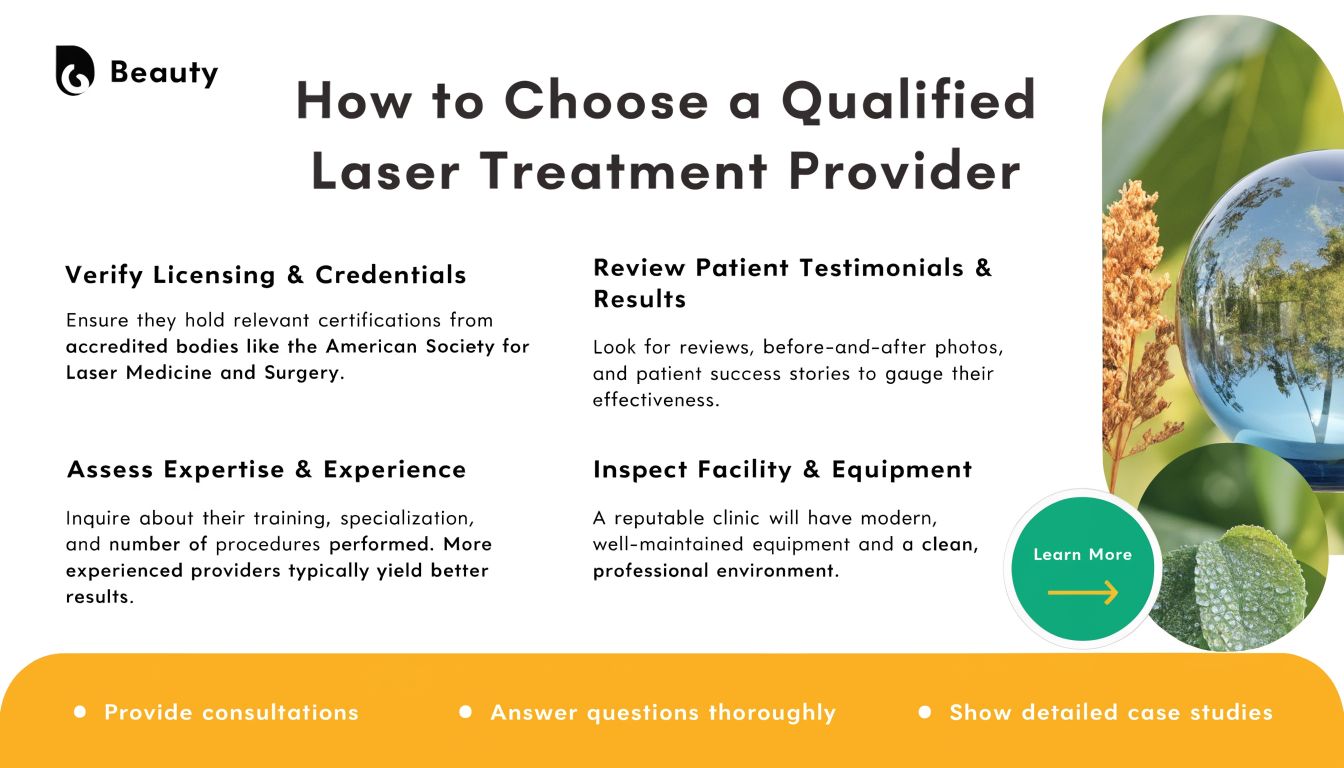
How to Choose a Qualified Laser Treatment Provider
The person holding the device matters as much as the device itself. That isn't marketing language. It's one of the most practical truths in aesthetic medicine.
A U.S. study found meaningful differences between practice types. Ninety-eight percent of plastic surgery practices customized laser treatments versus 63% of medical spas, and the average cost for an ablative laser procedure was $3,154 in a plastic surgery office versus $1,157 in a medical spa, according to this published analysis of cosmetic laser users in the United States. Lower price can reflect a simpler service model, but it can also reflect differences in supervision, customization, and who is treating you.
Questions worth asking in a consultation
Don't ask only what the treatment costs. Ask how the decision is being made.
- Who will perform the treatment: Ask whether a physician, nurse, laser technician, or other provider is delivering the procedure.
- How was this device selected for me: You want a specific answer tied to your skin type, your concern, and your downtime tolerance.
- What experience do you have with my skin and concern: This matters even more if you have melasma, darker skin, acne scarring, or prior complications.
- What does recovery usually look like in your hands: The answer should sound practical, not rehearsed.
- What happens if I don't respond as expected: Good providers plan for follow-up, adjustment, and alternatives.
Signs of a stronger treatment environment
A qualified provider usually does several things consistently. They document before-and-after photos. They discuss limitations as clearly as benefits. They can explain why one machine is being ruled out, not just why another is being offered.
Look for a setting where the consultation includes:
- A diagnosis, not just a menu selection
- A discussion of risk by skin type
- Specific aftercare instructions
- A realistic estimate of how many sessions may be needed
- A plan for maintenance if the concern tends to recur
The right provider won't try to make every patient fit the same package. Good laser medicine is selective.
Your Laser Treatment Questions Answered
Which laser is right for me
That depends on what bothers you most. If you're concerned about texture, acne scars, or etched-in sun damage, resurfacing options are often more relevant. If the complaint is redness or uneven pigment, a lighter-based approach may make more sense. If the issue is unwanted hair, the wavelength and your skin type become the key decision points.
Are med spa laser treatments painful
Most aren't intolerable, but comfort varies with the device and treatment intensity. Hair removal tends to feel brief and hot. Resurfacing is usually more involved. The right preparation, cooling, and settings make a major difference.
How many treatments will I need
Some patients improve with one stronger resurfacing treatment. Others do better with a series. Hair reduction is the easiest example of why repetition matters, because follicles respond over time rather than all at once. For many concerns, the honest answer is that treatment is a process.
Can lasers be combined with other treatments
Yes, and in many patients they should be. A laser may address one part of the problem while another treatment handles laxity, volume loss, acne activity, or ongoing pigment behavior. Combination planning is often where better judgment shows up. The device itself is only one piece of the strategy.
Are lasers safe for darker skin
They can be, but safety depends on cautious device selection, careful settings, and a provider who understands pigment risk. This isn't the place for generic treatment plans or aggressive first sessions.
Why do prices vary so much
Because treatment settings, supervision, equipment, customization, and aftercare vary. The least expensive option can still be appropriate in some situations, but price alone doesn't tell you how much judgment is built into the process.
What should I bring to a consultation
Bring a short list of priorities, your treatment history, any history of abnormal pigmentation or cold sores, and photos that show what bothers you. Not model photos. Your own photos in different lighting are often more helpful.
If you're considering med spa laser treatments and want a plan built around your skin, goals, and recovery tolerance, Chernoff Cosmetic Surgery offers consultations that can help you determine whether laser resurfacing, hair removal, IPL, or another approach fits your needs.