

You’re often not thinking about your neck until a camera angle forces the issue. It happens on a video call, in a candid family photo, or when you catch your profile in a mirror and notice fullness, banding, or loose skin that doesn’t match how energetic you feel. That reaction is common. It’s also usually the moment people start searching for neck lift before and after photos.
Those photos matter, but they’re easy to misread. A dramatic change doesn’t always mean a refined result, and an elegant result may look subtle unless you know what to examine. The essential value in before-and-after images is not the shock factor. It’s what they reveal about planning, anatomy, technique, healing, and restraint.
Table of Contents
- The Story Behind Neck Lift Before and After Photos
- How to Decode a Neck Lift Transformation
- Matching the Technique to the Result You Want
- The Journey to After Your Recovery Timeline
- Evaluating Outcomes Naturalness Scarring and Longevity
- Candidacy and Combining Procedures for Harmonious Results
- Common Questions About Neck Lift Surgery
The Story Behind Neck Lift Before and After Photos
A patient will often describe the same frustration in slightly different words. “My face looks fine from the front, but my profile tells a different story.” Another says she doesn’t mind aging, but she does mind looking heavier or more tired than she is. A man may notice that even after weight loss, the area under the chin still looks soft or undefined.
That’s why neck lift before and after galleries get so much attention. They speak to a specific concern people can see clearly, even when they can’t name the anatomy causing it. Fullness beneath the chin, vertical neck bands, loose skin, or a blurred jawline each create a different problem, and each needs a different solution.
Some readers start by exploring non-surgical options first, especially if the concern is mild or the goal is profile refinement rather than structural correction. If that’s where you are, BotoxBarb's non-surgical profile enhancement is a useful comparison because it helps show what filler can improve and what surgery addresses more definitively.
A strong gallery should do more than impress you. It should help you judge whether the surgeon respected the patient’s natural features, whether the result looks believable from multiple angles, and whether the neck now fits the rest of the face. That’s the difference between a technical success and an aesthetically mature result.
Good before-and-after photos don’t just show change. They show judgment.
Patients also deserve context about the human side of the process. A final image is the end of a longer journey that includes consultation, planning, healing, and follow-up. For a sense of that broader patient experience, the Chernoff practice patient resources show the kind of preparation and support that matter before anyone ever takes an “after” photo.
How to Decode a Neck Lift Transformation
A great result should look obvious in profile and unremarkable in conversation. By that I mean no one should see the surgery. They should see a cleaner neckline, a more defined jaw, and a face-neck transition that looks younger and less heavy.

Start with the profile, not the smile
Many before-and-after photos are taken with flattering lighting, makeup, or a more polished expression in the after image. Don’t start there. Start with the side view and look at the actual architecture of the lower face and neck.
Ask simple questions:
- Is the jawline clearer? A better mandibular border is one of the most reliable signs of a successful neck lift.
- Is the angle under the chin cleaner? You want to see a smoother transition from chin to neck, not a bulky shelf of tissue.
- Do the vertical bands look softer or gone? If they were present before, they should be meaningfully improved after surgery.
- Does the skin look smoother without looking stretched? Tight skin alone is not the goal.
Look for four specific markers
The best way to read a neck lift before and after result is to evaluate four features together, not in isolation.
Jawline definition
A refined neck should support the jawline. If the neck improves but the lower face still looks heavy, the result may feel incomplete.The cervicomental angle
This is the angle beneath the chin. Patients often describe wanting a “better side profile,” and this is usually what they mean. A youthful neck has a clean, crisp transition here.Platysmal band correction
The platysma is the thin muscle layer in the neck. The platysmaplasty technique specifically targets vertical platysmal bands, the muscles that separate and descend with age, creating a “turkey neck.” During surgery, the surgeon tightens these underlying muscles to smooth these bands while simultaneously removing excess skin, a multi-layer approach critical for defining the chin, neck, and jawline (Dr. Casso’s explanation of facelift and neck lift anatomy).Skin quality and drape
Excess skin should be reduced, but the result shouldn’t look ironed flat. Natural skin still has movement.
Practical rule: If a photo only shows improvement from one angle, keep looking.
A patient can have less fullness and still not have a refined neck if the underlying muscle wasn’t addressed. That’s why skin-only tightening often disappoints. The strongest results usually come from correcting the deeper support structures, then redraping the skin so it looks smooth rather than taut.
Matching the Technique to the Result You Want
Neck surgery isn’t one operation with one standard result. It’s a category of procedures, and the right choice depends on whether the main issue is skin laxity, muscle banding, excess fat, or a combination of all three. Choosing the wrong operation is like using the right instrument in the wrong place. You may get some improvement, but not the result you were hoping to see in the mirror.
Why technique matters
A limited procedure can work well for a patient with early looseness and a relatively preserved jawline. Someone with visible platysmal bands and hanging skin needs more than a small adjustment. Another patient may have modest laxity and prefer a less invasive option as long as expectations stay realistic.
There’s also a category in between. Some patients aren’t ready for a full surgical correction but want more structure than injectables can provide. In that setting, Ellevate minimally invasive neck lift options may enter the conversation alongside other treatments, depending on anatomy and goals.
Non-surgical treatments have a role, but it helps to be candid about the trade-offs. Filler can sharpen a jawline in selected patients. Energy-based treatments can improve texture and mild laxity. They don’t reliably correct prominent bands or remove excess skin in the way surgery can.
Neck Rejuvenation Options at a Glance
| Concern | Best Surgical Approach | Potential Non-Surgical Option |
|---|---|---|
| Mild early laxity with limited excess skin | Mini or limited-incision neck lift | RF microneedling or skin-tightening treatments |
| Visible platysmal bands | Platysmaplasty with skin redraping | Limited improvement with non-surgical approaches |
| Loose skin, submental fullness, and weak jawline definition | Full neck lift addressing skin, fat, and muscle | Injectables may camouflage, but won’t replicate surgery |
| Mild profile imbalance without major skin excess | Targeted contouring approach based on anatomy | Chin or jawline filler in selected patients |
What works best is usually the approach that treats the actual cause of the problem. If the issue sits in the muscle, removing skin alone won’t create a durable contour. If the problem is mostly mild fullness or early loss of definition, a smaller intervention may be enough.
A natural-looking result often comes from doing the correct amount of surgery, not the maximum amount.
The Journey to After Your Recovery Timeline
The “after” image patients love most is rarely the one taken too early. Healing changes the neck in stages, and understanding that timeline helps you judge photos more accurately and plan your own recovery with less anxiety.
The visual below gives a simple overview of that progression.
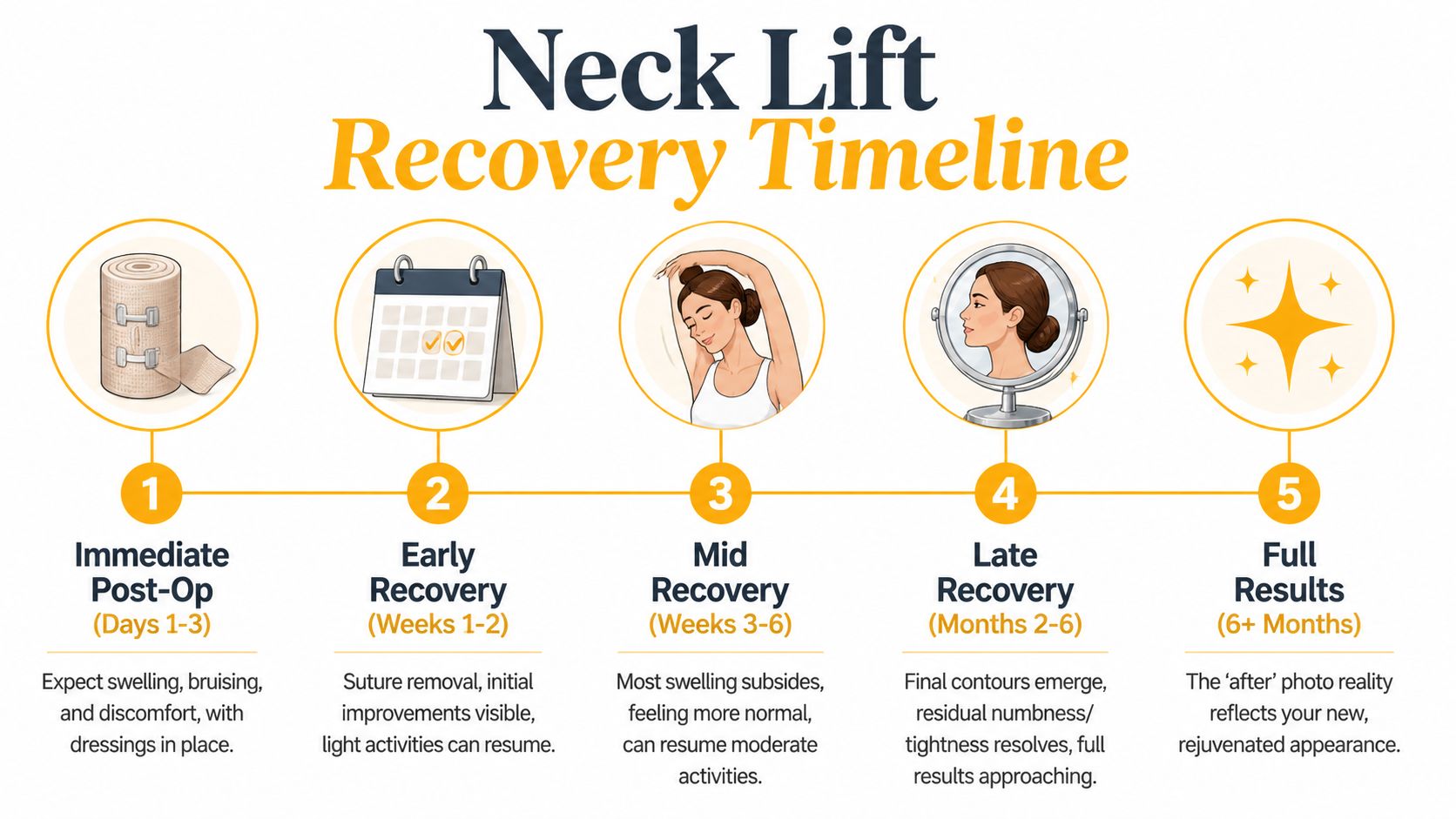
What early healing usually looks like
Right after surgery, swelling, bruising, and a sense of tightness are normal parts of the process. The neck may look improved quickly, but it won’t look finished. Patients sometimes worry at this point that they’re too swollen, too stiff, or not yet seeing the contour they expected.
Recovery does follow recognizable milestones. Most swelling and bruising subside in 7 to 10 days. By one month, patients are typically “event ready” with new contours well-defined. At three months, the majority of swelling is gone, and final results continue to refine over several months, as outlined in this neck lift recovery guide.
For anyone preparing for surgery, the patient surgery guide is the kind of resource that helps with the practical details patients often underestimate, such as arranging downtime, planning meals, and understanding activity restrictions.
A brief surgical overview can also make the recovery process easier to picture:
When the after photo starts to match real life
The photos patients tend to trust most are usually taken after the early swelling phase has passed. By then, the neckline looks more believable and the jawline reads more cleanly in everyday lighting.
That’s why a responsible gallery should include timing information when possible. An after photo taken early may still show residual fullness or firmness that has nothing to do with the final quality of the work. A later photo is often a better reflection of what you’ll live with.
- First week: Expect the most noticeable swelling and bruising.
- Weeks two through four: Social recovery becomes easier, and the contour starts to read more clearly.
- Around one month: Most patients look polished enough for events and public-facing work.
- Over the next several months: The result keeps softening and refining.
Patience isn’t a soft recommendation here. It’s part of the treatment.
Evaluating Outcomes Naturalness Scarring and Longevity
A neck can be tighter and still not look right. In such cases, surgical quality becomes easier to appreciate. Once you move past the obvious “before versus after” difference, three standards matter most: naturalness, scar placement, and how the result holds up over time.

Natural doesn’t mean unchanged
A natural result doesn’t mean subtle to the point of invisibility. It means the neck looks refreshed without looking operated on. Skin should move normally. The chin shouldn’t appear strangled by tension. The area under the jaw should look cleaner, but still human.
When I assess a result, I look for balance. Does the tighter neck fit the patient’s age, facial structure, and skin quality? Or does it look disconnected from the rest of the face? Excellent surgery respects those boundaries.
The best neck lift is often the one other people notice as “you look rested” rather than “what did you have done?”
Scars and staying power
Scars are part of surgery, but visible scarring shouldn’t dominate the outcome. Well-placed incisions are typically hidden around natural creases and contours, where they become less noticeable as they mature.
The timeline matters here. While visible improvements appear within weeks, the American Society of Plastic Surgeons states that incision lines require up to six months for complete maturation. At three months, 70 to 80% of swelling is resolved, but final refinements continue as tissues fully settle (American Society of Plastic Surgeons neck lift results guidance).
Longevity also deserves a realistic discussion. A neck lift can create a durable improvement, but it doesn’t stop aging. Skin will continue to change, weight fluctuations can alter contour, and sun exposure affects skin quality. Patients who protect their skin, maintain a stable weight, and follow postoperative instructions usually preserve the result more gracefully than those who don’t.
A strong long-term result looks less like a permanent freeze and more like a reset. You still age. You continue to age, but from a better starting point.
Candidacy and Combining Procedures for Harmonious Results
Some patients are excellent candidates for a neck lift alone. Others have a neck that’s aging in step with the jawline, cheeks, or lower eyelids. In those cases, treating only the neck can create an odd imbalance. The neck looks younger, but the rest of the face still signals laxity or volume loss.
Who tends to benefit most
Good candidates usually share a few features:
- Noticeable neck laxity or banding: The concern is visible in profile and often bothers the patient in photos.
- A desire for structural change: They want correction that skin care, filler, or devices can’t reliably provide.
- Reasonable skin quality: Better skin quality generally helps the result drape more smoothly.
- Realistic expectations: They want improvement, not a different identity.
A consultation should focus less on age and more on anatomy. Two people of the same age can need very different plans.
Why combination surgery can look more balanced
Facial harmony is a key consideration. Clinical case studies show that neck lifts are frequently combined with facelifts and lower eyelid surgery. When paired, the transformation is more complete, blending improvements across the face and neck for enhanced overall facial harmony and more dramatic, balanced results (The Aesthetic Society before-and-after examples).

That doesn’t mean everyone needs a facelift with a neck lift. It means the surgeon should evaluate the lower face and neck as one aesthetic unit. If the jawline is blurred by descent in the face as well as laxity in the neck, addressing one area alone may underdeliver.
Patients are often surprised by how much more coherent a combined result can look. Not more dramatic in a flashy way. More coherent because the face and neck now belong to the same decade again.
Common Questions About Neck Lift Surgery
How much downtime should I plan for?
Most patients need dedicated recovery time, especially during the first week when swelling and bruising are most visible. Many can return to desk work and light daily activity within the general recovery window discussed earlier.
When can I exercise again?
Light walking usually comes first, then a gradual return to more strenuous activity based on healing and your surgeon’s instructions. Pushing too hard too early tends to prolong swelling.
Does a neck lift hurt?
Most patients describe tightness, soreness, and stiffness more than sharp pain. Discomfort is usually managed with standard postoperative medication and careful aftercare.
Will I look obviously “done”?
A well-executed neck lift shouldn’t advertise itself. The goal is a cleaner, firmer neck and jawline that still fits your face.
How should I evaluate before-and-after photos online?
Look for consistency in lighting, angle, head position, and timing. Favor profile views and results that improve the neck without creating a pulled or artificial look.
Can non-surgical treatment replace a neck lift?
Sometimes it can delay surgery or improve mild concerns. It usually can’t reproduce the correction possible when skin, muscle, and contour all need to be addressed.
How much does it cost?
The investment varies based on the procedure, whether other surgeries are combined, anesthesia, facility details, and the complexity of your anatomy. A real quote should come from an in-person consultation, not a generic online estimate.
If you’re studying neck lift before and after photos and want help understanding what applies to your anatomy, scheduling a consultation with Chernoff Cosmetic Surgery can give you a clearer, more individualized answer. The goal isn’t to chase the most dramatic photo. It’s to choose the approach that gives you a natural, balanced result you’ll still feel comfortable wearing years from now.