

A surgical neck lift usually lasts about 10 to 15 years, and it's best understood as a long-lasting but not permanent result. If you're looking in the mirror and noticing loose skin, vertical banding, or a softer jawline, the main question isn't just how long the improvement lasts. It's how well that result will age with you.
Individuals who start researching neck rejuvenation often find themselves at that exact point. They still look like themselves, but the neck no longer matches the energy they feel. The lower face may still seem reasonably firm, yet the area under the chin has begun to blur, sag, or bunch in a way that makeup, posture, and skincare can't fix.
That's where expectations matter. A neck lift is not a pause button on aging. It's a structural correction that can turn back visible changes and give you a cleaner neckline for years. In the right patient, with the right technique and disciplined long-term care, it can be one of the most satisfying investments in facial rejuvenation because it restores definition in an area that's difficult to improve any other way.
A thoughtful surgeon doesn't treat longevity as a number alone. The operation creates the foundation. Your skin quality, healing, sun habits, weight stability, and general health determine how well that foundation holds over time. That partnership is what separates a neck that looks naturally refreshed for years from one that loses momentum earlier than it should.
Table of Contents
- Investing in Yourself A Decade of Confidence
- Understanding Neck Lift Longevity Resetting the Clock
- Surgical Techniques and Their Expected Durability
- Key Factors That Determine How Long Your Results Last
- How to Maintain Your Results with Non-Surgical Treatments
- Your Neck Lift Journey Recovery Timeline and Future Planning
Investing in Yourself A Decade of Confidence
A neck lift often gives patients about 10 to 15 years of visible improvement, and the procedure itself is typically an outpatient surgery lasting 1 to 3 hours according to the American Society of Plastic Surgeons neck lift overview. For someone deciding whether surgery is worthwhile, that timeframe puts the procedure in the category of long-term rejuvenation rather than a short-lived cosmetic fix.
What patients are really asking
When patients ask, “How long does a neck lift last?” they're usually asking three things at once:
- Will it be worth the recovery
- Will I still look like myself
- Will I have to do it again soon
Those are fair questions. The neck is one of the first places where aging becomes obvious and one of the hardest areas to hide. Extra skin, muscle banding, and fullness under the chin can make someone look tired or older even when the rest of the face still looks relatively youthful.
A well-planned neck lift can address that mismatch. It doesn't create a different face. It restores cleaner lines and better contour so your neck fits the rest of you again.
Practical rule: If your concern is structural, meaning loose skin, platysmal banding, or a poorly defined neck angle, surgery usually gives a more meaningful and longer-lasting correction than topical products or short-term treatments.
Why the investment feels different from other treatments
The neck responds best when the treatment matches the problem. If the issue is mainly skin texture, pigment, or fine creasing, non-surgical options can help. If the issue is descent of tissue, visible bands, or accumulated fullness beneath the chin, surgery addresses the cause rather than trying to disguise it.
That distinction matters because patients often spend years rotating through creams, devices, and one-off treatments before accepting that the neck needs structural repair. Once they understand that, the decision becomes less about chasing a miracle and more about making a durable correction.
Here's the mindset I encourage. Don't think of a neck lift as buying a frozen result. Think of it as investing in a better baseline, one that can age in a more favorable way for many years. When patients approach it that way, they tend to make better choices both before and after surgery.
Understanding Neck Lift Longevity Resetting the Clock

The best way to understand neck lift longevity is to think of it as resetting the clock, not stopping it. The operation improves what aging has already changed, but your tissues keep living in real time after surgery.
According to Cleveland Clinic's explanation of platysmaplasty and neck lift mechanics, the limiting factor isn't immediate surgical failure. It's ongoing biologic aging after platysma tightening, fat removal, and skin redraping. That's an important point because it changes how patients interpret longevity. If the neck ages again years later, that doesn't mean the operation failed. It means your tissues continued to age from a better starting position.
What the surgery actually changes
A true neck lift can address several separate problems at once:
- Platysmal banding when the neck muscles separate or become more visible
- Excess fat under the chin or deeper in the neck
- Skin laxity that blunts the neckline and jaw contour
- Poor transition between the chin, jawline, and upper neck
Each of those problems ages differently. Some patients have good skin but heavy banding. Others have thin skin with very little fat but significant wrinkling. Some need contouring beneath the chin more than they need skin removal. That's why one generic answer about longevity never tells the whole story.
Why the clock keeps moving
Surgery can tighten, contour, and reposition. It can't change your genes or make the neck immune to sunlight, gravity, or time. Skin still loses elasticity. Muscle tone still changes. Daily habits still leave marks.
The neck lift gives you a younger contour. Your later aging happens on top of that corrected contour, not instead of it.
That's why I prefer discussing a strategy rather than a promise. The most durable results come from matching the technique to the anatomy, then protecting that result over the years. If you're still deciding whether surgery is the right step, it can help to review broader options to redefine and restore your neckline so you understand where surgery fits and where non-surgical care still has a role.
Surgical Techniques and Their Expected Durability
Not all neck lifts are built the same. That's one reason patients hear different answers when they ask how long a neck lift lasts. Some guidance aimed at patients places longevity at about 7 to 10 years, while other sources cite 10 to 15 years or longer, and that spread reflects differences in technique, skin elasticity, and lifestyle according to this discussion of neck lift duration.
Less extensive versus more comprehensive correction
A smaller procedure can be appropriate in the right patient. Someone with mild early laxity, limited banding, and decent skin recoil may do well with a less extensive neck contouring approach. The appeal is obvious. Shorter incisions, less dissection, and often a more modest recovery.
The trade-off is equally obvious. A lighter procedure typically makes a lighter correction. If the tissues aren't fully addressed, the result may look improved but may not hold as strongly as a more thorough repair.
A more complete neck lift usually addresses deeper anatomy more directly. That can include muscle tightening, fat contouring, and more deliberate redraping of skin. When the neck has strong banding, a poorly defined angle, or more advanced looseness, this approach generally provides a stronger structural reset.
A simple comparison
| Approach | Best suited for | Typical strength of correction | Durability outlook |
|---|---|---|---|
| Limited or mini neck lift | Mild laxity, early changes | Modest contour improvement | Often shorter than a full correction |
| Comprehensive neck lift with platysmal work | Visible banding, fullness, looser skin | More complete contour change | Often more durable when matched to the anatomy |
This table is intentionally simple because the primary decision is anatomical, not marketing-based. A “mini” procedure sounds attractive until it's used on a neck that needed deeper correction in the first place.
What works and what doesn't
What works is honest surgical planning. If your neck problem lives in the muscle and deeper contour, a skin-only strategy usually disappoints. If the issue is mild and early, a major operation may be more than you need.
What doesn't work is choosing technique by name alone. Patients sometimes focus on scar length, buzzwords, or the hope of a shortcut. Longevity comes from adequately treating the structures that are aging.
For readers comparing more advanced structural approaches, this overview of deep plane neck lifts is useful because it explains why deeper support can matter in selected patients.
A neck lift lasts longer when the operation solves the real problem instead of the most visible one.
Key Factors That Determine How Long Your Results Last
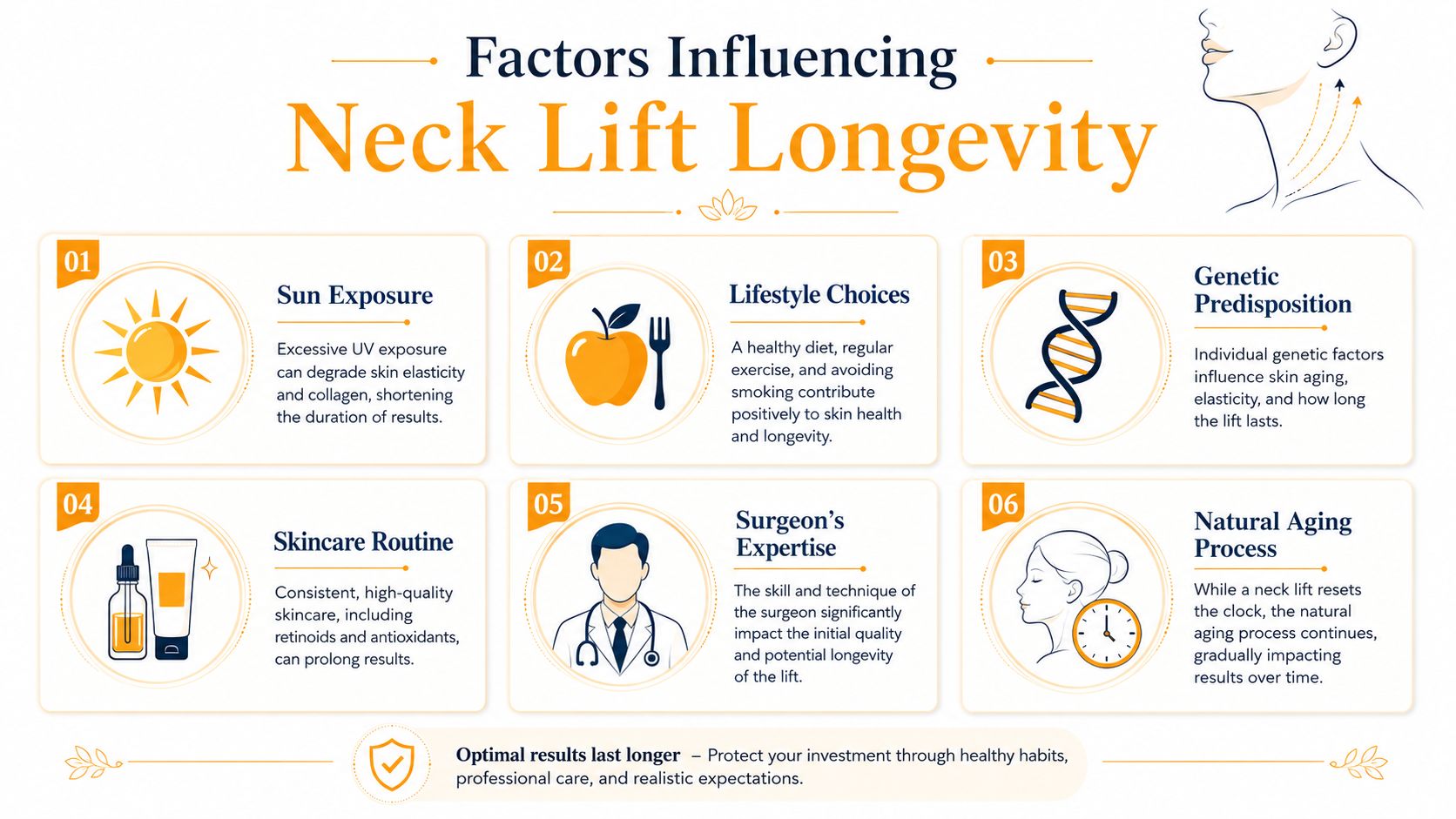
Expected neck lift longevity spans 5 to 15 years, with variation tied to genetics, smoking, sun exposure, skin care, and postoperative healing according to this clinical guidance on how long a neck lift lasts. That range tells patients something important. Longevity is personal.
The factors you can't control
Some parts of the equation are set before you ever step into the operating room.
- Genetic skin quality affects how your skin tolerates time, sun, and gravity.
- Baseline anatomy matters. Heavy tissues, thin skin, or strong platysmal bands can make aging patterns more visible.
- Age at the time of surgery influences elasticity and healing behavior, though age alone never decides candidacy.
These factors don't doom a result. They help shape the right plan and the right expectation.
The factors you absolutely can control
Patients have real influence over outcome.
- Sun protection: Sun exposure steadily works against skin elasticity. Daily protection is one of the simplest ways to support a surgical result.
- Stable weight: Significant gain or loss can stretch or deflate the neck in ways surgery can't fully prevent.
- No tobacco: Smoking works against circulation and tissue quality. In practical terms, it makes healing and long-term preservation harder.
- Consistent skin care: Good skin care won't replace surgery, but it can help the neck skin age more gracefully afterward.
- Postoperative discipline: Following restrictions, incision care, and follow-up advice matters more than many patients realize.
Partnership is the real model
I tell patients to think of surgery as the foundation and lifestyle as the maintenance contract. The surgeon can create a better contour, but no surgeon can protect that contour from years of sun, nicotine, repeated weight swings, or neglect.
A useful way to frame it is this:
The operation sets your ceiling. Your habits determine how close you stay to it.
That's also why two patients who undergo similar surgery can age very differently afterward. One protects the neck, keeps weight stable, and maintains skin quality. The other resumes habits that accelerate laxity. The difference shows up gradually, then all at once.
Where patients often lose ground
The most common mistakes are rarely dramatic. They're cumulative.
- Treating recovery as temporary: Once swelling resolves, some patients stop thinking about maintenance.
- Ignoring the neck in skin care: The face gets sunscreen and active products. The neck gets forgotten.
- Expecting surgery to override biology: It won't. Surgery improves anatomy. It doesn't cancel aging.
Patients who understand that from the beginning usually stay happier longer because they judge their result by how well it ages, not by whether it remains frozen.
How to Maintain Your Results with Non-Surgical Treatments
A long-lasting neck lift doesn't mean you should ignore the area afterward. It means you have something worth preserving. Good maintenance can support skin quality as the years pass and help you avoid the cycle of waiting too long, then feeling that only another major procedure will make a difference.
What maintenance can and can't do
Non-surgical treatments don't recreate the structural correction of surgery. They can, however, improve the surface and support quality of the skin that covers that correction.
That distinction matters. Patients get into trouble when they expect devices, injectables, or skincare to pull a loose neck upward in the same way surgery can. On the other hand, patients miss an opportunity when they assume surgery means they'll never benefit from maintenance care again.
Here's where non-surgical care tends to help most:
- Skin texture and crepiness
- Fine lines and superficial wrinkling
- General firmness support
- Pigment and sun-related skin quality issues
A sensible maintenance strategy
A good plan usually combines home care with selective office treatments over time.
- Medical-grade skincare: Retinoids, antioxidants, moisturizers, and daily sunscreen can support better skin behavior over the long term.
- Energy-based treatments: RF microneedling and fractional laser treatments can be useful when the skin itself starts showing age even if the underlying contour still looks good.
- Judicious injectables or refinements: In selected cases, subtle touch-ups can complement a surgical result without replacing it.
Some patients also explore conservative options for facial softening and maintenance before they need another operation. Resources on subtle anti-ageing solutions can help frame that broader maintenance mindset, especially when the goal is preservation rather than dramatic change.
For those comparing how injectables fit into a long-term facial plan, this guide on how long dermal fillers last can help clarify where fillers support results and where they don't.
The timing matters
The best time to maintain a neck lift is before you feel you've lost it. Once skin decline becomes obvious, maintenance becomes catch-up. When you address early textural change or mild laxity sooner, you usually preserve a more polished result.
Chernoff Cosmetic Surgery offers options such as RF microneedling, fractional laser resurfacing, and skincare-based maintenance for patients who want ongoing support after surgery. Those treatments don't replace a neck lift, but they can fit into a broader plan to keep the neck looking smoother and more refined as the years pass.
Your Neck Lift Journey Recovery Timeline and Future Planning
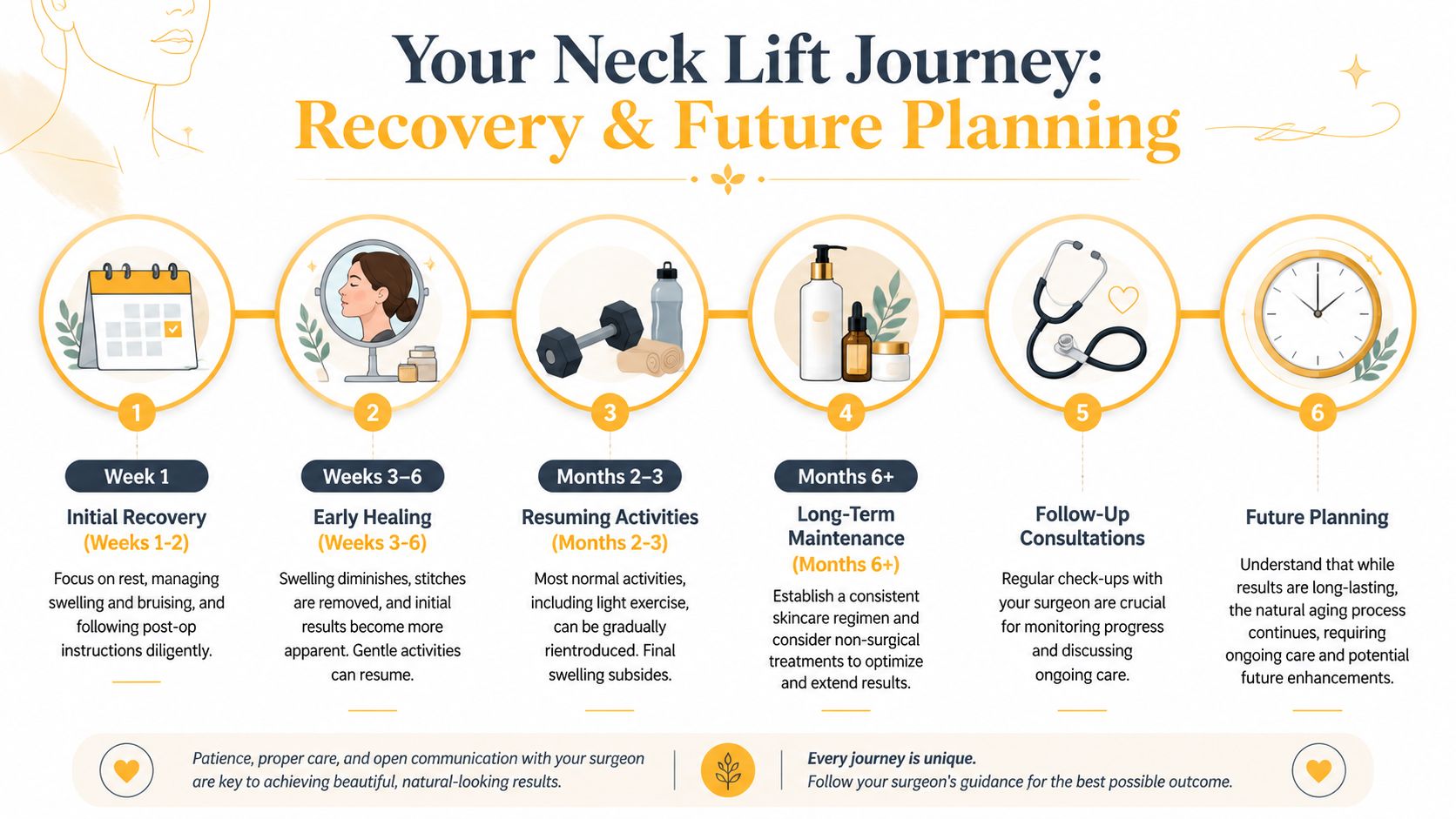
Patients usually feel most anxious about the period right after surgery, not the years afterward. That's understandable. You want to know when you'll look presentable, when the neck will feel normal, and whether the result will settle in a natural way.
The early part of recovery
The first stretch is about swelling, bruising, incision care, and patience. During that time, the neck often feels tight. That sensation worries people if they aren't prepared for it, but tightness early on isn't the same thing as a “pulled” result.
As healing progresses, the contour becomes easier to judge. The neckline starts to read as smoother and cleaner, but refinement continues beyond the first visible improvement. Subtle swelling can linger, and final softness takes time.
Most patients should judge progress in stages, not day by day. Recovery rarely looks linear in the mirror.
Looking natural over time
A well-done neck lift shouldn't advertise itself. It should make the neck look more rested, cleaner, and more proportionate to the face. Natural results come from respecting anatomy, not over-tightening skin in an attempt to create a dramatic early effect.
Patients also ask what happens if weight changes after surgery. Mild fluctuations are part of life. Large swings are more disruptive because they can alter the skin envelope and the fullness beneath the chin. If you're planning a major weight change, it's worth discussing the timing before surgery.
Will you need a revision
Some patients never pursue additional neck surgery. Others eventually consider a touch-up or a revision later in life because aging continues. That decision depends on what changed, how much it changed, and whether the issue is structural or mostly skin quality.
If concerns arise down the road, it helps to understand the difference between a limited refinement and a more involved secondary procedure. This overview of revision face and neck lift surgery explains how surgeons evaluate those situations.
Future planning is usually straightforward:
- Follow your aftercare closely
- Protect the result once healing is complete
- Address maintenance early rather than late
- Reassess only if your neck no longer matches your goals
The healthiest expectation is not that your neck will stay unchanged forever. It's that you'll continue to look better than you would have without the surgery, and you'll have options if aging eventually creates new concerns.
If you're considering a neck lift and want a plan built around your anatomy, lifestyle, and long-term goals, Chernoff Cosmetic Surgery offers consultations that focus on realistic longevity, natural results, and the right balance between surgery and maintenance.